
This is the story of a girl.
This is the story of a young blonde woman with supernatural strength. Who subverts our expectations by refusing to be the victim, and instead of being chased in an alley, turns round and kills them. This is the story of a woman who shapes the world with her actions. A charismatic, smart, and powerful woman, whose name is said in admiration and fear. A woman who sacrifices herself, who dies and is reborn twice over. I am talking, of course, about Darla.
Darla is one of the most fascinating characters in the series. She is the first character we meet in this universe (other than the red shirt she kills), and she is still present years later. Only two characters have a longer span between their first and final episodes (points for naming who). Played by Julie Benz to perfection, she oozes charisma in every scene she’s in. Her arc in the second season of Angel, when she straddles the lines between good and evil, between human and vampire, is one of the best arcs in either show. Even in between her deaths, memorable flashbacks show how she shaped the protagonist of the second show. More than that – she is the progenitor of every major vampire character in the series. Yes, she was sired by the Master, but she creates Angelus. Just as he creates Drusilla, and Drusilla creates Spike. It all comes back to her. She is the dark mother goddess of the Buffyverse, a captivating presence and a force of nature.
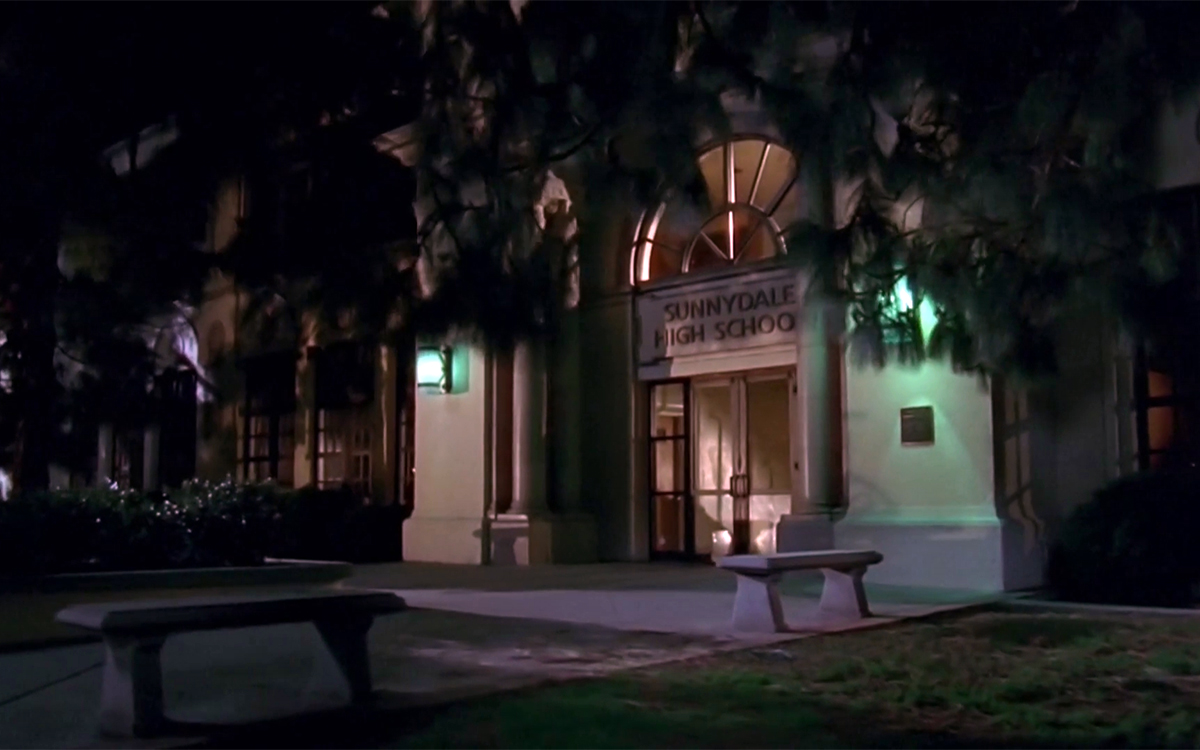
Except, the character we meet in this episode is most definitely not that. Oh, Julie Benz is incredibly watchable for sure, stamping her mark on the role wherever she can. She is engrossing just sitting in a swing-seat in the Bronze and saying her name. And the opening scene is a great start for her. The seminal image of Buffy for the creator, as is often quoted, is the image of “the little blonde girl who goes into a dark alley and gets killed”[1], turning around and killing her attacker instead. We see this basic idea play out twice in this first episode – later with Buffy and Angel in an actual alley, but first in this opening scene in the school, which purposefully frames Darla as a scared, fragile potential victim and the boy she’s with as a potential attacker, before flipping that. This puts Darla on the same level as Buffy. She has the same narrative power that Buffy does – to invert the typical horror movie cliche and transform from a victim to a danger. She parallels Buffy in many ways – in addition to everything in the first paragraph, she also battles Buffy for Angel’s soul and shapes him. You can very easily imagine a version of S1 with Darla as the Big Bad; a dark shadow of Buffy, a glimpse of who Buffy could be if she died as is prophesied, if she rose again as feared in Nightmares. She’s the closest we get to having Vampire Buffy as a villain.

This episode does introduce us to our Big Bad, but it is not Darla – it’s of course the Master. She is demoted, and not even to right-hand-man, because that is filled by Luke. This episode and The Harvest both put a fair bit of effort into building up Luke as an intimidating force – giving him a badass boast (“You’re strong. I’m stronger.”), establishing that he hasn’t lost a fight since 1843, and even allowing him onto the fairly small list of villains who actually beat Buffy in a straight fight. While Darla is reduced to the role of Named Mook, eating scraps of teenage boys in a high school and begging the Master for forgiveness. By rights this should be backwards. No disrespect to Brian Thompson, who shows why they kept bringing him back as other villains, but Luke is obviously a Mook, who dies in the next episode and is never mentioned again, while Darla ends up as one of the most important and powerful vampires in the Buffy lore.
The Darla we see from Becoming onwards would view her behaviour in this episode as clearly beneath her, and though there are ways to headcanon around why exactly she is so grovelling and weak here, the explanation is simply that the writers hadn’t fleshed her character out yet. That’s not a criticism – things change and it’s smart that they realised what potential the character and actor had. But it lends this episode a strangeness, a sense of being slightly wrong. Going back to this after watching both shows is like stepping into a parallel universe, where everything is just a little bit different.
I am talking about Darla because I think she is a perfect microcosm of the show at this point. There are glimpses of greatness there, but this is not the show that it will go on to be. I will change and develop and be expanded on, and end up so much richer and more interesting for it. I am not the first nor the thousandth person to point this out about season one. It’s not a bad season, but it is an unformed lump of clay. It’s like some kind of uncooked substance – the ingredients are there, but it hasn’t been shaped or molded or baked yet. What I’m trying to say is – it’s like cookie dough.
It’s quite nice that the show starts in the place that it’s protagonist finishes. This is a show that is in large part about the concept of choice, and how our choices can shape us. The series ends with Buffy free of limitations, free to choose any destiny for herself, to shape her own life going forward. The show is in that same situation right now. It can do anything it wants. If it wanted to be a goofy and uneven teen supernatural drama and no more, it could be that. If it wants to be a revered, intelligent, thematically rich drama that influences creators and inspires essays 20 years later, it can be that too. Luckily, it ends up being both.
I could say a lot about the general tackiness of season one. The weird intense American voice giving us the “One girl in all the word” speech at the start of every episode. The freeze-frame “To Be Continued” shot at the end of this one. The aggressive nineties-ness of the fashion choices. The shallowness of the Big Bad compared to what we’ll see later. Xander on a skateboard, Cordelia testing a “coolness factor”, cheesy lines, wipe-cuts, demons on the internet… we all know this. We know season one is weird and lumpy. So let’s talk about something more interesting. Let’s talk about death.

The word is plastered on the chalkboard in our first classroom scene, a blatant statement on the themes to come. Buffy loves to use school lessons and later lectures to deliver themes and veiled statements on the episode, and it starts right here. The lesson is on the Black Death, the deadly and contagious disease, which forms a double metaphor. It is of course our introduction to vampires, which like a virus spreads throughout a population, infecting and killing human beings. But it is also how vampires view human beings. Luke closes the episode with a speech that describes humanity as a plague (“And like a plague of boils, the race of man covered the Earth.”). Very early on, the show is presenting vampirism and humanity as two sides of the same coin.
The idea central to the season though isn’t the disease, it’s the word that’s zoomed in on on the chalkboard – Death. Specifically, Buffy’s death. The climactic event that we build up to; our hero’s final test, after which she is transformed into a more powerful version of herself. Death is the target that Buffy must reach in order to actualise. Buffy fears death throughout this season, but she wins not when she overcomes or avoids death, but when she accepts it. The show comes back to the topic of death and and again throughout its run, and it starts in an ambiguous state here, both something Buffy must overcome and something she must accept.
Vampires, in their many contradictions, capture this ambivalence. They are beings of eternal death and eternal life. They kill wherever they go, and they possess the unique ability to grant life to others through their blood. They are already dead, and can never die. They are beings of hedonism, who revel in life in the moment, and they can never live. They straddle both banks of the Styx with stubborn aplomb. In this season, they are villains who threaten to cause Buffy’s death, and in Prophecy Girl will do so. But they are also representative of Buffy’s fear of death, and her fear of growing up. They are the lost boys who refuse to become adults, and Buffy must defeat them in order to leave childhood and become an adult. They are the threat from both sides.
Slayerhood as Adulthood is an ongoing metaphor in the series. I think it is wrong to identify it as the sole metaphor throughout as some fans do. Slayerhood is also at times a metaphor for womanhood, for sexuality, for work under capitalism, for queerness, for the concept of power, and more. Buffy is a highly metaphorical work, and so it uses many overlapping metaphors to explore within one subject. But in this season, I do think that Adulthood is the primary metaphor driving the show. Buffy is trying to escape her magical destiny, and in doing so she is trying to escape adulthood. To remain a child forever and never grow up. We of course have sympathy with her – she is sixteen and having to deal with things that I would struggle to deal with at twenty-eight. But we all are faced with things we don’t want to deal with. That is the inevitability of life, and the inevitability of being the slayer. Whistler’s quote in Becoming is one of the most relevant quotes for the series, and especially here.
“The big moments are gonna come. You can’t help that. It’s what you do afterwards that counts.”
Whistler, 2×21 Becoming

In this episode, we get a direct link between death, adulthood and slayerhood with the scene between Buffy and Giles in the library, which is a direct mirror of their scene in Prophecy Girl. In this scene, Buffy rejects her role as Slayer because it will interfere with her life as a teenager, citing the issues of not having friends and getting in trouble at school. Later, she will reject her role as the Slayer because it will lead to her death. The crossover between Slayerhood, death, and adulthood will most obviously be drawn in What’s My Line, but the idea is here already.
Moving into adulthood necessarily means the cessation of “normal” teenage life. Now this does not mean a complete abandonment of things that are basic human needs that society deems “childish”, like friendships, personal hobbies, relying on others, and that tension is something that we will explore heavily going forward. But it does mean an acceptance of responsibility, and of the fundamental lack of care that the universe has for us as individuals. And ultimately, it means the acceptance of death. Our awareness of our own mortality is one of our most defining traits as humans. To be human is to live and to die. To “shanshu”. In a way, death is simply the natural endpoint of adulthood. It is, barring tragedies, where adulthood will end for all of us. To reject death is to reject adulthood. It’s what vampires do, and it’s what Buffy will continue to struggle with.
“Well, there you go! I don’t have to be the Slayer. I could be dead. Wouldn’t be much of a change. Either way I’m bored, constricted, I never get to shop, and my hair and fingernails still continue to grow. So really, when you think about it, what’s the diff?”
Buffy Summers, summing up slayerhood, adulthood, and death, 2×09 What’s My Line
I was fascinated on this watch-through by Buffy’s lines to Willow in the Bronze about “seizing the moment”. On the face of it, it’s not bad advice. Not the most original, as Buffy herself admits, but solid. Don’t worry about the future, just do what makes you happy. But it’s interesting how this relates to Buffy’s mindset in this episode, how she is avoiding her destiny, and therefore her adulthood. It’s a philosophy that does not take into account any future – “because tomorrow you might be dead”, and so it is a philosophy that doesn’t take into account adulthood.
“Seize the moment” might as well be a catchphrase of the vampire. They are beings of the Id, driven by base instincts with little regard for the future. Most importantly, they are beings without a future. They are creatures of eternal past and present, trapped in a single moment – the moment of their death – forever. They have no real future because they cannot physically change, while humanity can’t help but change. This aspect of them is what allows Buffy to identify a vampire in this very scene – she spots him by noticing that his fashion sense has not changed, and is stuck in the moment of his presumably-mid-1970s death. And as Buffy spots this vampire, she also spots his victim – Willow, “seizing the moment”. Following Buffy’s advice literally leads her directly to vampires. Perhaps this is advice that Buffy needs to be a little wary of.
Tracking back a little bit to the classroom scene, we and Buffy meet Cordelia. Cordelia is significant – the first of a series of characters (I would argue there are four) that will fill the role of Buffy’s ‘Shadow Self’. Put simply, the shadow self is a psychological concept; a representation of a person’s unconscious desires and repressed personality. They are the side of ourselves that is always present, but is not presented to others. Cordelia is who Buffy was before she was called, and therefore the person Buffy is trying to be now. She is concerned only with teenage concerns, and not with greater responsibility. You could call Cordelia ‘Human Buffy’, and compare her with Darla (Vampire Buffy) in this way.

We see them immediately hit it off, and they are perhaps closer friends in this episode than they are at any other point in the series. That is significant, as this episode is Buffy’s Refusal of the Call. She is closer to her own shadow than at any other point, indulging her more self-centred and childish impulses. If she really did walk away from her destiny now, then she could be Cordelia.
The turning point for this comes with Willow. Willow’s role in the series develops massively going forward, but at this point she exists primarily to be threatened by the monsters, and rescued by Buffy. Joss Whedon has specifically said in commentaries[1] that they worked to put Willow in danger because Alyson Hannigan was so good at being scared. It’s a little wounding to know that right after creating this powerful, heroic female lead, they immediately felt the need to create another female Damsel, but since we know how Willow’s character will transform, I can’t hold it against the entire show.
I am mentioning it now because Willow’s role as the victim to Cordelia’s bullying gives us another great parallel to Prophecy Girl, where Willow is again the victim of trauma, seeing what the vampires do in the school. In both instances, Buffy is trying to avoid her destiny, and in both cases she changes her tack because of what she sees happen to Willow. Later she goes to face her death, but here she takes the simple act to make friends with Willow, denying the wishes of her shadow self. In both cases, she turns away from her selfish instincts in order to protect the innocent.
And it happens again later this episode. Giles arrives in the Bronze to encourage Buffy to follow her destiny. He is the very image of out-of-touch in this scene – dressed in all tweed, complaining about the music these youths are listening to, and wishing for a cup of Bovril. And he frames Buffy’s magical destiny in the same way – distant, out of touch, full of vague clichés about “reaching out with her feelings”, like he’s some irrelevant Obi-Wan knock-off. It means nothing to Buffy. She only springs into action when it is revealed that Willow is in trouble.
“Aren’t you hanging out with Cordelia?”
Willow Rosenberg and Buffy Summers, 1×01 Welcome to the Hellmouth
“I can’t do both?”
“Not legally.”
When Buffy introduces herself to Willow, it is with the intention of being friends with both her and Cordelia, while Willow posits that this is impossible. On the surface, this is just high school clique bullshit, but symbolically it is about Buffy trying to straddle two worlds – the comfortable, purposefully ignorant human world as represented by Cordelia, and the hidden, supernatural world as represented by Willow & co. This instantly associates the supernatural with the outsiders, the unpopular, the geeks and freaks of mid-90s high schools. This is emphasised when one of the first things that Willow talks about to Buffy is the library and ~mysterious new librarian~ that works there – the supernatural world that Buffy is trying to escape.
The tension between these two worlds is expressed in this scene when Cordelia is disgusted at Buffy’s interest in the dead body that was found (“Morbid much?!”), but most heavily later, after Buffy follows Willow out of the Bronze, and in her panic, threatens Cordelia with a stake. The symbol of her vampiric destiny literally being held at the neck of the symbol of her childish humanity. Again, it is her desire to protect Willow (her heroic side) that destroys her friendship with Cordelia (her selfish side).

This friction between Buffy’s human desires and her magical destiny will go on to be a central theme – if not the central theme – of the show, and it’s all set up in this episode. The first episode of this first season that is so rusty and misshapen and so not the show that it will go on to be, already knows so much about what it’s about. It’s not there yet, but we’ll see where we go from here. So what else is there to say, other than the three words that the episode ends on, plastered over an honest-to-god freeze-frame ending, with the monster hovering over our heroine, fangs open, in full B-movie fashion.
To be continued.
—
References:
[1]Joss Whedon, Season One Episode Commentaries, ‘Welcome to the Hellmouth’
—
If you enjoyed this essay, please consider supporting me on Ko-Fi.
 Insect Reflection
2 thoughts on “I’m Not Done Baking (Welcome to the Hellmouth)”