

We need to talk about Jesse.
As a character, he ostensibly exists because of Joss Whedon’s long-standing obsession with killing off a character in the opening credits. According to David Fury:
“Joss has bandied about, ‘I love the idea of putting a character in the main credits as one of the stars of the show and then kill him right off the bat.’”
David Fury[1]
This quote is in reference to what happened with Doyle on Angel, but it was apparently also the plan in this episode, to have Eric Balfour in the opening credits before abruptly killing him. It’s a trick Whedon attempts to pull over and over again – with Jesse, with Doyle, arguably with Dobson (the 10th character brought aboard Serenity in the Firefly pilot) and Tara, when Amber Benson is added to the title sequence for Seeing Red. It’s a ploy that makes sense on the surface – subverting the audience’s expectations by introducing us to a group of characters in the pilot that we assume are all going to be main characters, and then killing one of them. It’s a stunt, but one that makes sense if you’re wanting to grab an idle viewer’s attention. Game of Thrones gained worldwide attention and acclaim partially thanks to this stunt in their first season.
There’s just one problem. Jesse sucks.
The plan was doomed, I think, from the moment the network apparently nixed the plan to have Balfour in the title sequence. Presumably, this was for cold financial/legal reasons – actors that appear in the opening credits have additional rules and rights surrounding them. Relatedy, Balfour does not appear in any promotional material for Season One. So the central joke is ruined right off the bat – there is no shock to killing off a purported main character if he is never marketed as a main character.
And it’s obvious even if you ignore the marketing. The show tries to position Jesse as a potential cast member when Buffy describes Jesse as “a potential friend”. But Giles, Xander, Willow, Cordelia and Angel all have individual introductions and bonding scenes with Buffy to establish them as main characters in Welcome to the Hellmouth, while Jesse has none. Jesse is also blatantly a loose end functionally. Every other character has a clear and distinct narrative role – the Mentor, the Rival, the Mysterious Stranger, etc – while Jesse offers nothing that isn’t already covered by Xander. Jesse is so obviously the least important of all these characters that it is no shock at all that he dies – and as a human he dies 7 minutes into this episode with no lines. It is not quite as transparent as when Suicide Squad became a meme for killing off the one member of the Suicide Squad who wasn’t given a cool animated intro card, but it’s almost on that level.

An example of an attempt to pull this trick that does it far more successfully comes from a much worse show. In 2006, the sci-fi series Torchwood launched. Written by Russell T Davies, whose work on Doctor Who as well as Torchwood was strongly influenced by the structure and sensibilities of Buffy and Angel[3], the show was a pretty basic sci-fi procedural with the premise of “here’s a team of people who catch aliens”. It was marketed with six lead actors[2], all of whom appeared in the title sequence in the first episode. The first episode primarily focuses on everywoman Gwen Cooper (Eve Myles) and mysterious immortal Jack Harkness (John Barrowman), but the rest of the cast (Burn Gorman as Owen, Naoko Mori as Toshiko, Indira Varma as Suzie and Gareth David-Lloyd as Ianto) are introduced with roughly equal weight, all being given a clear and obvious role – the doctor, the techie, the weapons expert, and the secretary. And then Suzie, played by Indira Varma, is revealed as a traitor and shot in the head at the end of the episode. It’s a solid twist that sells the meta-expectation that Suzie will be a main character effectively, and then subverts it. It achieves the shock that Whedon had been failing to produce for years.
Suzie even manages to appear again in a later episode that expands a bit more on her character and relationship to the rest of the cast, while Jesse is never mentioned again. This is the sticking point for me, and the reason I’m wasting so many words talking about this is that it feels so wrong for the show to have this Chuck Cunningham of a character. One of the show’s greatest assets is that it always dealt with consequences. Very few things are ever allowed to happen without having a lasting impact on the characters. Willow and Xander lose their friend – seemingly the only friend that they have apart from each other – and by the next day they’re joking around, and never mention him again, in a show that references its own continuity obsessively. It’s anathema to coherent drama.
A charitable reading would suggest that Xander’s consistent hatred and distrust of vampires, which starts in this episode (“I don’t like vampires. I’m gonna go out on a limb and say they’re not good.”) and persists through all seven seasons, stems from this initial trauma of having to kill his vampified friend. Certainly, that would be a more sympathetic motivation than what is often suggested by fans – that his hatred of Angel and Spike is purely romantic jealousy around their relationship to Buffy. I think that perspective is pretty incomplete and unfair to Xander, but there’s certainly plenty more examples of the show explicitly linking Xander’s jealousy to his vamp-phobia than there are examples of linking it to Jesse. I think it would be generous on the show to treat Jesse’s death like it continues to matter to Xander’s mental state going forward.

The comparison of Xander and Jesse is interesting, because I think it highlights the problems with both of them. As alluded to earlier, they both fit a similar archetype – a slightly nerdy, awkward teenage boy with a tendency to make jokes and embarrass themselves in front of their crushes. Jesse’s one-sided pursuit of Cordelia is very similar to Xander’s pursuit of Buffy, especially given how Cordelia is Buffy’s Shadow Self. The way vampire!Jesse preys on Cordelia is reminiscent of hyena!Xander’s treatment of Buffy in The Pack (and, weirdly, Spike’s in School Hard). Jesse displays a lot of entitled, incel-adjacent behaviour around Cordelia, persistently dogging her despite her very clear rejection of him, which goes a decent way towards ensuring our sympathies towards Cordelia, despite her being an open bully in this episode towards Willow. Conversely, it goes a long way to ensuring that nobody is really that cut up when Jesse kicks it. There’s also the added layer of discomfort when you consider how Xander, and by their similarity Jesse, shares a lot of qualities in common with the creator of this show; by this point a known abuser.
Some fans ascribe this behaviour to Xander pretty consistently. I think there is an element of that, and there are plenty of problematic elements to Xander that go unexamined, but on the whole I think Xander is more sympathetic, and more complicated than that. We see some of his worst qualities on display in this episode, such as his taking Buffy’s status as the slayer as a slight against his masculinity (“I get it. I’m less than a man.”). But we also see his bravery and loyalty, as he throws himself into a vampire lair that Angel was scared to enter, armed with nothing but a torch. The multiple layers and sympathetic aspects that we see to Xander, we do not have time to see with Jesse.
Despite all the issues with Jesse, his vampirification does give us a strong first insight into how the vampiric version of a person relates to their human self. Giles presents a strictly binary separation between vampire and human, insisting that the former is simply a demon setting up shop in the body of the latter.
“You listen to me! Jesse is dead! You have to remember that when you see him, you’re not looking at your friend. You’re looking at the thing that killed him.”
Rupert Giles, 1×02 The Harvest
It’s clear from this episode that there is a direct relation between the thoughts and feelings of the human, and of their vampire self. Vampire!Jesse on the one hand refers to Jesse in the third person, and mocks his human self. But he also is driven by human!Jesse’s desires and insecurities. The one motivation that we saw in Jesse – his obsessive pursuit of Cordelia – we see turned up to eleven in his vampire self. It’s not clear if this means that the vampire is a corruption of the human self, or if the demon is simply imprinting on memories the human had, and it’ll never be made entirely clear. I think it doesn’t matter, really. The interesting part is the dynamic between the vampire and human selves; the tension that will go on to define the journey of Angel, Spike, Darla, and even Buffy herself.
The worldbuilding of the Buffyverse is intentionally shallow of course, but we get one of the lengthiest lore-drops in the series here, as Giles lays out the history of how demons and vampires came to be. One interesting aspect of this lore is that it explicitly rejects christian mythology (“Contrary to popular mythology, this world did not begin as a paradise.”). This is another ongoing tension of the show. It never strays down the Supernatural route of canonising Christian myths as part of the lore, but it is still steeped in christian iconography.
This is in part because the vampire myth, as modern Western audiences understand it, has unavoidable ties to christianity. Buffy lists the “usual stuff” as defences against vampires, including crosses and holy water – those defences are included in the show not for a specific thematic purpose, but because they are easy reference points for the viewer, who already understand that vampires are afraid of crosses. The show uses existing cultural knowledge so they can skip specific lore and focus on metaphor and character development. But this episode has plenty of religious references on top of this. Luke and Angel both have biblical names, the Master is trapped in a “house of worship”, Giles references the Garden of Eden, Luke refers to a degradation “most holy” and behaves as a disciple of the Master. Buffy even seems to keep a jar of communion wafers among her Slayer supplies for god knows what reason.

Later in the series, we will get multiple references to the existence of Heaven (or at least something close to it), but it never slots its lore into a specifically Christian framework. The show could have excluded all references to Christianity if it wanted, but it chose to walk this tight line alongside it. So why? I think that by using Christian iconography, the show can lend greater weight to the status of vampires as “negative Christ figures”, who rather than shed their blood to save humanity, consume blood to destroy it. Both are tied deeply to the consumption of blood. To quote a couple of scholars on the subject:
“Why would a theologian give credence to such a myth? The answer lies in the similarities between the basic beliefs of Christianity and the vampire. The vital feature in the foundation of both is blood. There could be no human existence without blood; it is the essence of life.”
– Dorothy Ivey, ‘The Vampire Myth and Christianity’, Rollins College, 2010 [4]
“Blood is life, lackbrain. Why do you think we eat it? It’s what keeps you going. Makes you warm. Makes you hard. Makes you other than dead.”
Spike, 5×22 The Gift
This of course positions Buffy as a Christ figure. They luckily avoid any Snyder-esque overuse of this trope, but as a hero who wears a cross, fights soldiers of hell, and who sacrifices themself to save humanity and is later reborn, it’s kind of unavoidable.
One pitfall you inevitably run into when you position your hero as a Christ figure is the ties that Christianity has to a puritanical worldview. Puritan christianity is opposed to sexual desire, while vampires represent sex. Vampires are symbolic of lust and hedonism, driven by their biological urges to penetrate and exchange fluids with innocent young men and women. Buffy plays with the biting/sex metaphor constantly. There are more obvious examples later on, but it’s also in this episode, with the ritual between The Master and Luke where they exchange blood becoming a kind of perverted marriage, or a sex act. The language eroticises and romanticises the act of vampirism.
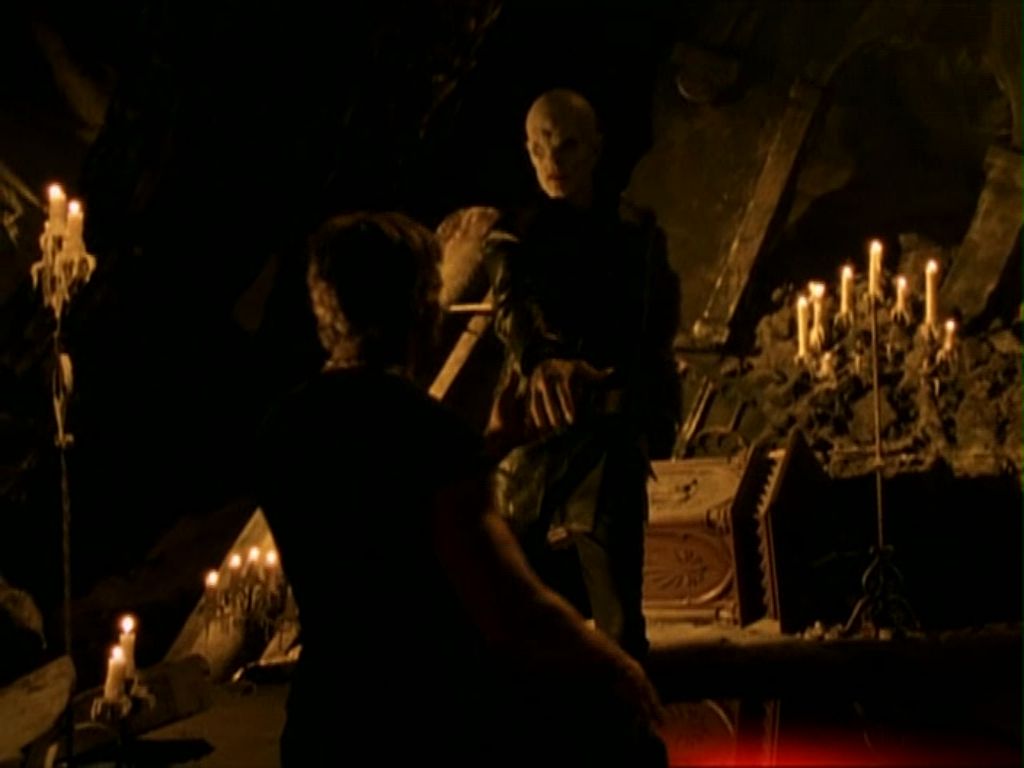
Luke: My body is your instrument.
– Not Hozier lyrics, but dialogue from 1×02 The Harvest
It is going to be a problem if your feminist coming-of-age story, centering around a teenage girl who you want to hold up as a strong, independent hero, is constantly threatened by symbols of “dangerous sexuality”. Controlling the sexuality of women has been a tool of patriarchy for centuries, with fear-mongering around the supposed inherent danger that sex is for women still repeated by morons and misogynists today. Buffy is constantly in danger of falling into that trap. In this episode we see Buffy become closer to Angel – literally with their conversation in the mausoleum, and shown metaphorically as Cordelia (Buffy’s Shadow) gives us a monologue about the appeal of “senior boys” and their “mystery”. Her relationship with Angel is largely about the problems that come from sex, with the arc of season two being able to be accurately summed up as “Buffy has sex and so bad things happen”.
I think that the show actually handles this topic far better than that flippant description would imply. Not always – but more often than not the show does allow Buffy agency in her sexual desires and takes extra steps to avoid coming across as punishing Buffy for having sex. This is a narrow tightrope that they will continue to wobble across for the next seven seasons.
In the meantime though – the show is all set up and ready to go. This opening two-parter, like any show’s pilot, has the thankless task of introducing the world, the characters, the lore, the basic themes. There are missteps like Jesse along the way, but for the most part it does a great job. The final line – “The Earth is doomed.” – which gets a call back in the final episode, sets the tone for the rest of the show. It promises misery and annihilation with a wink and a joke, and that’s exactly what we’re going to get.
* * *
Thanks for reading! If you enjoyed this piece, please consider supporting me on Ko-Fi!
* * *
References:
[1] https://www.cbr.com/angel-doyle-season-1-killed-off-plan/#
[2]https://dvdbash.files.wordpress.com/2014/09/torchwood-s1-barrowman-myles-owen-david-lloyd-gorman-mori-price-kasey-phifer-havins-pullman-ambrose-dvdbash-09.jpg
[3]https://www.denofgeek.com/tv/10-ways-buffy-the-vampire-slayer-changed-the-world/
[4]https://scholarship.rollins.edu/cgi/viewcontent.cgi?article=1015&context=mls
 Insect Reflection

Well, sexually affirming forms of Christianity have always existed
& especially in the last 70 years, but i agree i don’t like obvious Christ-figure characters except when essential, like Aslan. Althoguh Christianity’s Fall does teach a perfect world, the Garden of Eden itself is a fairly small territory, had only 2 people in it for a short time. The idea of a human paradise-earth is more the thing of lost-continent writers like Donnelly and Churchward. DaddyCatALSO
LikeLiked by 1 person