

There comes a point in the life cycle of every piece of popular culture, when a major twist stops being a spoiler, and becomes instead common knowledge, presumably known by anyone who has not dwelt beneath rock for their entire life. Darth Vader is Luke’s father. Rosebud was his sled. It was Earth the whole time. Snape kills Dumbledore. I’m not tagging these as spoilers, because you already know them, even if you haven’t seen these films. And the fact that you do know these twists changes the fundamental experience of viewing them. You can never have the same experience that those original audiences did. The emotions that they originally intended to invoke are lost to time. The pop-cultural osmosis that these texts have undergone has twisted the texts themselves into something new.
Rowan Ellis, in her excellent video on Black Sails[1], talks about the idea of “pre-read texts”. These are pieces of media that become so deeply ingrained in popular consciousness that all people within a society have a pre-existing knowledge of the text, even if they have never actually consumed the text itself. Sometimes this knowledge is accurate, and sometimes it is warped by the game of telephone that is common knowledge. Either way, this knowledge changes the experience that anyone consuming the text for the first time will have.
The example she uses initially is of course Treasure Island, the book that Black Sails is a proposed sequel to. In a later discussion[2], she uses the example of Jekyll and Hyde. Everyone knows the basic premise of Jekyll and Hyde – a regular, unassuming man creates a potion that causes him to become his dangerous and violent alter-ego. It’s a story that’s become a trope that’s become, among other things, one of the most popular comic book characters of all time. But in the original novel, The Strange Case of Dr. Jekyll and Mr. Hyde, the fact that Jekyll and Hyde are the same person is initially a secret to the reader. It is presented as a mystery, and the reveal that Jekyll is Hyde is a major twist, coming halfway through the story. Not one person who reads that novel now will be surprised by that twist. The experience of the story is inevitably altered.
It is in this context that we must view this seventh episode, Angel (named exactly the same as both a character and a show, seemingly in order to ruin my tagging system). Because this episode is built around a major twist: the shocking revelation that the mysterious Angel, the man who has been following Buffy around dropping cryptic warnings, is in fact… wait for it… A VAMPIRE!

It would be an extremely difficult task to find someone now who would be capable of being surprised by this twist. The basic premise of the spin-off show tells you this fact. Any marketing for the show after this episode clearly advertises it. Angel’s vampirism is so deeply baked into his character concept, that if you know anything about him, you know that one fact. Just being vaguely aware of the YA tropes that dominated the late-00s/early-10s would tell you this, since Buffy popularised the tropes that Twilight made mandatory. Of course the heroine of this supernatural teen drama has a vampire for a love interest. It would be a subversion if she didn’t these days.
I myself first watched this episode after having seen seasons two through five of Buffy, and the first three seasons of Angel. This episode therefore wasn’t just not a surprise – it was almost a farce. Playing up the mystery of Angel when you know well and good he’s a vampire cursed with a soul is like the bit in a pantomime where the villain creeps on stage behind the hero, who acts like they don’t know he’s there. “HE’S BEHIND YOU”, we cry, knowing that the obviousness of this fact is the joke. The original experience that audiences in 1997 must have had, of seeing his vamp-face suddenly appear in Buffy’s room, gasping in shock as it cuts to the ad break, is lost. The experience we have is instead one filled with unintended dramatic irony.
This episode is often one listed by fans as the point in which the series “becomes good”, or as “the other good episode in S1 after Prophecy Girl”. I think the weirdness of seeing this episode after seeing so much of Angel’s character in greater depth, is part of the reason why I never shared those sentiments. For me, this episode has the feeling of finding yourself back at the tutorial level after you’ve almost completed the game. It broaches some questions about morality that are very basic, beginner questions compared to some of the more interesting stuff explored later in both shows. But that’s only because this episode has become a kind of pre-read text. I, and anyone else who watches now, will have a unique experience because of the knowledge we have. We can’t really blame this 24-year-old episode for not holding up in the same way now. Children have to walk before they can run, games need a tutorial level before the real challenge, and TV shows exploring the nature of choice and redemption first have to introduce the basic concepts of choice and redemption.
Here’s a simple question – why is it morally okay for Buffy to slay vampires? It’s a fundamental pillar to the show, right there in the title, but why is it OK? Vampires are sentient beings, and many of them in this series are fully-rounded characters with feelings and arcs. This isn’t the type of action series that is blase about the heroes killing random henchmen – the show is pretty consistent in the idea that killing a human being is not OK, even when that human has done things as bad or even worse than some vampires (e.g. Warren, Faith). Even most other demons are left alone unless they’re actively villainous. But it’s fine to kill vampires on sight, before they’ve had a chance to do anything for evil or good. The answer suggested in this episode is simple – because a vampire is not human. They are animals.
“A vampire isn’t a person at all. It may have the movements, the memories, even the personality of the person that it took over, but it’s still a demon at the core, there is no halfway.”
Rupert Giles, 1×06 Angel
“Question: a hundred years or so before he came to our shores, what was he like then?”
Buffy Summers and Rupert Giles, 1×06 Angel
“Uh, like all of them. A vicious, violent animal.”
“Vampires hunt and kill. It’s what they do.”
Rupert Giles and Xander Harris, 1×06 Angel
“Fish gotta swim, birds gotta fly.”
“I walk like a man, but I’m not one.”
Angel, 1×06 Angel
“I’m just an animal, right?“
Angel, 1×06 Angel
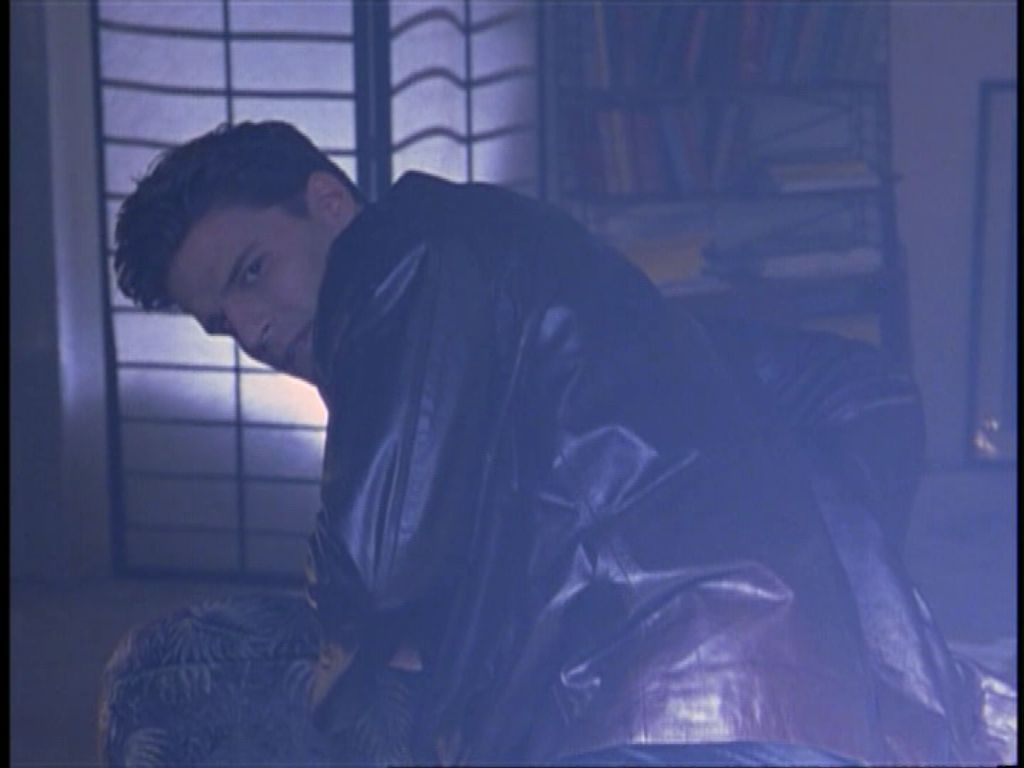
The positioning of vampires as animals is particularly strong in this episode, with David Boreanaz seemingly getting more opportunities to growl animalistically than in any other episode. Beyond the above quotes, we also have the framing device of the pre and post fumigation parties at The Bronze, where customers are rewarded with a free drink for every dead cockroach. There is no question of morality here – the cockroaches are pests that need to be dealt with. It’s not a judgement on the moral worthiness of the cockroach, it’s just a fact of life. To quote another Whedon script: “An ant has no quarrel with a boot”[3].
(The metaphor of cockroaches and vampires is interesting, given that cockroaches are notoriously unkillable – they exist after the fumigation, just hardier. Cockroaches will survive a nuclear war, and vampires will survive anything Buffy the forces of good can throw at them. There is no “winning”, just endless Sisyphean war.)
When Buffy slays vampires, she is not judging them worthy of death, because there is nothing to judge. A Slayer does not hate vampires, she just kills them. Buffy says it herself: “I’ve killed lots of vampires. I’ve never hated one before”. They are simply pests, a plague that spreads and infects and kills indiscriminately, and is not capable of doing anything else. They are beings of pure id, lacking in both ego and superego, who act entirely on desire and urge. Like Slayers, they don’t hate their victims, they just kill them. In a way, they’re not truly evil, any more than a lion is evil for killing a zebra.
Of course, it wouldn’t be moral to go around slaying lions for doing this – as The Lion King says, they’re just taking part in the circle of life. But vampires are not a part of this cycle – they are a corruption. They pervert the circle, turning the dead to the un-living, turning people into walking corpses, twisted mirrors of themselves. Like animals, they lack the ability to make conscious choices. But unlike animals, there is nothing natural about them. They are an intolerable invasion into humanity, just as the cockroaches are in The Bronze. So they must die, simple as that.
Except, it is not quite that simple. The quotes from earlier are mostly from Giles and Xander, who have their own preconceived hang-ups on the subject, and from Angel, who seems to be attempting a suicide-by-Slayer in The Bronze, and so wants Buffy to have no moral issue with killing him. But Buffy herself is not convinced.
“You’re not an animal. Animals I like.“
Buffy Summers, 1×06 Angel
She spends the latter half of this episode struggling to come to terms with the idea of killing Angel, but even after she sees him apparently feeding on her mother, she still expresses uncertainty over what she is told is her straightforward duty. She understands what Giles and Xander do not – that Angel is not an animal. She knows this because he has taken actions that do not make obvious sense if he is purely acting on selfish instinct. He has helped her, and so demonstrated his ability to make selfless choices. So she offers him another choice; a simple test. She steps up to him and offers him her neck.
Both Angel and Buffy, Vampire and Slayer, are coming to realise in this episode that their existence is not as simple as they thought. Both had killed their respective prey without much of a thought in the past. Angel makes this comparison between them explicit (“Feels good, doesn’t it? Feels simple.”). Xander and Darla are the voices on each of their shoulders’ this episode, telling them that it is still that simple – Vampires kill humans, Slayers kill vampires. Again, it’s right there in the show’s title. Giles is a little more aware of the complexity, but is still obeying the rules as he understands them. (“I think this is gonna take more than a simple stake.”). But this easy, convenient truth is not as self-evident as they claim. Because Angel has a soul. He is no longer an animal, a slave to his urges. He has the ability to make a choice.
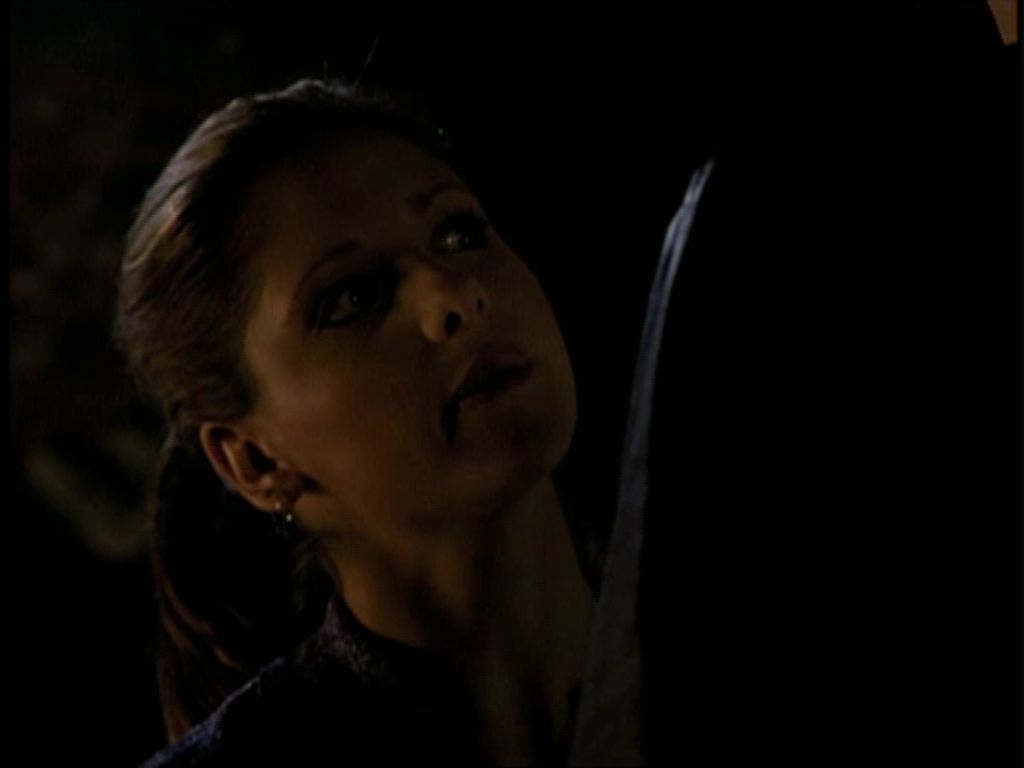
There are certain desires and urges that are not a result of conscious choice. Angel wants to drink Buffy’s blood – that is not something he chooses, it is innate within him, as displayed by his fridge full of O positive. Buffy and Angel do not choose their attraction to each other either. Willow spells this out for us when she says: “If you care about somebody you care about them. You can’t change that.”
The romantic desire is as innate and inescapable as the urge for a vampire to drink. Romance, sex, and hunger are all tied up in the id, and all tied up together for a vampire. The moment that the reveal of Angel’s nature, the twist that this episode centres around, comes in Buffy’s bedroom, after they share their first kiss. Angel first tells her that they shouldn’t date, but they are drawn to each other, like animal magnetism. It is in that moment, that lack of control and seeming lack of choice, that the vampire is made visible. The moment that they give into their id is the moment that the id is released.
Also set up in this episode is the addiction metaphor in relation to Angel’s blood-drinking. Many have described Angel’s struggles with the urge to drink human blood as akin to an alcoholic trying to remain sober, including Angel co-creator David Greenwalt[4]. That metaphor is all over this episode, from Darla’s inversion of the anti-drug slogan when she offers him Joyce (“Just say yes!”), to Buffy shooting an anti-smoking poster as she is preparing to fight Angel. In our real world, people do not choose to become addicted. It is something that happens to them, a condition. They and Angel can both choose whether to indulge in a harmful addiction that hurts others, or to not. But neither people nor vampires choose their condition.

Neither can anyone choose or change their past. Angel is cursed with the knowledge of everything he has done, and understanding that there is nothing he can do to change it. He cannot un-maim, un-kill, un-slaughter. The past is permanent. But the future is not. There’s an interesting runner in this episode of Buffy having a series of History tutors. Willow is her actual history tutor, she tells Joyce that Angel is too, and Darla also claims to be one. Much of the question around Angel can be boiled down to ‘should Angel’s history define him?’. Darla tries to entice Angel with knowledge of their history (“Remember Budapest?”). Angel urges Buffy to kill him with stories of his own history – a hundred years of bloody mayhem. But Buffy does not let history define him. Giles clues us in when he talks to Joyce: “She lives very much in the now, and history, of course, is very much about the, uh, then.” A major aspect of Buffy’s character is revealed here – her ability to look past a person’s history, and instead look at what they are doing now, in the present. That is what defines them.
So we come back to The Bronze, and Buffy offering up her neck. The forces of nature and history and simple desire, all demanding that Angel give in. But there’s force more powerful than all that: choice. He is caught in this moment between good and evil, between Angel and Angelus, between Dr. Jekyll and Mr. Hyde, and he chooses not to bite. He chooses to kill the person telling him he has no choice in the matter. He chooses, for now, to be Dr. Jekyll. To be Angel.
The character we have seen up until now has been insistently poisoned by the perspective from the future, from knowing that this character stars in a five-season spinoff about a vampire detective with a soul. But this episode is where all that really stems from. Where we get our first solid glimpses into the themes and ideas that will shape both shows. Where the Angel capable of carrying a show first comes into view. From this point, he is no longer the mysterious stranger in the shadows. He is the character we always knew he was, the tortured vampire with a soul, in love with a slayer. Angel has arrived. And more than that, so has Angel.
* * *
Thanks for reading! If you enjoyed this piece, please consider supporting me on Ko-Fi!
* * *
References:
[1] Rowan Ellis, ‘Black Sails: How To Write a Better Ending than Game of Thrones’, https://www.youtube.com/watch?v=SMFll3aIbmo
[2] Elizabeth Rae Stevens & Rowan Ellis, Fathoms Deep Episode 79: Talking about all the things with Rowan Ellis, https://www.justsaypodcast.com/fathoms-deep-podcast/rowan-ellis
[3] Joss Whedon, The Avengers (2012), https://getyarn.io/yarn-clip/8d562c19-c221-4f8f-96cd-a72a30c828be
[4] David Bushman & David Greenwalt, Angel:Vampire Noir, https://paleymatters.org/angel-vampire-noir-e4eacd39dc4a
 Insect Reflection
4 thoughts on “Am I A Thing Worth Saving? (Angel)”