
The 90s were a weird time. Music was pretty awful, everyone got into Tamagotchis, and the Satanic Panic of the 80s moved on from fearing Dungeons and Dragons to a new boogeyman that threatened to steal our children’s souls and destroy society as we know it: a little-known fad called the Internet. (They also feared the same about Harry Potter, but to be fair they turned out to be right about that).
Technically the internet itself has existed in some form or another since the 1960s, but the World Wide Web as we know it didn’t come into existence as we know it until 1989, and it wasn’t until 1994 when web browsers started to be widely used[1]. Netscape, the most popular web browser of that decade, wasn’t founded until 1994. Suddenly, people had the opportunity to connect to others all over the world, to gather in virtual forums and share whatever came to mind. Frankly, society has never really recovered.
We can joke about the inevitability and total ubiquity of the internet, but honestly, the viewpoint that Giles has in this episode, of it all being some kind of fad, was a fairly commonly held opinion at the time (including my own father, who as I remember grumbled worse than Giles as he reluctantly purchased our first modem in 1999). Notably, this was a time that mainstream media was starting to get interested in this “internet” thing. 1995’s Hackers explores the dangers of malicious actors bypassing the world’s security systems, and wearing sunglasses. You’ve Got Mail came out in 1998, giving us a romcom that treats the idea of meeting somebody and starting up a relationship online as a genuine novelty. If you haven’t seen these films though, don’t worry, because I Robot You Jane combines all of these elements into one, fun-filled package.

This is an episode that is all about the intrusion of modern technology onto the ancient and mystical. This is the main source of Giles’ frustration, and his rom-com bickering with Jenny Calendar, who enters in this episode (but more on her later). It’s also the plot driver – the big danger comes because of how Moloch’s worship-gaining powers interact with the total connectivity of the internet.
This is an idea that the show likes to return to. It’s why we have Adam, Riley, and the Initiative. It’s why we have the Trio, karaoke-singing demons, April, the Buffybot, and any of the other magical robots bouncing around the Buffyverse. And while some of those elements are not fan favourites to say the least, they represent an integral part of the show. This series is all about the blend of the mystical and the modern, right down to its protagonist.
We saw in Welcome to the Hellmouth how Buffy brought a fresh, modern perspective onto Giles’ dusty old world of books and prophecies. She took on her duties – identifying and slaying vampires – but did it with her own method of identifying the latest fashion trends and how the vampire didn’t follow them, rather than “reaching out with her feelings”. She weaponises the modern against the mystical.
On a meta level, Buffy represents a more modern approach to horror storytelling, by being a strong female and feminine Hero. Within the universe, Buffy makes herself a unique case among Slayers by rejecting much of what she is told, and instead bringing her own, up-to-date perspective. What makes her strong though is that she doesn’t reject everything – if she completely rejected her calling then she wouldn’t be The Hero – but that she blends both her ancient mystical destiny and her modern 20th century viewpoints into one coherent whole. The Buffy and The Vampire Slayer.
Our mouthpiece for that harmonisation in this episode isn’t Buffy however – it’s Jenny Calendar. Jenny is a “technopagan”, blending mystical power and knowledge with the cutting edge technology of Windows 95. She is the one clashing with Giles in this episode, the stand-in for all things ancient. By his own confession, Giles is out of his depth, and unwilling to change. It’s the role of Jenny in this episode, and Buffy in the wider season, to challenge that stubbornness and bring out a more open mind.
Jenny is a glorious breath of fresh air in this respect. I’ll admit, I hadn’t given much thought to Jenny on previous watches – I liked her well enough, but hadn’t ever dug into her character or the role she plays. This time, I found myself cheering as she swooped in, sassing Giles over his unstylishness (“I’ll be back in the Middle Ages.”/“Did you ever leave?”), and teaching us all about the wonders of cyberspace. Jenny is a figure of fun in a season that can occasionally get bogged down with the dreary antics of old-fashioned villains.
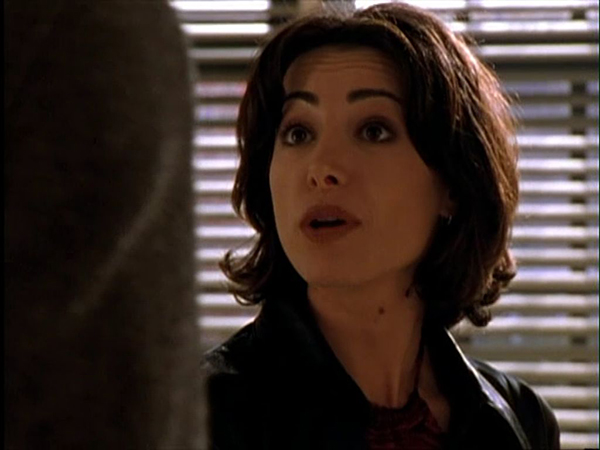
As the second adult in this show (Angel is technically the oldest but he is never a source of authority – structurally he’s on the same level as the teen characters), Jenny is immediately positioned as a counterpart to Giles. She is the Secondary Mentor, who provides a different kind of knowledge to the young Hero. The Yoda to his Obi-Wan, the Baloo to his Bagheera. She is there to let us know that power and knowledge is not solely tied up in ancient tomes and wise old men. The link to the patriarchy is made clear at one point – Jenny represents the progressive point of view as she admonishes Giles for not letting information be freely available.
“Oh, you are a big snob. You think that knowledge should be kept in these carefully guarded repositories where only a handful of white guys can get at it.”
Jenny Calendar, 1×08 I Robot You Jane
In some ways, Jenny can be seen as an older version of Buffy, a model for her to strive towards. They both talk back to Giles in similar ways, calling out his old-fashioned sensibilities. They both disrupt the established order of things. Perhaps Jenny is in fact the true mentor of S1, the progressive future that Buffy must pursue, while Giles is the student who needs to learn from both of them.
This episode is not solely in support of technology however. It’s skepticism is baked into the premise – where Willow gets seduced by a stranger online who turns out to not be who they said they were. It’s a very basic parable about the importance of internet safety, given a supernatural makeover, in classic Buffy fashion. This was a major fear that dominated the conversation surrounding the internet at this time. I remember being a child, being sat down and told to be very careful and never give anybody on the internet any information about myself. There was an overriding fear, mostly from older people who weren’t on the internet, that every other person online was a secret satanic pedophile monster.
It makes a curious comparison to today, where most major websites enforce or at least strongly encourage the use of real names on all accounts. Where once you would join a forum with a username thought up on the spot, and know everyone there by a nickname and 24x24px avatar, now every website you visited has tracked you from another, and every comment you make is now linked to your Google account, Facebook account, mobile number and dental records. Anonymity has been replaced by mandatory identification. It’s part of the creeping insistence of capitalism – you cannot market to Anonymous, so anonymity must be destroyed. Where once personal information had to be closely guarded under lock and key, it now must be extracted, packaged, and sold to every unknown corner of cyberspace.
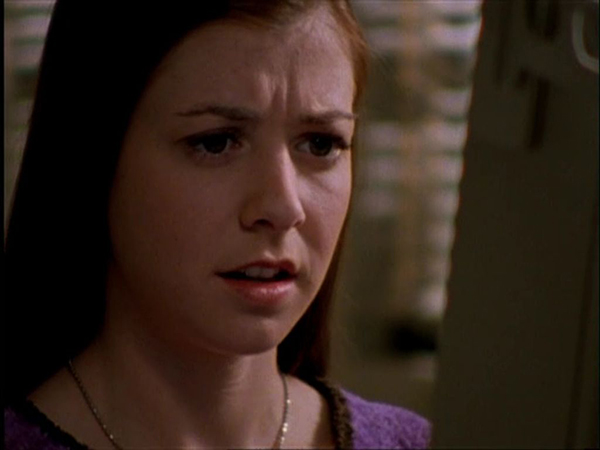
At the time, most people who actually used the internet scoffed at the dangers that the older generation warned of. Without wanting to dismiss the danger of online grooming, which of course always existed – most people knew it was actually pretty easy to stay anonymous, and so stay safe. As wider society has become more comfortable with the Internet, it has become more comfortable with sharing personal information, and so ironically enough has actually become more dangerous. Nowadays, Moloch wouldn’t need to hack into the school system to find out more info on Willow and Buffy – her real name would be right there on her profile, alongside her friends list and education history.
That contributes to why this episode does feel like such an odd relic – it’s based around a danger that was more perceived than reality in its own time, but it also treats the internet as too much of a bizarre novelty to be remotely relatable to modern audiences. It’s not just stuck in the 1990s – it’s stuck in the alternate universe of the 1990s that only exists in Hackers.
For what it’s worth, there is a character-based reason for this plot, beyond the topical discussion of online predators. In this episode, Willow comes to realise that this mysterious guy that she has been drawn to hasn’t been entirely honest about his identity – he is, in fact, a demon. It’s significant that this episode comes right after Angel. Buffy is working through her emotions around finding out her new beau is a vampire, through Willow’s arc.
Through that lens, there’s two significant moments. The first is when Moloch tells Willow that he didn’t lie, that he really does love her. This could be Buffy trying to reckon with the fact that Angel lied to her, but also does love her, despite everything she knows telling her that that should be impossible. It also, bizarrely, is an uncanny parallel to a moment between Spike and Buffy in season six.
“Let me leave?”
Willow Rosenberg and Moloch, 1×08 I Robot You Jane
“But I love you!”
“Don’t say that! That’s a joke! You don’t love anything!”
“You are mine!”
“I’m not yours! I’m never gonna be yours! Never!”
“I have to do this. Just let me go.”
Buffy Summers and Spike, 6×13 Dead Things
“I can’t. I love you.”
“No, you don’t.”
…
“Come on, that’s it, put it on me. Put it all on me. That’s my girl.”
“I am not your girl! You don’t … have a soul! There is nothing good or clean in you. You are dead inside! You can’t feel anything real! I could never be your girl!”
– 6×13 Dead Things
Both women are insistent that their demonic paramour cannot love them, that they are not capable of it, while the demon insists that yes, they can. It’s the classic push and pull of a supernatural love story. It gets more interesting when you take into account the final scene, where Xander, Willow, and Buffy all jokingly opine about how their only romantic interests are demons. This scene is appropriately prophetic, coming well before these characters go on to have serious romantic relationships with werewolves, witches, slayers, more vampires, and 1000-year-old ex-demons. Early on, the characters are seemingly aware that they are “doomed” to only date demons, while also consistently believing that demons are not capable of loving them back. It could indicate the futility of being star-crossed lovers, or a crippling lack of self-worth – either way, it’s very tragic.

Outside of the romantic lens, there’s another danger that this episode warns about, perhaps unintentionally – the dangers of online radicalisation. This is something that wasn’t really being talked about in 1997, but now is a mainstream issue in internet safety[2]. Moloch has two other victims this episode – Fritz and Dave, two terminally online white dudes who become obsessed with the power promised to them. We see that Moloch’s infection of the computers creates an essay on one student’s computer: ‘Nazi Germany was a model of a well ordered society’. We could see these two, particularly the unstable Fritz, as radicalised alt-righters, posting Pepe memes on /r/TheMoloch.
This was almost certainly unintentional – the online proliferation of fascist ideology is more of a 21st century concern. But the biggest problem with getting anything of value from this reading is Fritz. Fritz is intended as the cautionary tale for becoming too invested in modern technology, something Buffy must avoid if she wants to reach the happy medium represented by Jenny. Problem is, unlike Jenny he never once feels like a real person. Right from the moment he appears on screen, ranting about how “the only reality is virtual”, he feels like a vague collection of ideas, more metaphor than human.
It doesn’t help that his catchphrase is “I’m jacked in.”, a sentence I’m not sure any human being has ever said. Again, this guy is a Hackers character, not a real person. So the cautionary tale falls flat. We watch him carve an ‘M’ into his flesh as he repeats his bizarre catchphrase, and we don’t think “oh, what a tragic figure”, we think “what in the actual fuck is going on here?”.
That might be the core problem with this episode. This episode is, uh, not remembered fondly to say the least. It’s the lowest-ranked episode of season one according to IMDB[3], and the 8th-lowest overall. When people talk about the cheesiness of this first season, they’re probably thinking of Fritz, of Moloch in his Power Rangers robot suit, punching through a wall. “Dumb” is a hard concept to quantify, but like pornography, you kind of know it when you see it. Those parts of this episode are, to be fair, kind of dumb. But as I go through this first season, I’m noticing an incredible amount of groundwork and thematic foreplay that goes unacknowledged by fans of the show who dismiss this season. For all the valuable nuggets that can be mined from any episode of this show, sometimes its dumbest elements override everything else in our collective memory.
We have to regard this episode as a real relic of its time. It’s a distillation of the fears and misconceptions and general uninformed bemusement that dominated mainstream discussion of the internet at this time. It’s also a distillation of everything the Buffy fandom as a unit remembers about season one. It’s a perfectly accurate summation of a point in time that only exists in the collective imagination of others. It’s an artifact of the 1990s that only partially reflects the reality of the 1990s, and an symbol of the failing of season one that doesn’t really do justice to season one.
* * *
Thanks for reading! If you enjoyed this piece, please consider supporting me on Ko-Fi!
* * *
References:
[1] Couldry, Nick (2012). Media, Society, World: Social Theory and Digital Media Practice. London: Polity Press. p. 2.
[2] https://www.internetmatters.org/issues/radicalisation/protect-children-from-radicalisation/
[3] https://www.imdb.com/search/title/?series=tt0118276&view=simple&count=250&sort=user_rating,desc
 Insect Reflection