
Buffy the Vampire Slayer is a story about powerlessness. This remains the case throughout the series. It’s about how the universe is fundamentally unjust, how the worst things will relentlessly happen, how you will be forced to make the most difficult choices, again and again. It’s a show that confronts the fact that we as humans simply don’t have any control over the conditions of our lives. In the first three seasons in particular though, it’s also specifically about teen powerlessness.
Adolescence is a difficult time for anyone. It’s a point in life in which you are neither a child nor an adult. You are flooded with a range of emotions and bodily changes you are never prepared to handle. You are rapidly gaining new knowledge and realisations about life, but not enough to realise how little you know. You are matured enough to reject some authority, but not enough that you can completely be your own. You want control over your own life, but the structures of our society rob you of that control. Legally, you are not an adult yet, and so are subject to the authorities in your life – parents, schoolteachers, watchers. We have an ambivalent relationship to teenagers, treating them as children or adults depending largely on our own convenience.
Some of this control is necessary. There are certain things that teenagers simply are not developed enough to confidently consent to. Other times, this control is less about protecting young people, and more in service of a society that relies on an uncritical obedience of authority – to the family unit, to the police, to the state, to the education system. Either way, it is a state of affairs that is deeply frustrating for any teenager living them. We mock the cliche of teenage rebellion, but the fact is that teenage life is a unique and challenging experience.

Buffy Summers is navigating the classic adolescent experience on steroids. Her situation is one that the adults in her life literally have no knowledge of. They do not know about vampires and Slayers, and even if they did, they could not fully comprehend what being a Slayer means. This is the first and most central of the ‘teen experiences as supernatural metaphors’ that defined the early seasons. Creator Joss Whedon has talked about how high school was extremely difficult for him, and that it felt like “a horror movie and a soap opera”[1]. He imbued that feeling into the show and into its lead character, and that’s part of what lends the show its unique flavour.
Slayerhood is a unique and challenging experience that the people with power over you simply cannot understand. Side note – this is also one of the many ways in which Slayerhood works as a metaphor for queerness. Many queer teenagers are stuck in situations where the people around them do not and cannot understand what they are going through, which leads to a delayed adolescence for them. The authorities in Buffy’s life admonish Buffy for her actions, but have a severely incomplete picture of what is causing those actions. A big part of her challenge in these early years is completing her duties around the hurdles placed in front of her by clueless authority figures.
Giles and Joyce make really nice counterpoints in this regard. Giles is fully aware of her calling as a Slayer, but at this point in their relationship is still coming to grips with the fact that she is also a human being. He does not give full respect to that side of her, and so robs Buffy of power over half her life (see Witch, Never Kill A Boy on the First Date). Joyce on the other hand knows Buffy as a teenage girl, but has no knowledge of Buffy the Slayer. She robs Buffy of power over that half of her life, and makes it difficult for her to perform her duties (see The Harvest, Witch). Buffy is powerless twice over.
What these two characters have in common is that they do care about Buffy, and genuinely want the best for her, despite the limits in their perspectives. The other authority figures introduced in the first eight episodes are much the same, including the late Principal Flutie. Flutie was a little dopey and insincere (think him sellotaping Buffy’s permanent record back together while insisting that she totally had a clean start at Sunnydale High), but he was never actively malicious. Like Giles and Joyce, he seemed to be doing what he thought was best for a student in his care. There were no authority figures who just hated Buffy and wanted her to fail.
Enter Principal Snyder.

Principal Snyder is the concentrated essence of malicious authority. He is a petty tyrant, the human form of bureaucracy, wielding discipline as a blunt instrument. Like Giles and Joyce previously, he gets in the way of Buffy’s investigation in this episode, but this time it’s caused by his own vicious pettiness. As Buffy’s life is the heightened version of the teenage experience, he rises to meet that, being a heightened version of the ignorant and opaque authority that a teenager might rail against. He does not want the best for Buffy, or any of the students in his care. He uses his power over them, not because he thinks it is necessary for their development, but because he enjoys wielding power. Because, in the immortal words of Cordelia Chase, he is a tiny impotent Nazi with a bug up his bottom the size of an emu.
Armin Shimmerman deserves so much praise for making this horrible toad of a man so incredibly watchable. Snyder is basically a cartoon character, and could’ve easily come off as one – a Gargamel figure constantly cackling about how he’s going to cause our hero trouble this week, over and over again. Shimmerman avoids this by imbuing Snyder with a genuine smallness. He works because he’s not an evil mastermind, but just some arsehole who happens to have immense power in this very small space. He’s every crappy teacher, every entitled customer, every pigheaded boss. It helps too that when we do get glimpses of his backstory, there is no grand tragedy there – we see in Becoming and Band Candy that he was just an unpopular kid who couldn’t get a date, and never ever let that go.
It also helps that Snyder has simply some of the best lines of the show. My favourite might come in this episode (“Kids need understanding. Kids are people. That’s the kind of wooly-headed liberal thinking that leads to being eaten.”) but I’m also partial to his graduation speech (“This is a time of celebration, so sit still and be quiet. Spit out that gum.”). You’ll probably have your own. The writers clearly had great fun thinking up absurd lines for this vicious little peacock of a man. I’m not sure where they got such inspiration for this character – a man who never quite let go of his experiences as a teenage nerd, who has now gained dominion over a tiny little kingdom and now thinks he’s God, who brags about his power and wields it arbitrarily, using it to punish anyone who he perceives as challenging that authority, who make existing in the same space as him its own kind of hell, who oversteps his professional boundaries, and whose actions are always tinged with pettiness and barely concealed misogyny.

Part of loving Buffy is realising its many tensions and contradictions, and here is a big one. Its creator is both its hero and one of its main villains. Both sides of this discussion, of teen powerlessness .vs. ignorant authority, can adequately be described as expressions of the same single person. Joss Whedon is Buffy Summers, and Joss Whedon is Principal Snyder.
Still though, we shouldn’t hold that against either character. Buffy is a hero, who stands alone from her creator. And Principal Snyder is one of the greatest love-to-hate villains of all time. He is not a character we fear, or engage with emotionally, or are impressed by. We just love to hate the little toad. He deserves to be listed alongside Joffrey Baratheon and Professor Umbridge as one of the most successful examples of this kind of character in modern media.
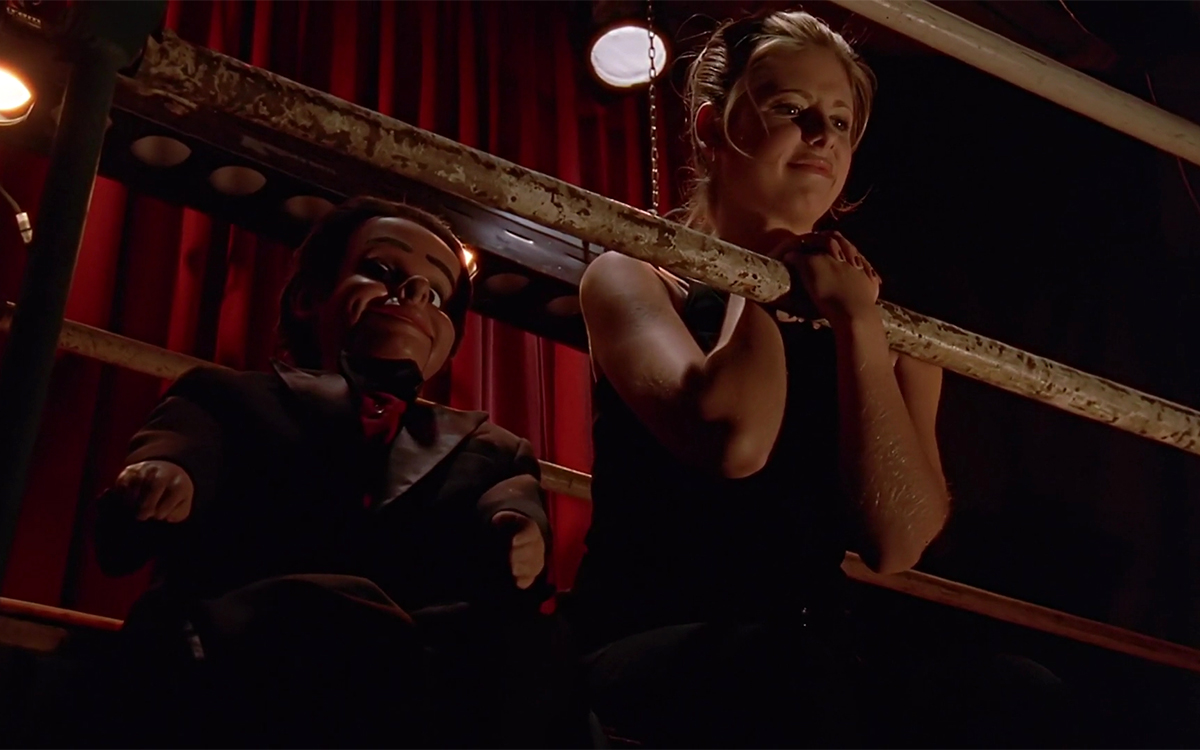
I have avoided talking directly about the episode for most of this piece, for the simple reason that I don’t think the rest of the episode is very interesting. The plot is simple enough – there’s a demon going around stealing human parts, and the red herring is the sinister ventriloquist’s dummy that is talking to its master, and seems to be hunting Buffy. The second act twist reveals that the dummy, named Sid, is actually a former demon hunter who’s trying to kill the demon, because when he does, he will be free from his curse and get to die.
The metaphor here is clear – Sid is Buffy. He needs to complete his destiny and then die. The dilemma Buffy will face at the end of the season is that she needs to fulfil her destiny by dying. She empathises with him, and learns from him that dying isn’t the worst thing in the world. Because of this, much of the emotion in the third act of this episode relies on Sid, and Buffy’s empathy for him. The episode climaxes with Sid’s farewell, his noble death, and Buffy cradling his lifeless body in the strangest Pietà ever.
The problem is that Sid is not particularly likeable as a character. He is kept at a distance for most of the episode, as the red herring villain. By the time we learn that he is a good guy, there is little time left to flesh out his character enough that it means anything to us when he gives up his life. The only personality trait he has beyond his demon-hunter backstory is “horny dummy”.
Buffy’s correct at the start – the horny dummy schtick gets old, fast. The grossness is treated with not much seriousness, the gentle “oh, you” kind of eye-rolling that lets us know that the writers are aware it is inappropriate without actually doing the job of condemning it. And it is very inappropriate. The shot of Sid’s eyes rolling back as he leers at a sixteen year old Buffy, slurring the word “nubile”, never fails to make my skin crawl. Yes, he’s a puppet, but he’s also mentally (and was physically, before he was cursed) an adult man. It comes off as gross, and since there’s little else to his character, it’s the grossness that sticks in the mind.
This specific kind of humour – where the female characters are sexualised by male characters, and the script gives it nothing but a wry smile and maybe a verbal slap on the wrist, is pretty endemic to Whedon properties. It’s something that a lot of people point to in regards to Xander’s character, and while I think it’s simplistic to try and boil it down to one problematic character, there is an accuracy there. I’ll defend him plenty in later seasons, but at this early stage, a high percentage of Xander’s lines boil down to this similar kind of grossness. His behaviour at times, such as spying on Buffy changing in Never Kill A Boy On The First Date, might not make him the devil incarnate, but it’s just shitty enough to be off-putting. Yet the show treats it as nothing worth anything worse than an eye-roll. The problem here isn’t any one specific joke, but the general pattern.

Unfortunately, the spectre of this show’s creator haunts us once again. In February of this year, Michelle Trachtenberg posted a message on Instagram[2] in the wake of the wave of accusations of Joss Whedon’s bullying, cruelty, and inappropriate behaviour on set. It’s a post that I still find genuinely haunting to read.
“This must. Be known. As a teenager. With his not appropriate behaviour… very. Not. Appropriate. […] There was a rule. Saying. He’s not allowed in a room alone with Michelle again.”
I don’t want to make wild accusations about what happened here. There’s a wide range of things that could’ve triggered this rule, and to speculate on specifics would be disrespectful to the victims of his actions. But when I see this post, I see every bit of slight grossness the show fails to condemn. I see Xander comedically failing to spy on Buffy changing. I see Sid the Dummy, eyes rolling at the thought of the word “nubile”. I can’t help but link Buffy’s intense feeling of powerlessness with the powerlessness that the actors must have felt every day they went to work.
The show is imbued at every level with the sensibilities of its creator. That is its great gift, and great curse. I have never seen another show that so perfectly captures the teenage sense of alienation and powerlessness. That deep relatability is part of why the series is so meaningful to people who watched it in their teenage years. And I think that is still important. That universal sense of compassion found in the show is not any less valid because of what we now know. That feeling belongs to all of us, and it is powerful. I think that it just also means we have to deal with Sid the Dummy. As a trade-off, it’s one I’m just about happy to make.
Just about.
* * *
Thanks for reading! If you enjoyed this piece, please consider supporting me on Ko-Fi!
* * *
References:
[1] https://www.empireonline.com/movies/features/buffy-vampire-slayer-turns-20-joss-whedon-looks-back/
[2]https://ca.movies.yahoo.com/michelle-trachtenberg-says-rule-buffy-041530998.html
 Insect Reflection
I really love the unpacking and intersection of Joss being interwoven into the show! It’s a really nuanced place where we can both recognise the world he gave us AND also call out his treatment of feminism, his cast and his desperation for power through abusive behaviour.
LikeLike