
Fear is in the mind. This is the hypothesis put forward by The Master at the start of this episode, as he wraps his hand around the cross he so innately fears. And he’s right, of course. What is any emotion but a series of electrical impulses, hammering away at our synapses? The Master reaches the conclusion that if it is in the mind, then it is therefore something that can be controlled – mastered, as his name would imply. That is an idea that is a little harder to prove, and the rest of the episode is dedicated to discussing: is this true, or not?
This scene is the second time we see the Master, and the only time in what we assume is reality. The first comes in the episode’s opening, where Buffy dreams of descending into the Master’s lair. She is dressed in pigtails, a picture of childish innocence, and she is helpless to fight back as she dies. This is Buffy’s fear; not only that she dies, but that she dies a child, never growing up. Death and growing up are tied together. The theme of the season as a whole tells us that in order to accept one, she must accept the other. She must master both fears.
It’s significant that this episode pairs Buffy with Billy – a young boy stuck in a hospital bed, in desperate danger of dying young, who must overcome his fear in order to save the day, and live. Buffy is Billy, and the episode hammers that home several times.
The Master’s fear of the cross is irrational. He points out the absurdity of it, how two planks of wood “suffuse [him] with mortal dread”. That is the fear that he manages to master, one that isn’t based in pure logic. Yes crosses can burn vampires, but they do not pose an actual mortal threat. It is a different proposition when the thing you fear is an actual threat to your life. Billy’s fear of the Ugly Man (aka. his kiddy league coach) and Buffy’s fear of The Master are the same, in that these are real things that have or will almost kill these kids. That kind of fear is less easily overcome through pure brute force of will.
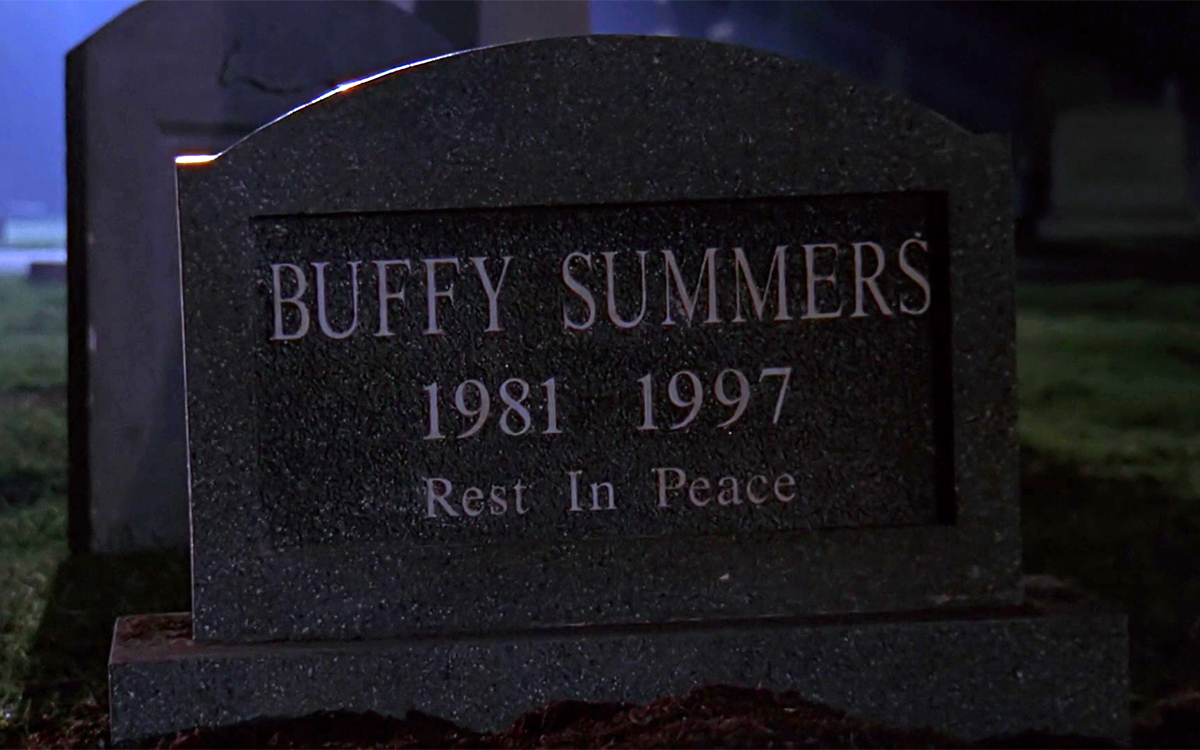
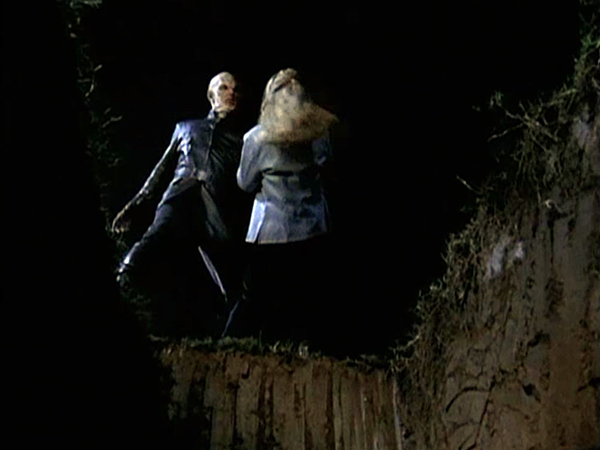
The rest of the nightmares this episode run the gamut of irrational to rational. Some are born of simple anxiety that is not based on anything in real life, such as Xander’s sudden nakedness or Cordelia’s hair magically transforming. Some are born of childhood traumas but are irrational to actually fear, such as Wendell’s spiders or Xander’s clown. And some are based on probable likelihoods, of things that have already or will soon inevitably come to pass. Buffy will be killed by the Master. Billy is in danger from the Ugly Man. Giles will outlive Buffy and stand over her gravestone. Buffy will be buried alive, and have to claw her way out. These aren’t idle worries that exist only in the mind, but logical and terrifying conclusions they can make from their lived reality.
We cannot blame anyone here for fearing what is fairly likely to come to pass. That is something a lot of us are living through right now – with global climate change threatening to kill millions, or fascism on the rise, there are a lot of things to fear that are also fairly probable if you listen to any scientist or historian. Some of us will be used to being told “stop being so negative, it might never happen”, which would be about as useful as telling Buffy, who has a job that near-guarantees her dying young, to not fear dying young. Sometimes fearing the worst is the rational option.
And to be fair, neither can we blame those with more irrational fears for having those fears. No, a clown probably isn’t coming to kill you, but that doesn’t stop anyone from being scared of clowns. Xander’s right, clowns are terrifying, and when you hear that disembodied laughter, it seems just as logical to fear them as anything else. You can’t logic somebody with anxiety out of being anxious. We are not responsible for the contents of our own head, and nobody should ever be blamed for them.
Blame is kind of the key to linking all these different fears together. Wendell blames himself for the death of his pet spiders. Giles blames himself for Buffy’s death, for failing to protect her. And Buffy… well, it wouldn’t be Buffy Summers if she didn’t blame herself for every death, misfortune, and random happenstance that occurs within a 50-mile radius of her. She blames herself for her parent’s divorce, for her father’s absence, for her own flaws, for The Master’s threat to the world. Self-blame is her drink of choice.
“It was my fault. … I missed a ball and I should have caught it.”
Billy, 1×10 Nightmares
“They’re comin’ after me. God, can you blame them after what I did?
Wendell, 1×10 Nightmares
“I’ve failed… in my duty to protect you. I should have been more c… cautious. Taken more time to train you. But you were so gifted. And the evil was so great. I’m sorry…”
Rupert Giles, 1×10 Nightmares
“You still don’t understand, do you? I am free because you fear it. Because you fear it, the world is crumbling.”
The Master, 1×10 Nightmares
“It was you. Having you. Raising you. Seeing you everyday. I mean, do you have any idea what that’s like?”
Hank Summers, 1×10 Nightmares
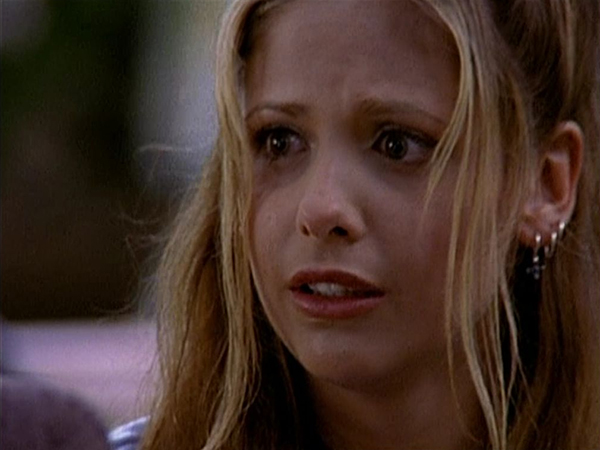
We see early on how Buffy feels about her parents divorce, as she speaks to Willow. She knows logically that she is not actually the reason for them separating, but emotionally she feels she is. She ignores anything specific to Joyce and Hank’s relationship that might perhaps be more applicable to why they broke up, and leaps straight to pointing out her own faults.
“Do you know why your folks split up?”
Willow Rosenberg and Buffy Summers, 1×10 Nightmares
“I didn’t ask. They just stopped getting along. I’m sure I was a really big help, though, with all the slaying and everything. I was in so much trouble. I was a big mess.”
She really does instinctively center herself in every situation, a behaviour that will define a lot of her relationships going forward. It’s a quality most explicitly discussed in Conversations With Dead People, where Holden diagnoses her with having both a superiority complex, and an inferiority complex about it. I tend to agree with this analysis, but I would simplify it, and diagnose her with Main Character Syndrome. As an actual psychological condition, this is bullshit made up by Boomers to have another reason to complain about Millenials[1], but as a literary analysis term I think it makes sense. I do think there is a part of Buffy that believes the world revolves around her, and that shapes her feelings and reactions, but to be honest, I can’t blame her for that. The world does revolve around her, both in a Watsonian sense, being literally the one person in the world standing between it and its total destruction, and in a Doylist sense. It’s hard not to have Main Character Syndrome when you are the main character.
The sad thing is, Buffy does seem to be aware of this, and, of course, blames herself for feeling that way. We see this at two points in this episode: when her father is explaining how awful she is, and at the start, when Cordelia yet again demonstrates her purpose as Buffy’s Shadow.
“Gosh, you don’t even see what’s right in front of your face, do you? Well, big surprise there, all you ever think about is yourself.“
Hank Summers, 1×10 Nightmares
“Hello? Doofus! You’re in my light.”
Cordelia Chase and Xander Harris, 1×10 Nightmares
“Wendell, what is wrong with you? Don’t you know that she is the center of the universe, and the rest of us merely revolve around her?”
“Why don’t you revolve yourselves out of my light?”
One of Buffy’s many fears this episode is that she is like Cordelia – selfish, and self-centred. It is a part of herself that she feels shame about, and tries to repress. She feels guilty for feeling this way, while Cordy of course feels no guilt at all. She understands perfectly that she is a main character in this world, while Buffy frets over it. We come back again to this idea of blame, and whether it is justified. We’ll discuss more on this topic when we reach Out of Mind Out of Sight next week. I think it’s fair to say for now that Buffy should go a little easier on herself, in this regard and many others.
Buffy’s conversation with the nightmare version of her father is so revealing, and a simply brilliant scene. It’s brutal to watch, partly thanks to Sarah Michelle Gellar’s incredibly compelling cry-face. She grounds the scene in an emotional truth. We know that it is objectively absurd for her father to sit there listing off all her faults like he’s a personification of low self-esteem, but Buffy’s reaction makes it feel real, to the point that many fans mis-remember this scene as something that actually happened. Buffy thinks she deserves this, just as Billy thinks he deserves to be blamed for his team’s loss. In both cases, a man comes to punish them.
This is a true nightmare come to life, pure emotional distress. It’s not spiders or clowns or public nudity or realising there’s a test you hadn’t studied for. It’s every horrible little thought and doubt you’ve ever had about yourself, every nasty whisper in your brain, given form and sent to tell you that you’re right to hate yourself. It’s high melodrama smashed together with the brutally mundane – Buffy at its best. I think there’s a good argument to be made that this is the first truly Great scene that the show does.
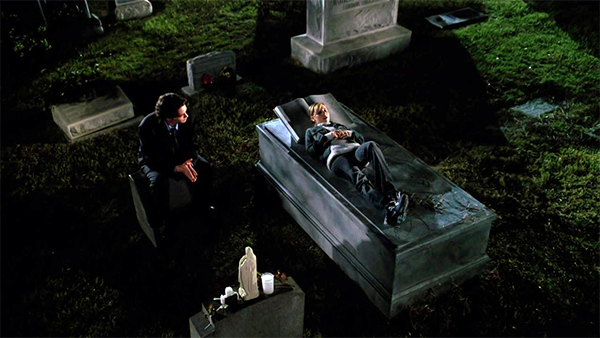
In fact, this comes close to being the first Great episode – only a slightly awkward finish prevents that. It’s an episode that is telling us so much about every character, and doing so with style and flourish. A close second best scene of the episode is Giles at Buffy’s grave, a chilling scene that tells us so much about Giles, his growing relationship with Buffy, and the sickening truth about Watchers and their Slayers – that more often than not, the Watcher’s last job is to bury them. It’s a scene that’s sad on first watch, and devastating after you’ve seen The Gift.
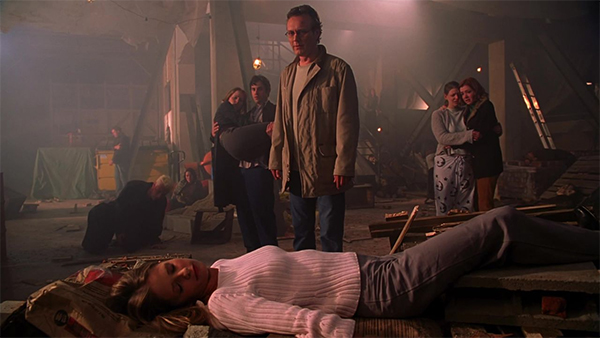
This is an episode that is in conversation with so many other episodes across the series, which marks it out as a really important waypoint in the series’ development. Season One is in many ways a season of the show growing into itself, and as the show grows, it becomes more and more in constant dialogue with itself. I count major similarities and parallels to, at least, Something Blue, The Gift, Bargaining, Witch, Life Serial, Once More With Feeling, and of course the big one, Restless.
Restless is an obvious sequel, with the danger coming from the blend of real life and the dream world, and the resolution coming when a character decides to stop letting their fear control them. Xander foreshadow’s Willow’s dream when he is stripped in front of the entire classroom. Willow’s performance anxiety is set up here too, and her being pressed into starring in the opera is a scene repeated almost wholesale in Restless. This is a significant character trait for Willow. She hates the idea of having everyone pay attention to her, yet feels repeatedly compelled to be the star of the show. Keep that in mind next time you watch Two To Go.
There are aso massive parallels to Once More With Feeling, to the point where I would characterise this episode, Restless, and OMWF, as a trilogy. They are all episodes revolving around the idea of dreams or wishes coming true, and the chaos that develops from that. In all three, we see the characters’ subconscious fears and desires exposed. As Giles says in this episode:
“Dreams? That would be a musical comedy version of this.”
Willow calls back to Nightmares in both Restless and Once More With Feeling, and the latter drives home Willow’s performance anxiety, when she points out her own lack of lines in the episode. Alyson Hannigan’s own dislike of singing serves the character well here.
The most significant parallel comes when Buffy and Billy are running from the Ugly Man in the school, escape through a hedge, and come out the other side in a graveyard. Like many examples in Restless, it’s a sudden shift of location that makes sense only in dreams. And Billy asks Buffy – is this where they’ll find her friends?
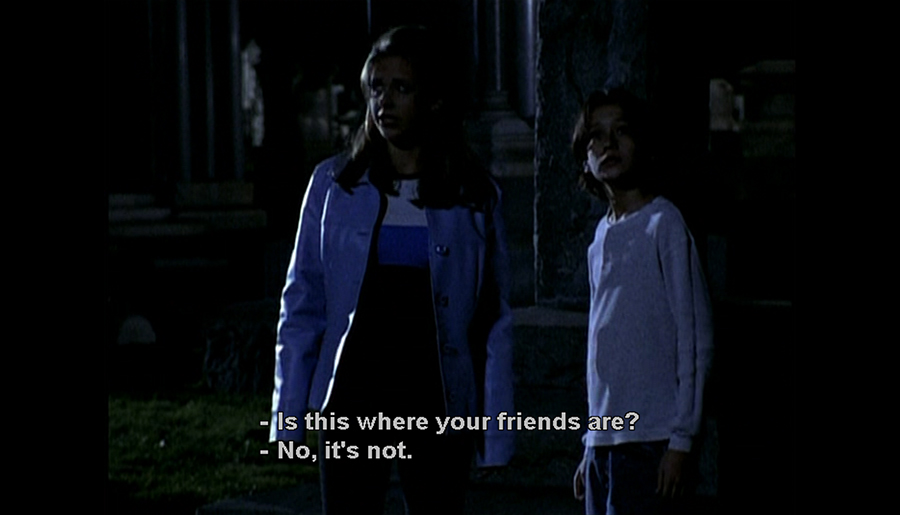
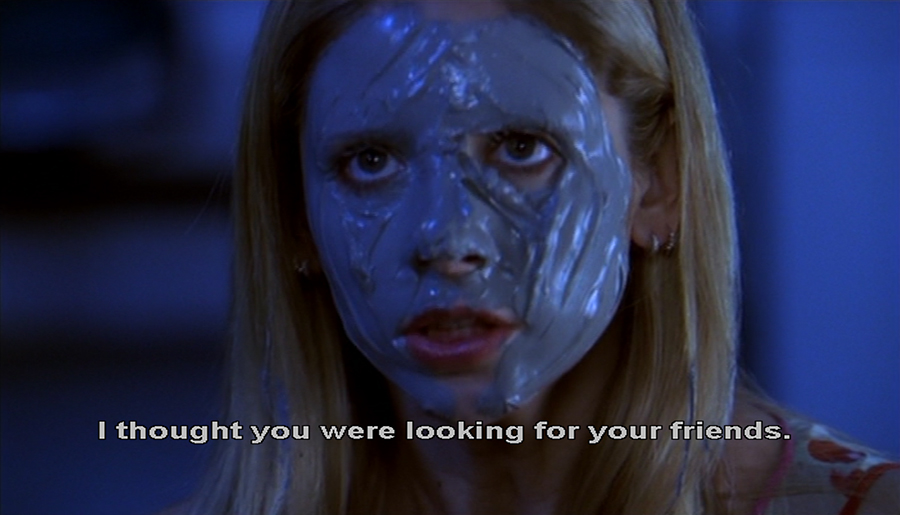
Buffy wants to find her people. To have friendship, to have community. Yet always there is something pulling her towards something more morbid, towards death and darkness. The pull of the grave. The death wish. Be it duty or destiny, biology or curiosity, there is a magnetism there. She is drawn back here and away from her friends. The gravity of graveyard dirt is constant and inescapable. And of course, she blames herself for that too.
As the seasons go on, we start to see Buffy accept her own urges a little more. Sometimes, she doesn’t actually want to find her friends. There is a part of her that wants to explore her own connection to death and the dead. And though she still will feel guilty over it, by the time of Once More With Feeling she’ll at least be ready to admit that desire.
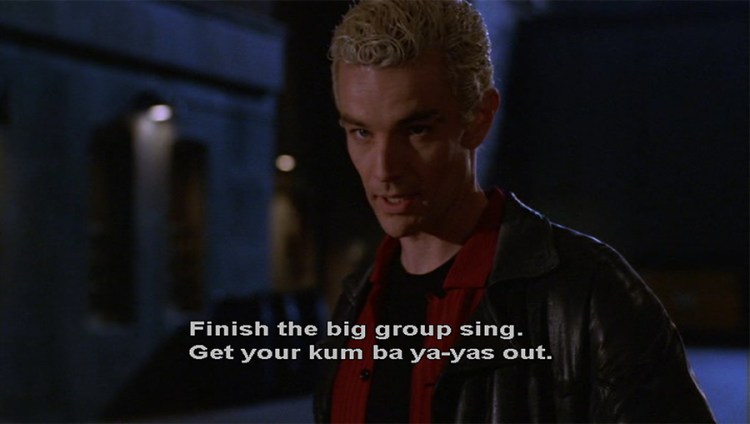
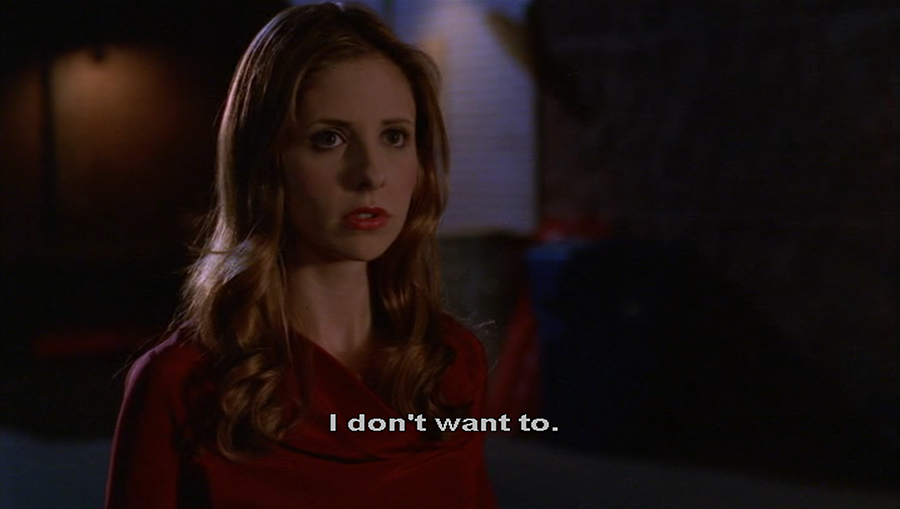
But in Nightmares, she is not there yet. She still fears her urges, and still fears the grave. This is when the Master arrives. He is the spectre of Death, come to reap and bury her. He is the Ugly Man, and her father too, coming to blame and punish her. He explains why this is all her fault, how her fear freed him and caused the world to crumble. He is able to best her and throw her into the grave, metaphorically killing her, because she believes that he is right. She dies because, on some level, she thinks she deserves to.
I think it’s interesting to consider at this point the idea that the scene we see between The Master and The Anointed One, where he talks about controlling his fear, is not actually reality, but another nightmare of Buffy’s. This comes back to the idea of self-blame. If fear and thoughts can be controlled, then that means she can control her own, which means she is to blame if she does not. So when the Master tells us that fear is in the mind, it is the same to her as her Dad coming to tell her that it was her fault that her parents got divorced.
Buffy lets fear and blame rule her, and so she dies. When she rises again, it is as a vampire. She has now become a killer, something that she fears many times in the future. It’s also another example of Buffy’s ongoing struggle to deal with her attraction to Angel after the events of Angel, fearing that her love for him might rob her of her humanity. It’s significant that the episode ends with Xander feeling shame for still being attracted to Buffy after she was a vampire. But most importantly for this season, she is now a creature of eternal youth. She’s stuck at 16 forever. Allowing fear and doubt to control her will render her unable to do the one thing the protagonist of a coming-of-age story needs to do: grow up.
Fear is in the mind. But that does not mean we are in control of it. Fear is not a decision, but a natural consequence of being a human being in the world. When Billy, our proxy for Buffy, unmasks the Ugly Man and saves the day, he is not doing something so simple as “facing his fear”. He is rejecting self-blame. He refuses to take responsibility for something he has no reasonable control over. This is the key lesson that Buffy must learn, as we barrel towards the finale – that she is not responsible for every whim of the universe, but only for her own actions in the face of them. Only when she stops blaming herself, will she become a complete person.
* * *
Thanks for reading! If you enjoyed this piece, please consider supporting me on Ko-Fi!
* * *
References:
[1] https://www.glamourmagazine.co.uk/article/what-is-main-character-syndrome
 Insect Reflection
Wow, this was a great read. You draw really interesting parallels here with future episodes. Great writing!
LikeLike
I have been obsessively reading your essays on this show. You have made me think about this show on a much deeper level than I was ever capable of appreciating before, and inspired me to search out more meaning and symbolism in other media I consume. You have a beautiful mind and I’m so grateful you are sharing your thoughts!
LikeLike