
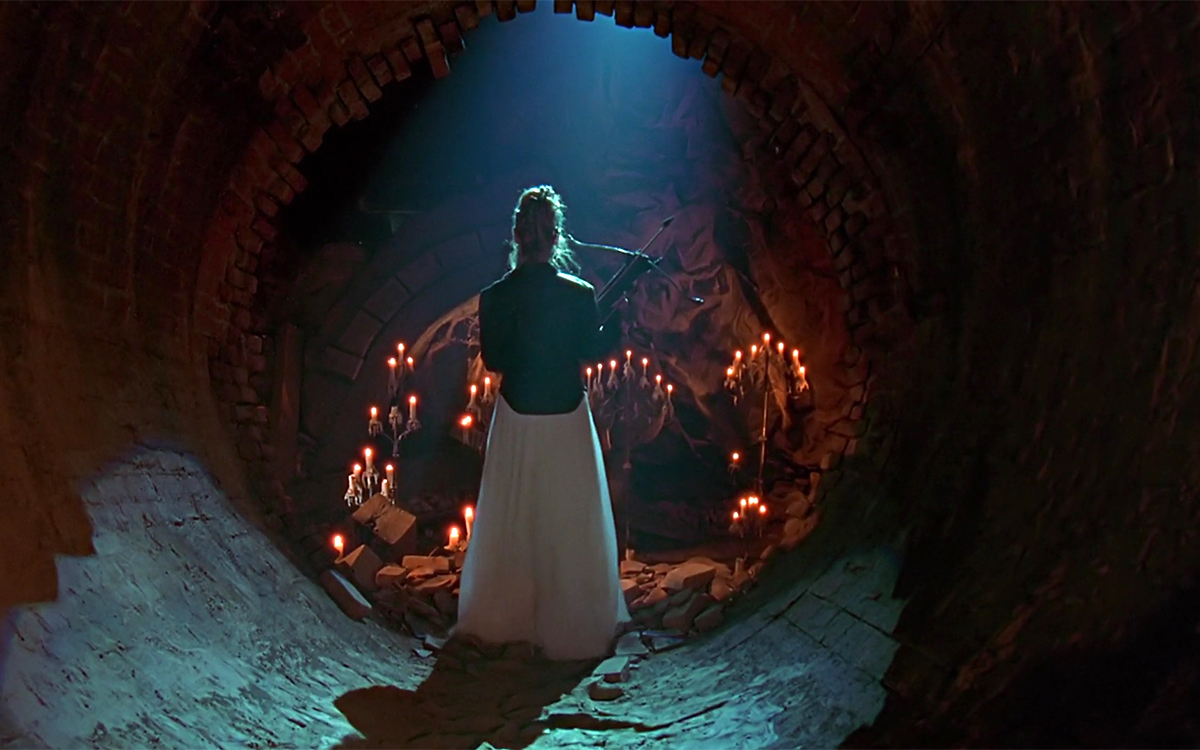
“Allow me to give my lord one last piece of counsel,” the old man had said, “the same counsel I once gave my brother when we parted for the last time. He was three-and-thirty when the Great Council chose him to mount the Iron Throne. A man grown with sons of his own, yet in some ways still a boy. Egg had an innocence to him, a sweetness we all loved. Kill the boy within you, I told him the day I took ship for the Wall. It takes a man to rule. An Aegon, not an Egg. Kill the boy and let the man be born.” The old man felt Jon’s face. “You are half the age that Egg was, and your own burden is a crueler one, I fear. You will have little joy of your command, but I think you have the strength in you to do the things that must be done. Kill the boy, Jon Snow. Winter is almost upon us. Kill the boy and let the man be born.”
― George R.R. Martin, A Dance with Dragons
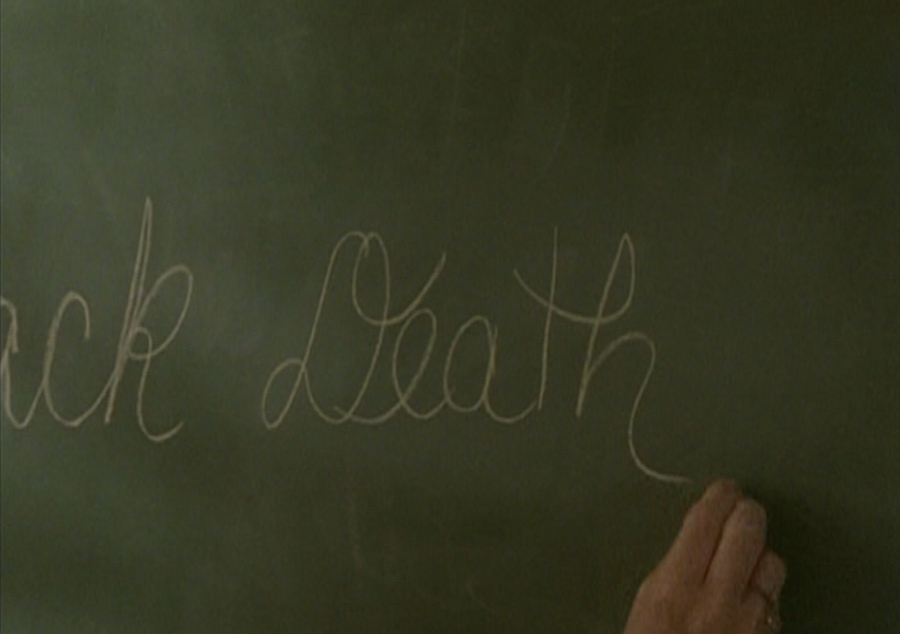
Death has been coming for Buffy all year. It has stalked and preyed on the fringes of her life – in a teacher’s chalk, in Luke bearing down over her in a crypt at the end of Welcome to the Hellmouth, in the prophecies of the Anointed, in The Master hurling her into her grave, in Giles’ sad eulogy, in her dead lover, returning to her now, and bringing with him the omen of her doom. It is now written – in the ink of the Pergamum Codex, and in the clack of Joss Whedon’s typewriter. Tomorrow night, Buffy will face The Master, and she will die.
This is what it’s all been leading to. If the dominant metaphor through this season is Slayerhood as Adulthood, then this is the natural endpoint for that metaphor. Acceptance of adulthood means acceptance of aging. Acceptance of aging means an acceptance of mortality, for that is the finish line for all of us, at the end of our adult lives. Buffy accepts her metaphorical adulthood by accepting her death. If she did not, she would remain a child forever. She must kill the girl, and let the woman be born.
Giles, as the adult, knows this first, before Buffy does. His job is to lead her into metaphorical adulthood, so the path is revealed to him first. His opening scenes are tinged with this tragic irony as he sees Buffy, and is achingly sad because he knows what is coming. She talks in the library early on about “facing her terrible fate”, which catches him off guard. She is, of course, talking about the fact she has biology class. It’s normal, teenage bullshit. Buffy is still a child and so has childish concerns. Only Giles is aware of the true adult danger facing her.
The other character dealing with childish concerns in this episode is Xander. He wants to ask Buffy out, and when she turns him down he behaves immaturely – first begging her to give him a chance, and then throwing barbs about how “a guy has to be undead to make time with you”. It’s an ugly portrayal of a petty, insecure boy. And I kind of love him for it. A lot of fans call this out as an example of Xander being shitty, but I don’t have a problem with that. I have and will point out problematic aspects of Xander that are not adequately called out by the writing, but this is not one of them, because it is called out. Buffy tells him he’s being harsh, and is allowed to not budge a little on her answer. The way he reacts is not pretty, but I think it’s pretty honest to how teenagers can be cruel when they’re upset. The important part is that Xander is criticised for his behaviour, and does get over it, and redeems himself by episode’s end.
Xander’s arc is a photocopy of Buffy’s in this episode; her journey in miniature. To break it down simply:
- Xander wants something (to date Buffy)
- It is denied him (she turns him down)
- He gets upset, bargains, and lashes out
- He sulks, and tries to get Willow to go out with him to avoid dealing with it
- He realises that people are in danger (Buffy)
- He accepts reality (that Buffy doesn’t love him, and does love Angel)
- He does the right thing and descends into the Master’s lair to save Buffy
And Buffy’s:
- She wants something (to live a normal life)
- It is denied her (she’s going to die)
- She gets upset, bargains (“I quit, I resign, I’m fired!”) and lashes out (“You’re so useful sitting here with all your books!” / “What do you know about it? You’re never going to die.”)
- She grieves, and tries to get Joyce to leave town so she can avoid dealing with it
- She realises people are in danger (the world)
- She accepts reality (that she has to face the Master)
- She does the right thing, and descends into the Master’s lair to save the world
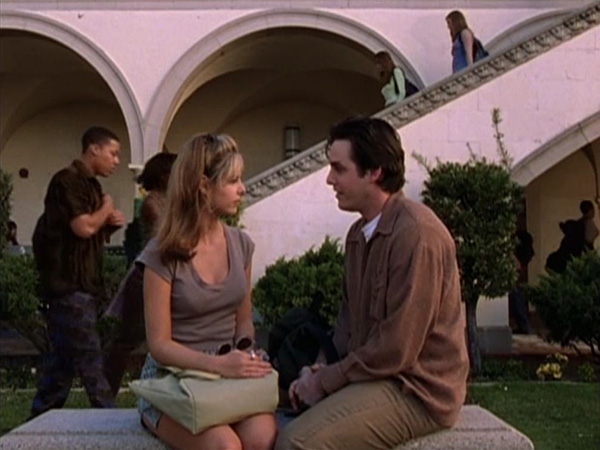
Of course, Buffy’s angst is far more significant, and far more sympathetic. The pain of finding out you’re going to die in one day is light years beyond the pain of your crush not liking you back. Buffy is far more justified in lashing out, I don’t think anybody would contest that. The point is, Xander’s arc is meant as a tiny model of Buffy’s, and it’s vital he goes through all the stages of grief in order to get there.
The scene where Buffy finds out that she’s going to die is stupendously good. If the scene between Hank and Buffy in Nightmares threatened to be the first great Buffy scene, then this is a titan. It’s delicate and brutal, filled with perfectly off-beat little choices. Buffy’s quiet laughter at hearing the news. The way she goes straight to asking logistical questions about the next slayer (“Will you train her, or will they send someone else?”). It’s like she’s reached Acceptance before touching any of the other steps, like the news hits her on a delay. The hurling of the books. The way Sarah Michelle Gellar breaks as she delivers the iconic line.
“Giles, I’m sixteen years old. I don’t wanna die.”
This scene is constantly listed as one of the best of the entire show, and that reputation is entirely justified. As Passion of the Nerd on YouTube puts it: “This point represents a shift in the series, from being a clever show about monsters and high school to being a show about characters with hearts and souls, and the consequences these horrifying situations have on their lives.” We are reaching the watershed, when Buffy becomes Buffy. I’d argue this turning point comes a little bit later, but undoubtedly this scene demonstrates the raw power the series can harness from its character’s emotions alone.
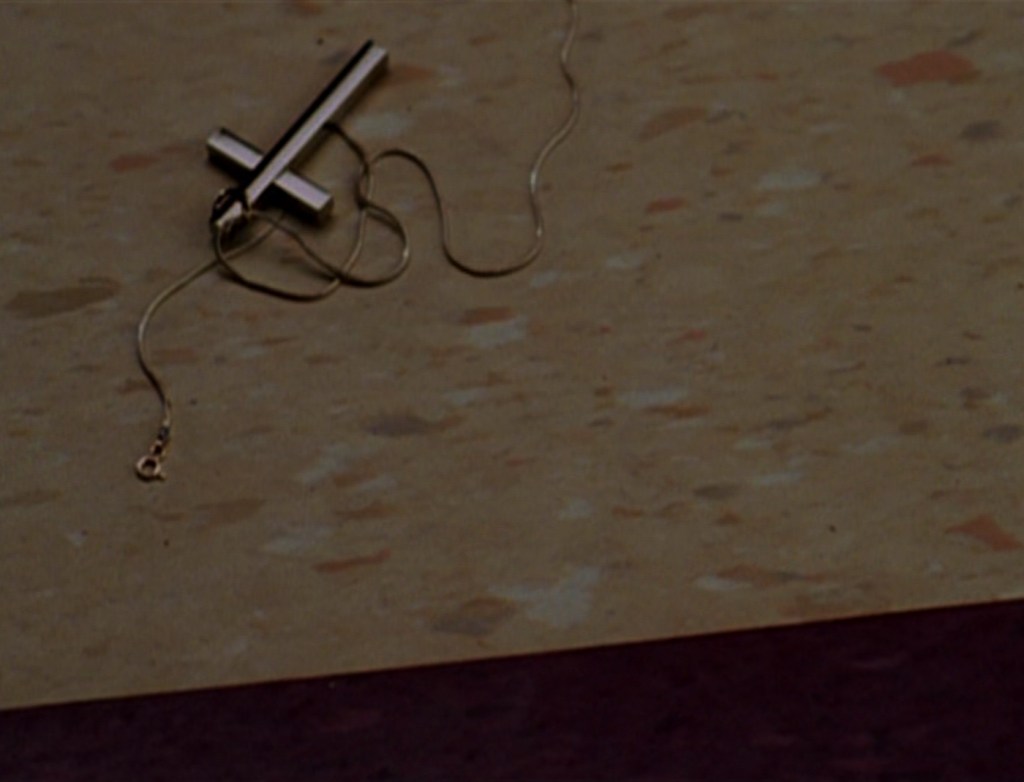
It’s in this scene that Buffy quits, and in effect, tries to quit the show. She relinquishes her Slayer duties and casts the cross necklace, her talismanic weapon against the darkness (the Supernatural Aid granted to her, as Campbell would put it) onto the floor. She rejects her destiny, rejects the call, rejects the narrative. When she throws Giles’ books, she’s throwing her story as it has been written away, raging against the almighty author. She no longer wants to be the lead of Buffy the Vampire Slayer.
In her excellent ‘TARDIS Eruditorum’ series (a series of essays covering every episode of Doctor Who, which this series is shamelessly ripped from), Elizabeth Sandifer talks about the concept of ‘narrative collapse’. Put simply, this is a threat against the concept of the show itself. If this event occurs, then no more stories can be told, because the premise of the show has been destroyed. This is what is happening here. Buffy is threatening to quit being the Slayer, and so destroys the concept of Buffy the Vampire Slayer. This fledgling show is at risk of being assassinated by its own protagonist.
Buffy is not only avoiding the story she is stuck in. She’s avoiding her metaphorical adulthood, of course, but she’s also avoiding a part of herself. She is the Slayer, and cannot avoid it. We’ve talked before about how the Slayer and the Girl are two intrinsic parts of who Buffy is, and she can’t really exist without both. When she rips off that necklace, she is reaching into herself and ripping out a part of her soul.
It is in this moment that all the Scoobies fall apart. Giles, heartbroken having to lead his charge to the slaughter. Xander and Willow, depressed and alone. Buffy, broken and lost in her bedroom. Buffy’s Heart, Mind and Soul are shattered, unable to continue with her in this state. It takes Joyce to remind Buffy of the show’s themes.
“Says who? Is it written somewhere? You should do what you want.”
– Joyce Summers, 1×12 Prophecy Girl
This is the crux of it. Buffy can, in fact, choose to not follow the prophecy. Though Giles says it’s not as simple as quitting, when it comes down to it – it is kind of is. She claims she doesn’t care about the consequences of the Master rising, and that’s the key point. If she really doesn’t care about what happens, then she can just walk away. To quote one of the most thematically important lines in the series – she doesn’t have a good choice, but she has a choice. She can walk away and live. She just has to accept the consequences of that choice.

It is of course Willow that comes with news of the consequences. Remember that it was the danger Willow specifically was in that prompted Buffy to action the last time she tried to refuse the call, back in Welcome to the Hellmouth. She is emotionally destroyed by seeing the bodies of her murdered classmates. Of Cordelia’s boyfriend, who we see she actually liked. This is the reality of the world they live in now, the consequence of Buffy’s choice. Blood and corpses, as far as the eye can see. Buffy wants to live in the world, but that means accepting it in this form. It will no longer be the world she wants it to be, but instead a world that belongs to the vampires. A world filled with eternal youth, of course, since Buffy has rejected her metaphorical adulthood. But also a world filled with death. Death is a universal constant and cannot be avoided. Buffy just gets to choose where that death is directed. She doesn’t have a good choice but she has a choice.
“It wasn’t our world anymore. They took it and made it their own. And they had fun.”
– Willow Rosenberg, 1×12 Prophecy Girl
She’s not the only one making a choice here. Giles makes one of his own, deciding to go down to face the Master himself. He is distraught here, torn between two patriarchal urges. His position as Buffy’s watcher is inherently paternal, in the most negative sense – he is meant to guide and control this young woman, to do the bidding of the Watcher’s Council (aka. Patriarchy incarnate). His job is to lead her as a lamb to slaughter, and we saw his pain over this with his nightmare in Nightmares. But this same job has demanded constant interaction with her, which itself has led to affection, to friendship, to a different kind of paternal relationship. He cares about her, and wants to protect her. This is the continuing tension within Giles throughout the first three seasons; these two patriarchal urges demanding entirely contradictory things of each other. He must teach and guide her as a father would, but lead her to her death as a father never would.
Of course, here he chooses the nobler kind of paternalism, the one based in love. He tries to take her place and do her job for her, certainly putting his own life at risk. But at the end of the day, that is still paternalism. It’s not what Buffy needs. She cannot expect her father to go and sort out all her problems like a child might; she has to face it herself. So she knocks him out, and leaves to face her destiny, with a line that will get a subtle and tragic call-back in The Gift.
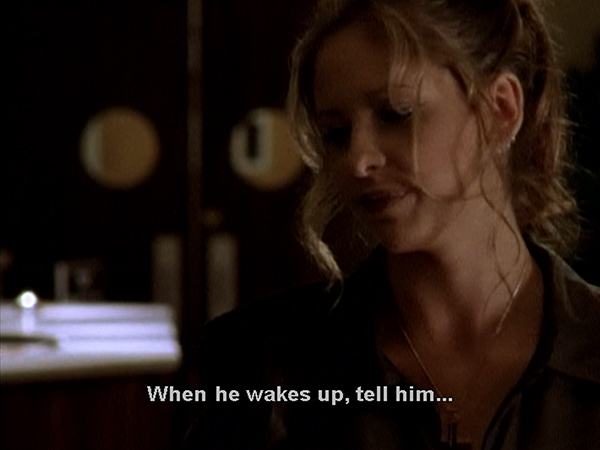

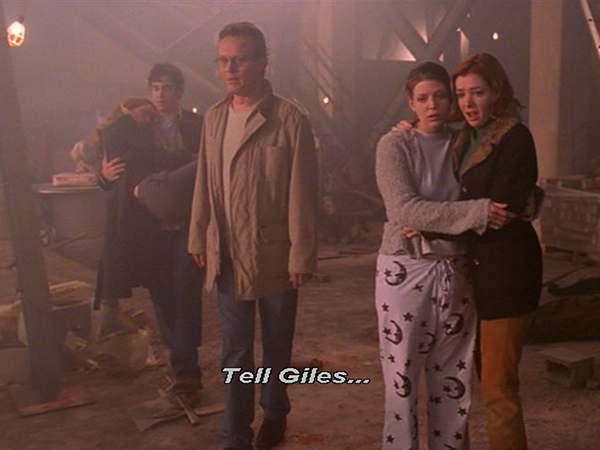
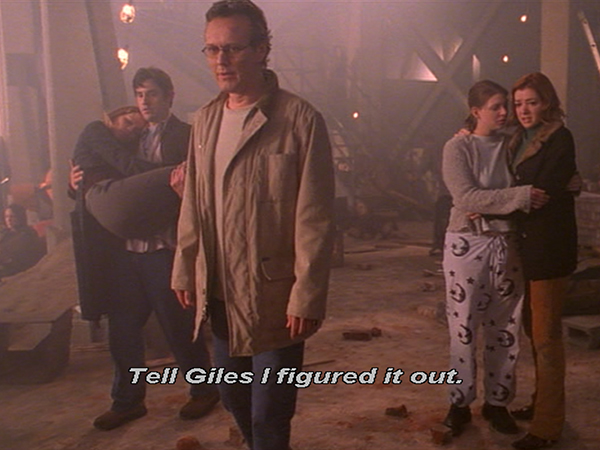
As soon as she leaves the school, she sees the Anointed One. A child coming to lead her into adulthood. She follows him beneath the ground, and into the grave. She has accepted her death, and her role as the Slayer. And so… she dies. The Master kills her and leaves. That’s it. That’s where doing your duty as a Slayer leads. Face-down in a pool of water and the world about to end.
This is where I think Slayerhood as purely a metaphor for adulthood breaks down. At this point, Buffy has done all the correct things. She’s accepted her destiny, followed the written prophecies, accepted the Call to Adventure, left Neverland, and decided to metaphorically grow up. And yet, she won’t. A corpse can’t grow up. She has died young and will stay pretty, so to speak. She’s followed the path of the Slayer, and so dies like one – alone, and ready to be forgotten as the next is called. Her death even evokes Kendra’s, the Slayer who was all about duty, as she falls victim to The Master’s hypnosis skills, unable to fight back. It’s evident here that a pure adherence to duty and Slayer responsibility would have left Buffy dead and alone, and the world no more safe for it.
What saves Buffy is her rebellion. The friends she was told she couldn’t have, as ‘the Slayer acts alone’. The man she was told she couldn’t love, because he was a vampire. She defied these edicts. She made friends, she fell in love, she forged forbidden bonds. And those bonds save her. They are the necessary ingredient in her resurrection.
As we’ve already said, Xander in this episode is Buffy on a delay. Just like Buffy, he is told about the impending apocalypse and says “I don’t care”. Like Buffy, he makes a choice. He’s told by Angel that the Master will kill him, but he carries on anyway, insisting on going down to the Master’s lair, and even dragging the far more powerful Angel along with him. You could say that he was inspired by Buffy – we do know from The Freshman that he often asks himself “what would Buffy do?”. It is because of her influence on her friends and lover that they make the choice to come and help her.
And so, she lives. Xander breathes life back into her, and she is reborn. It’s an obvious joke to point out how David Boreanaz loudly pants as he tells Xander he “has no breath”, but there’s a reason it had to be Xander. He stands in for all the Scoobies as a symbol of friendship, humanity, community, of Heart. He represents The Girl: that rebellious part of Buffy that insists on a normal life. She could not be complete as a person if she rejected her Slayer half, but neither can she live without her Girl half. Both are required for Buffy to exist. Both are required for Buffy to exist.
When a vampire dies, they are buried, and a new creature rises from the earth. It’s the same with slayers. One dies, and somewhere another one rises, carrying the burden of the last. The creature that comes up is not the same one that went down. The grave is not a final resting place, but a place of transformation. This is worth remembering when any character descends beneath the earth. Generally speaking, when this happens, there will be some kind of change for the character. And it’s true here, as Buffy tells us.

Having accepted her role as the Slayer, and imbued with the power of the Girl, she rises again, harder and stronger. She has shed her childish desires and accepted responsibility, but she has not shed her humanity. That is what allows her to live. That’s what makes her a complete person. Becoming an adult does not mean putting aside all things we love and make us happy, and pursuing only some drudging duty. Yes, responsibility is important, but so is friendship and romance and other fruits of life.
I quoted a section from A Dance With Dragons at the top of this essay primarily because I love the quote, and I think it’s fun to apply here. Her childish self must die in order for her to rise again as a stronger version of herself. Buffy must kill the girl, and let the woman be born. But I also mention it because if you have read the book, you might realise that Jon Snow takes the wrong lessons from this advice. He takes “kill the boy” to mean that he must cut himself off from all his friends and family, which results in him losing all his allies and becoming vulnerable to a little bit of stabbing.
Buffy does not make this same mistake. She accepts adult responsibilities, but she does not cut herself off from those around her. She does not kill The Girl, and that allows her to live, for the adult version of herself to exist at all. She brings into balance both parts of herself.
So, she ascends. All parts of her being come together to form something new as she rises to the surface. She is reborn with new powers – now easily resisting the Master’s attempted thrall. She has become The Vampire Slayer, and she remains Buffy. The theme tune invading the episode for the first and only time in the series tells us this fact. Buffy, the Vampire Slayer, has arrived. Buffy the Vampire Slayer has arrived. The character becomes the show itself as she becomes a true, full version of herself. This is the moment the show we love truly enters the picture.
And what a picture it is. Buffy is at full punning strength, delivering vicious verbal blows alongside the physical. She reminds us how she has defied destiny through her choices. So what if her death was set in stone, and decided by dusty old writers? She flunked the written. She doesn’t “die young and stay pretty” in the tragic sense that phrase usually implies. She did die young, but she is still pretty, still full of life and power. The Master, once the figure of Death, now means nothing to her – he’s just an ugly monster who she sends to hell with ease.
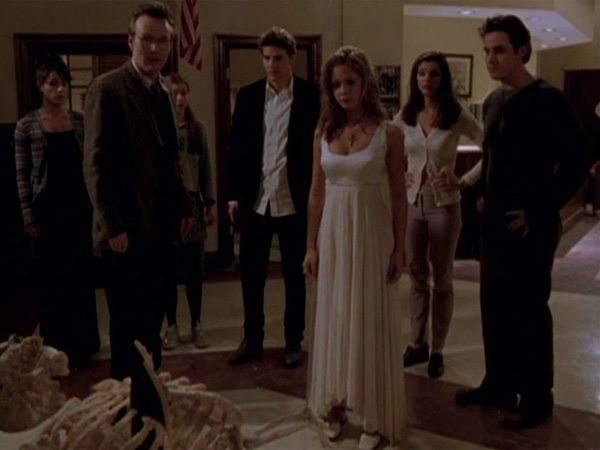
As we close out the season, we end with all our characters together in the library. The core Scoobies, Angel, Jenny, Cordelia – and Buffy, united within herself and more powerful than ever. The building blocks that have been gradually put in place are now showing their worth, as a vital part of the series, folded into the central narrative. Prophecy Girl is the first truly great episode of the show, but it’s not dragging up the rest of season one. It’s held up by it, by the foundations put into place, and even by the missteps it has made along the way. Even in its larval stage, the show was always building towards something, and this is it.
There are miles still to go. Buffy and Buffy have both entered their adulthood. They have become more complete in themselves. But adulthood is not a final stage that we attain, to remain static for ever more. We continue to grow and regress and change in every moment of our lives. We are never done baking. And neither is the show. Buffy has so many more places to go, more emotional depth to plumb, more heartstrings to tug. It has learned so many lessons from this first season and will carry on learning them. As we enter into the show’s maturity, we must remember this: this is only the beginning.
* * *
Thanks for reading! If you enjoyed this piece, please consider supporting me on Ko-Fi!
* * *
 Insect Reflection
One thought on “I’m Buffy, The Vampire Slayer, And You Are? (Prophecy Girl)”