

In terms of genre, Buffy the Vampire Slayer has always played in many sandpits. It’s a superhero show, and it’s a horror, and it’s a teen drama. It’s a fantasy show with knights and witches and demigods, and a sci-fi show with cyborgs and brain chips. It’s a comedy, and it’s a tragedy. It’s a realistic, down-to-earth show, that’s completely off the wall and swarming with magic robots. A significant part of the show’s appeal comes from its ability to turn on a dime: one second you’re cackling with laughter, and the next your heart is ripped from your chest. This is the show that ended the fun robot-girlfriend episode with the protagonist’s dead mother on the couch.
In addition to this constant genre soup, I also believe that each season of the show is also infused with its own distinct genre. One is the Hammer Horror season, Five is the High Fantasy season, Seven is the War Movie season, etc. Season Two is all about the gothic. It’s filled with crumbling mansions and grand old churches. Mad, sickly women in Victorian dress. Byronic heroes with dark, shameful secrets. Lighting that emphasises shadows and duality. Ancient curses awakening, hideous gargoyles, and the dangers of sexuality. Passionate and overwrought declarations of love. Equally passionate speeches on death and “the ecstasy of grief”.
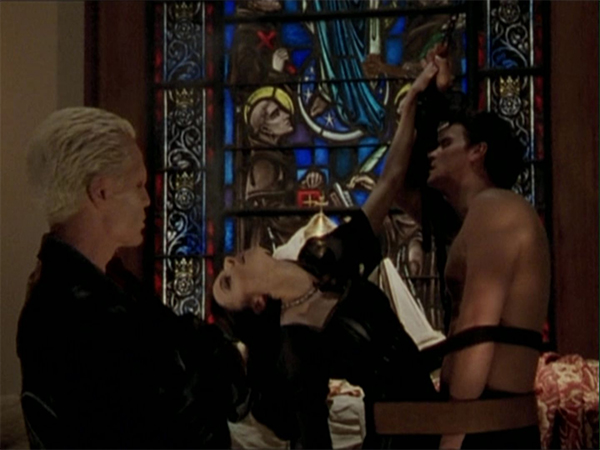
I have to give credit to impalementation’s post on these motifs – it’s excellent and you should give it a read. I’m going to be talking a lot about Gothic styles and themes as we progress through season two, and everything I say will probably be inspired by and better explained in that essay. The main point to keep in mind is how season two uses the tropes and aesthetics of the Gothic in order to lend power to the great, melodramatic, romantic tragedy at the centre of the story.
The genre we now recognise as gothic was born in the 18th and 19th centuries, with a wave of gothic literature, many of which are remembered as iconic classics today. Dracula is one of the most important ones when considering this show for obvious reasons – any vampire show will have an innate assumption of Gothic-ness because of Dracula’s influence. There’s also Wuthering Heights, Jane Eyre, Jekyll & Hyde (which we talked about back in Angel), and the most important novel for considering this episode in particular: Mary Shelley’s 1818 masterpiece, Frankenstein.
It’s no surprise that such an early episode takes such strong inspiration from this story. Frankenstein is not just one of the most iconic works of gothic literature, but shares a lot of the same themes and interests of Buffy – family, alienation, isolation, queerness, the nature of monstrosity, the horror of being reborn. It also, of course, gave birth to one of the most iconic halloween monsters. We’ve already had vampires, demons and witches, and later this season we’ll have mummies, werewolves and ghosts. If a classic monster exists, then it is more than likely Buffy will use them at some point. This won’t be the last time they visit the Frankenstein well either, as we’ll see in season four with the entry of Adam.

This episode is not a remake of the original Frankenstein however, but rather an homage to the 1935 film Bride of Frankenstein. This is a sequel to 1931’s Frankenstein (itself an adaptation of a play), taking inspiration from a minor subplot in the novel. It’s a copy of a copy of a sequel of an adaptation – not the original creature, but created from chopped-up parts of older beasts, to give life to something new. There might be a metaphor there, I’m not sure.
Just like in Bride of Frankenstein, in this episode we see two genius but slightly unhinged and creepy scientists attempt to construct a mate for an undead creature that one of them previously created. Eric performs the Dr Pretorius role, as the more sinister, seductive figure – the devil on Chris/Henry’s shoulder, encouraging him to create this second creature. The scene where Cordelia sees Daryl’s face and screams is a direct reference to the climactic scene in the film, where the titular Bride screams in horror when she sees the Monster. Knowing this scene adds an extra layer of humour to Cordelia’s insistence that she “won’t scream”. This rejection inspires the Monster to destroy the building and kill them both – which itself is repeated when Daryl chooses to stay in the burning warehouse, clutching the headless corpse of his hypothetical wife.
The choice to draw from Bride is an understandable one. This is a season structured around a doomed romance, and is fascinated with the potential dangers that Bangel poses to Buffy. The concern here is that the relationship may consume her, may transform or corrupt her. That her love for a vampire may consume her humanity and result in her becoming a vampire herself.
The infamous line in Reptile Boy – “When you kiss me I want to die” – is probably the most on-the-nose exploration of this idea, but there’s also the fact that Drusilla exists as an alternate-universe version of Buffy, corrupted and destroyed by Angel’s obsession. There’s Bad Eggs, where that episode’s sexual metaphor takes control of Buffy’s friends and turns them into mindless monsters. Later in season three, we see that this is Angel’s greatest fear – as he watches her burn up in the sunlight.
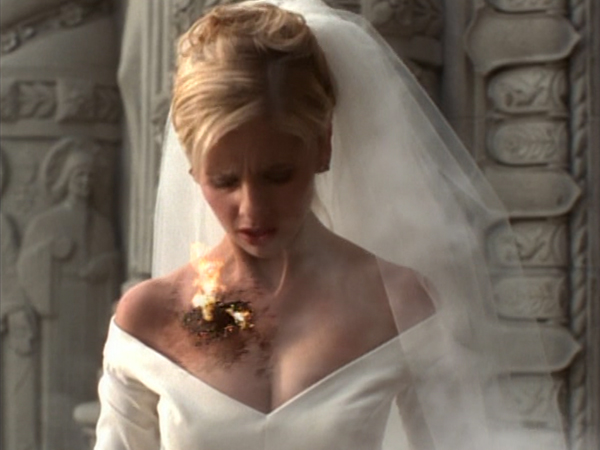
Cordelia and Daryl in this episode present a dark potential future for Buffy and Angel. Unable to live a normal life together because of his undead nature, Daryl intends to turn Cordelia, to make her like him, so that they can be monstrous together. His need for love and companionship drives him to do unthinkable things – as Buffy puts it in this episode, it makes him do the wacky (Buffy says this in reference to Chris, after Willow says the same thing in reference to Angel). Unlike Buffy in What’s My Line, Cordy is unable to look upon Daryl’s true face with anything but horror.
“Did you think she would understand? That she would look at your face… your true face… and give you a kiss?
Darla, 1×07 Angel
“Please? Just take off the blindfold! I promise I won’t scream! I promise!”
Cordelia Chase, 2×02 Some Assembly Required
In a heart-breaking parody of typical romantic courtships, he approaches and shyly but hopefully asks:
Transcript: The Bride of Frankenstein (1935)[1]
“Friend? Friend?”
The ugly creature’s clumsy and ludicrous overtures are rejected and repelled by the unreceptive Bride – she recoils and emits a piercing, ear-shattering shriek, one of the most famous screams in screen history, when he reaches out to touch her arm.
“You shouldn’t have to touch me when I’m like this.”
Angel and Buffy Summers, 2×09 What’s My Line
“Oh… I didn’t even notice.”
We could therefore see Buffy and Angel as a successful version of Frankenstein’s Monster and his Bride, one where the Bride can look past the Monster’s hideous visage, and instead of screaming, gives him a kiss.
This Frankenstein parallel is made most explicit in Xander’s speech:
Buffy: Love has nothing to do with this.
Xander: Maybe not, but I’ll tell you this: people don’t fall in love with what’s right in front of them. People want the dream. What they can’t have. The more unattainable, the more attractive. Willow: And for Eric the unattainable would include everyone. That’s alive.
Xander is hypothesising about Chris and Eric here, but really he’s talking about… well, everyone in this scene. He’s talking about himself, desiring the unattainable in Buffy – as Willow will put it in a later episode, looking around at everything he hasn’t got, so he doesn’t see what’s right in front of him. This particular quality of Xander raises its head at the end of the episode, where Xander is so busy complaining about how everybody gets paired off instead of him that he blows off Cordelia (the character who he actually will be paired off with) attempting to genuinely thank him.
He’s also talking about Willow – who at this point is still harbouring her own impossible crush, for Xander himself. And he’s talking about Buffy – who doesn’t want the person right in front of her (Xander), but instead has fallen for the most impossible option – the 241 year old vampire. Buffy is not only Cordelia, in danger of being consumed and transformed by her monstrous relationship, but she is also Daryl – a lonely creature longing for connection, and finding it by falling in love with a reanimated corpse. As we’ll see with her future dating patterns, Buffy is indeed drawn to the unattainable dead.

The tragedy of Buffy and Angel is ever on the horizon this season, looming in every plotline, moving us closer to the climax of Becoming. This episode continues in that manner with a handy little discussion on utilitarianism.
“I tried to tell him. If you take a life in order to make a life, the whole thing is a wash. No harm, no foul.”
Eric, 2×02 Some Assembly Required
The basic ideas of utilitarianism are pretty simple: the value of any action should be based on the consequences of that action only, on the relative negative impact .vs. the positive impact. If a utilitarian as to encounter the Trolley Problem, it’s likely they would pull the lever, concluding that it is simply better for 1 person to die than for 10 people. I am not a philosopher, just someone who’s watched a lot of PhilosopyTube, so it’s likely I’m wildly oversimplifying a very complex field of study – but to be honest, the same goes for the writers. I think we can approach their work with a similarly amateur understanding, because that is the level that the text expects of us (and quite right too; any work that expected a graduate-level understanding of any subject would be obscenely inscrutable).
The writers are clearly obsessed with the idea of the Trolley Problem, the idea of weighing one life against others. It forms the climax of Becoming, and they return to it again in Graduation Day and The Gift. The whole of season five is kind of one big Trolley Problem. It’s a key concern for Buffy as she comes to understand her role as a slayer and the choices she has to make.
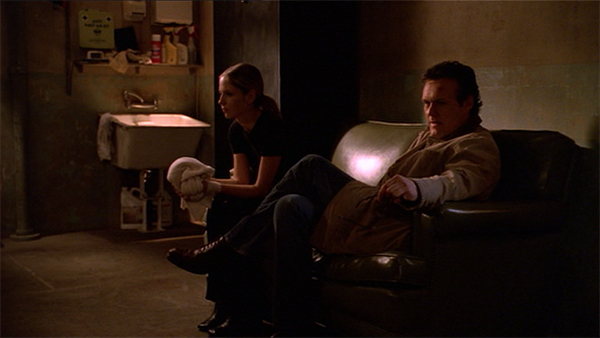
Eric’s supposition here that one life can be traded for another is presented as an obvious sign of his twistedness. Even leaving aside that his “life” he would make would be a mere simulacrum, it’s also a chillingly impersonal take on it. This guy would be willing to cut off Cordelia’s head, sew it onto a corpse, and call it a wash. It’s also not a theory really based in reality. Buffy could save a girl from being bitten by a vampire, and then turn around and snap that girl’s neck – by his logic, that would be an entirely neutral act. To any viewer it would be pretty clearly villainous.
Yet, in a way this is also the same basic calculation that Buffy makes at the end of the season. She is forced to judge the value of Angel’s life against the value of many others, and she decides to take his. There’s a kernel of truth somewhere inside this villainy, which the show will explore more.
Eric’s line foreshadows the long line of Shadow Selves that will try to convince Buffy that she has some special dispensation to judge the relative value of lives. That the simple number of how many people Buffy saves can outweigh any that she kills, so she has carte blanche as long as she remains in the positive integers. Cordelia in Ted, Faith in Consequences, Spike in Dead Things – we can see that Buffy is constantly struggling with the power she has, and what choices she can make with it.
“You can’t just give and take lives like that. It’s not your job.”
Buffy Summers, 2×02 Some Assembly Required
Here in this episode, she firmly asserts that Chris does not have the right to judge lives in this way. This is a very interesting moment to consider in the retrospective wake of Becoming, of course. We should also put a pin in this and remember it when we reach a very important quote in What’s My Line.
Going back to Frankenstein, this line evokes the themes of the original novel: Viktor Frankenstein’s hubris as he tries to play God. He perverts the natural course of things by taking charge over life and death; a role theoretically reserved for God alone. It’s heretical; it’s not his job. When Buffy reprimands Chris for the same thing, we should remember that Buffy herself does have power over life and death. She will be required to take charge of it in Becoming, in The Gift, in Selfless, etc, etc. It is quite literally her job. Just as God has supposed rights that Dr. Frankenstein does not, Buffy has rights and duties that Chris does not. She is to him as God is to Frankenstein.
“Life and death appeared to me ideal bounds, which I should first break through, and pour a torrent of light into our dark world. A new species would bless me as its creator and source; many happy and excellent natures would owe their being to me.”
Viktor Frankenstein, Frankenstein (Mary Shelley, 1818)
“At some point, someone has to draw the line, and that is always going to be me. You get down on me for cutting myself off, but in the end the slayer is always cut off. There’s no mystical guidebook. No all-knowing council. Human rules don’t apply. There’s only me. I am the law.”
Buffy Summers, 7×05 Selfless
The Buffyverse does not have any God in the sense of most major religions. There are creatures of immense power that are called Gods. Season six suggests the existence of some kind of heavenly dimension. But unlike something like Supernatural, there is no canonical God. There is however one powerful figure, who wields religious iconography against evil, an Idol with power over life and death, who as we see from Xander’s speech in The Freshman, inspires moral goodness in her disciples. “What Would Buffy Do” is a common refrain from Buffy fans for a reason. Buffy is God, or at least the closest thing to it in this universe. The series is in large part about the loneliness of that existence.
With all this juicy set-up and thematic resonance, you would think that this would be a great episode. Unfortunately, it is Some Assembly Required. Its central plot has little emotional throughline for the main characters. Daryl and Chris may reflect Buffy in interesting ways in retrospect, but there is no emotional connection for Buffy herself. The emotional heavy lifting falls to Chris and Daryl, and the family tragedy that has occurred to them. The episode ends on Daryl’s tombstone, inviting us to feel sadness for his story. But it is an absurd ask to make us really connect with these characters in such a short space of time. The scene with Chris and his mother is fairly well done, but there is too little time to construct a story that has any emotional resonance.
This is one of those episodes that fans might commonly advise new viewers to skip, and I can’t entirely blame that instinct. It comes right before the game-changing School Hard, and the emotional throughline being placed onto these one-episode characters lends it a sense of disposability. And yet, the genre, motifs, and thematic discussions involved are central to the entire show. Buffy is weird like that. This is a monster-of-the-week filler that you can argue proves the protagonist is God. As far as Bride of Frankenstein pastiches go, that’s not bad work.
* * *
Thanks for reading! If you enjoyed this piece, please consider supporting me on Ko-Fi!
* * *
References:
[1] Tim Dirks, Filmsite Movie Review, https://www.filmsite.org/bride3.html
 Insect Reflection