
The final scene of Lie To Me left us with a promise of increasing complexity for the show – and increasing adult awareness for Buffy – as we head into the second third of season two. This promise is brought into reality through a process of deconstructing the mentor figure – and parental figure for Buffy – in Giles.
Giles received a steady character arc in the first season, growing to understand that Buffy was right in her insistence to live her own, self-determined life outside of the one designed for her as the Slayer. He came to realise his own shortcomings as a Mentor. However, he has still remained firmly in the Mentor role – advising Buffy, scolding her when necessary, and imparting the Lesson of the Week (most notably in Reptile Boy). If Giles’ arc is one of a gradual deconstruction of the Mentor (as I believe it is), then we are at this point still barely scratching the surface.
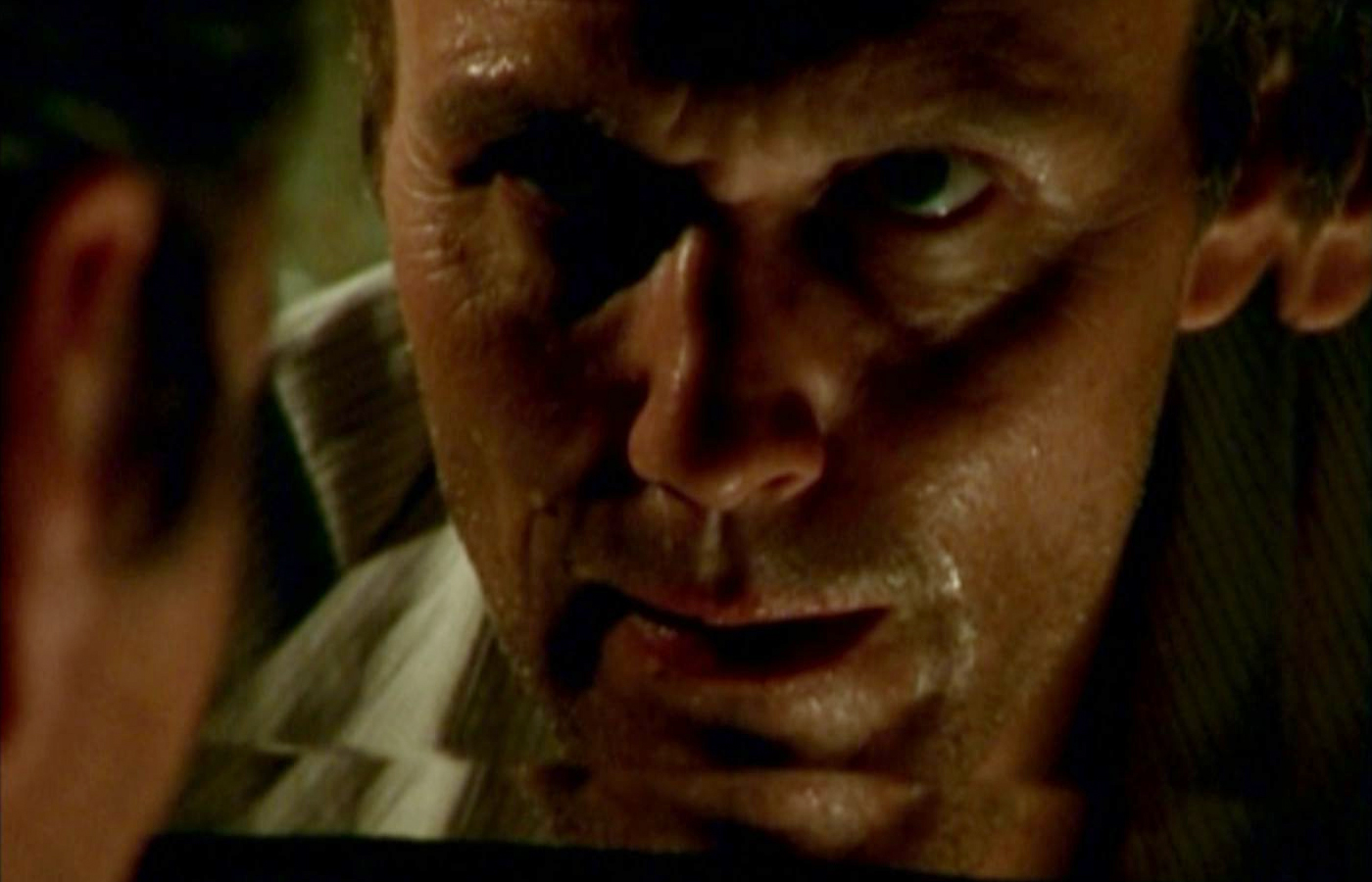
This episode gives us a vital step in this journey, by fully revealing the dark aspect of Giles’ personality that was hinted to us in Halloween. This is a season heavily invested in the idea of duality, of the hidden dark sides to people – (of course, you could say that about half the seasons in the show, but still) – and Ripper is the most significant character to explore that idea after Angelus himself. We caught a glimpse of him a couple of episodes ago, and we get another sighting here. Alone in his apartment, Giles looks into the camera not dissimilarly to how we ended Halloween, and delivers a dramatic line that is ostensibly about the returning demon, Eyghon. We should notice though, that he is looking in a mirror when he says this – looking right at himself.
“So. You’re back.”
Rupert Giles, 2×08 The Dark Age, definitely talking about Eyghon and not Ripper
We start the episode with the younger characters in comfortable ignorance of Giles’ full humanity. Buffy quips about how his diapers were tweed, Xander claims he wished there were more than twelve grades. Later, they are shocked to consider the idea of Giles being late for an appointment and indulging in a little day-drinking. This is the classic trap of childhood, this view of authority figures as more forces of nature than actual people. One marker of adulthood is the moment that a child realises that a parent is, in fact, a person, full of flaws and mistakes and bad choices. That is the marker that Buffy reaches in this episode.
“It was scary. I’m so used to you being a grownup, and then I find out that you’re a person.”
Buffy Summers, 2×08 The Dark Age
Significantly, this increased humanity is tied to an increased parallel between Giles and Buffy herself. We learn that he was once just like her – a kid with a destiny pushed onto him too young, struggling with the responsibility and constant workload he was forced to maintain. So he did what Buffy did in Prophecy Girl – rejected the Call, and ran away to live a less demanding life. And just like in Prophecy Girl, that choice led to the arrival of demons, and the death of innocents.
The parallels to Buffy call forward too. Not only is Ripper an early warning sign for Angelus, but so is Eyghon. He is the demon that Giles “creates” in a night of intended passion, and blames himself for – just as Buffy blames herself for “creating” Angelus. He is the one to deliver the line that will be disturbingly repeated in Innocence. He is the one who threatens to kill Jenny Calendar.
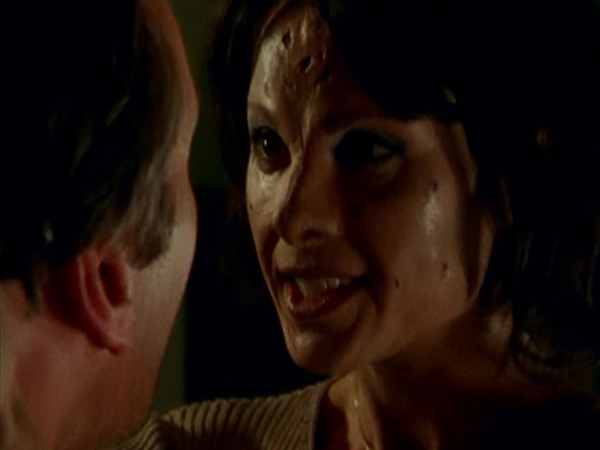
“Was it good for you too?”
Eyghon, 2×08 The Dark Age
Foreshadowing for the events of Passion is all over this episode. Willow asks us to “feel the passion” the moment she appears on screen; Eyghon speaks to Giles of crying at funerals; Angel arrives at the end to choke Jenny, causing Giles to declare that “he’s killing her”. And he is. Since Giles’ sarcastic assertion at the end of the last episode that “nobody ever dies”, the first major character death of the Buffyverse is now locked in stone. Jenny’s final fate has become a ticking time bomb, sealing her doom with every second of screentime. Angel is already killing her, and one day he’ll finish.
When Jenny was introduced, we talked about the potential of her as a Secondary Mentor, as a blend of the mystical and modern – a figure that Buffy should strive towards. This potential has somewhat dissipated this season. She is almost entirely contained to a role as Giles’ love interest. Which is a role she plays extremely well – Robia LaMorte exudes charm, and we see in this episode why Jenny works as a partner to Giles. She sees both sides of him – the “sexy” Ripper side and the “fuddy-duddy” Watcher side.
Buffy herself does eventually come to see this side of him too (though without the sexual connotations of course), and integrates all of them into her perception of Giles as a person. She realises that he is human, with messy histories and flaws. In a moment that calls forward to I Only Have Eyes For You, she tells him to forgive himself, regardless of the forgiveness he wants and believes will not get from Jenny. She teaches the lesson that she will later need to learn. The student has not become the master, but is now on more of an equal footing with them, exchanging wisdom in dialogue.
“I don’t think she’ll ever really forgive me. Maybe she shouldn’t.”
Rupert Giles and Buffy Summers, 2×08 The Dark Age
“Maybe you should.”
“To forgive is an act of compassion, Buffy. It’s, it’s not done because people deserve it. It’s done because they need it.”
Rupert Giles, 2×19 I Only Have Eyes For You

I believe that there is more than a character reason for this storyline however. It is not especially revolutionary or surprising that Buffy chooses to deconstruct the Mentor at this time. This was a time when it was becoming increasingly vogue in fiction to do so. The reason for this perhaps being that it was a time when distrust in authority was more widespread than ever before. Stories of this time are being written by those born in the wake of Vietnam[3] and Watergate[4], (and in the UK, the economic hardships of the 1970s and subsequent horrors of Thatcherism). People stopped believing in authority figures, and so we started questioning the authority figures of our stories. We start to see them more as flawed, distrustful people, rather than wise and benevolent. Nowhere is this more obvious than the difference between the way A New Hope treats Obi-Wan Kenobi, and the way that The Last Jedi treats Luke Skywalker.
There is another fantasy series that I think highlights an interesting comparison. As much as I loathe to talk of JK Rowling’s unfortunately influential magnum opus, it would be a disservice to try and analyse a fantasy show from 1997 without acknowledging the existence of the most popular fantasy series of modern times, also from 1997. So let’s swallow our bile and talk about Harry Potter.
In this series, the teenage protagonist hits some significant moments of character development when he comes to realise that the authority figures he admired and idolised were in fact flawed people who made plenty of mistakes. In the fifth book, Order of the Phoenix, he learns that the father he had been proud of being compared to was in fact an arrogant bully, who enjoyed humiliating less popular classmates. The seventh, Deathly Hallows, is largely concerned with the history of the central Mentor in the series – Albus Dumbledore. It is gradually revealed to the reader that this wise, benevolent figure was once deeply interested in the power of dark magic, and explored it in his youth. After this led to the death of his sister, he pulled away from this, and hid his shameful past beneath a veneer of sexless responsibility.
It is the same for Giles, as we learn. He too is an authority figure in a school to our teenage hero, and a guide in their magical world. He too meddled in dark forces, jointly caused the death of someone close to him, and then pulled away, coming to present himself as the fuddy-duddy watcher we have seen so far in the series. He too has a utilitarian side, and is willing to sacrifice innocents for the greater good. These parallels probably weren’t fully considered when Willow explicitly likened Giles to Dumbledore in season seven, but it’s interesting to consider.
“When you brought me here, I thought it was to kill me or to lock me in some mystical dungeon for all eternity or—with the torture. Instead, you go all Dumbledore on me.”
Willow Rosenberg, 7×01 Lessons
Additionally interesting/disturbing is the link made between this dark, shameful past, and homosexuality. In a 2007 interview[1], JK Rowling made headlines by confirming something that was only mildly, if at all, implied in the series – that Albus Dumbledore was gay, and had a relationship with the in-universe historical villain Gellert Grindelwald. The problematic nature of this revelation is obvious, even without the context that Rowling passed up the opportunity to explore the Dumbledore/Grindelwald relationship beyond out-of-story interviews when given obvious opportunity to do so in the Fantastic Beasts series. Dumbledore’s dark past is explicitly tied to his same-sex dalliances, and his turn back to the light comes complete with permanent celibacy. He is the only gay character in the series, and he is not allowed to be both gay and heroic.
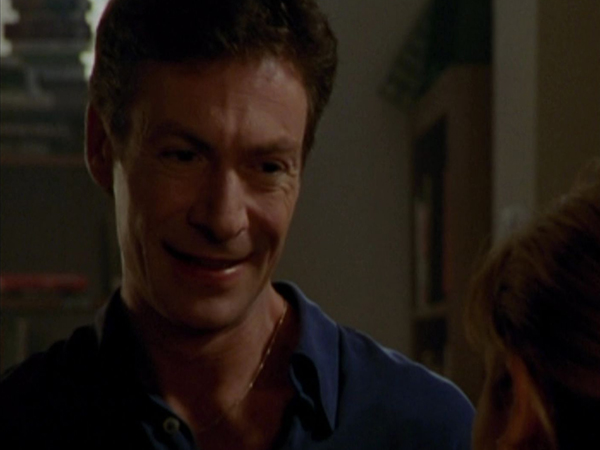
Giles of course comes with his own gay history, in the form of Ethan Rayne. There is no in-universe confirmation that Giles and Ethan had a sexual or romantic relationship, nor any interview announcement from the creator (though Jane Espenson tried her best[2]). But the idea of them having such a history is so fully ingrained and accepted by fandom, it may as well be canon. Much of this is down to the clear queer coding of Ethan as a character. He is a refined, subtly flamboyant man who never shows any interest in the opposite sex. He is a sorcerer (note the use of magic to symbolise gay sex later in the series). He is described as “unmanly” in this episode, and in Halloween as “degenerate”, both stereotypes associated with gay men. This all contributes towards this subtle coding of Ethan as a gay character. It is not all complimentary – the tropes of queer coding that emerged in the wake of the Hays Code rarely were – but that’s the hand we are dealt.
It is difficult to remember sometimes, with the hindsight of 2021, that JK Rowling’s announcement was hailed at the time by a lot of progressive groups. Not that there wasn’t some criticism also – there was – but it was also a big step in a lot of respects, that just four years after Section 28 – a homophobic law forbidding the “promotion of homosexuality” (read: “acknowledging the existence of”) in schools and public service – was revoked, one the most famous authors in the world was happy to come out and confirm that the mentor of this children’s fantasy series was gay. This was not nothing.
This situation gives us an important context to consider when we talk about Buffy’s own depiction of same-sex characters. Buffy also exists at an uncomfortable intersection of progressive and reactionary. It will bravely give us one of the the first and most important lesbian relationships in television. It will also bury those lesbians. Ethan Rayne will not be the last of the queer-coded Dark Halves in the series, and it will not be the last time that dalliances with same-sex attraction are directly linked to dalliances with evil. There are Problematic tendencies here, and yet I am happy to ignore them for simply how damn entertaining Ethan Rayne is. As, for that matter, are Vampire Willow and Faith Lehane. Problematic representation is still representation, and still enjoyable to watch. That is just something we have to accept when considering works from this era.
Both JK Rowling and Joss Whedon have undergone a cultural transformation over the years. From almost universally beloved in nerd circles in the 00s, they have, through their own increasingly repulsive behaviour, descended into being considered persona non grata in all morally decent circles. We look back on their works now, as two seminal pieces of 1990s fantasy media, with justifiably increased skepticism. It is slightly fascinating to me, that they have shared this fall from grace, and even back then shared these tendencies to be erratically progressive and reactionary in their writing, often not aware of their own ignorance in some of these areas.
One example of erratic progressiveness that we will see will arrive in season six, with the infamous “magic drugs” storyline. We’ll obviously dig more into that when we get there, but one issue fans have raised with it is the way that the multiple metaphors used for magic intersect. In season four, it is a sledgehammer symbol of queer love and lesbian sexuality. In season six, it is an equally sledgehammer symbol of corruption and unhealthy addiction. Buffy has a habit of using multiple metaphors for the same thing. Sometimes that leads to very interesting intersections, and sometimes it leads to very distasteful ones. This is more of the latter.
And it all starts right here. This episode is filled with clear drug imagery, and Giles describes summoning the demon as an “incredible high”. This is the dark past that Giles wishes to concealed, tied up with both the drug metaphor and the implied homosexuality with Ethan. Later episodes compound this. In A New Man, Ethan toasts to him and Giles as “a couple of old sorcerers”. The next scene shows us Willow and Tara, completing one of their first erotically charged spells, where they float a rose (a spell notably interrupted by Ethan’s own magic). The next scene cuts to Giles waking up in bed, clearly using the visual language of a one-night stand.
JK Rowling has become infamous last year for pulling the mask off her own transphobia, and leading the cultural charge against one of the UK’s most discriminated against groups. Yet her star has been fading for a while. She has not only been leaning towards this particular hate for a while, but she has also caused herself problems for making increasingly ill-advised statements about lycanthrophy being an AIDs metaphor, or building colonialist propaganda into the backstory for her American Wizard School. And even back in the series itself, there are troubling signs, as many more have noted – chattel slavery apologia, jewish-coded evil goblin bankers, and naming her one asian character “Cho Chang”. She may have only recently planted her flag in the turf, but that flag has been red for a while. Perhaps we just didn’t want to see it.
Joss Whedon has become infamous this year, as Charisma Carpenter’s Instagram post in support of Ray Fisher[5] triggered a wave of support, verification, and similar stories from other Buffy and Angel actors. His abuse of power and vile treatment of actors is now beyond doubt. Yet, there have been hints for a long time – stories of Carpenter’s mistreatment have been circling since the 00s, his ex-wife exposed some of his hypocrisy in a 2017 letter[6], and of course there was the original statement from Ray Fisher about his experience on the set of Justice League. The writing has been on the wall for a while with Whedon. Perhaps we just didn’t want to see it.
The problems with the way that Buffy uses metaphor are myriad and complex. They perhaps become most infamous in the aforementioned “Magic Drugs” plot, and all the fall-out that stems from Seeing Red and how it relates to some problematic tropes (an essay for another day). Yet they are already in evidence here, and in season four. We have evidence of an uncomfortable mixing of metaphors emerging just twenty episodes into the show. Perhaps there is not really enough to have a real problem with yet. It’s small enough to give the benefit of the doubt. Or perhaps, we just didn’t want to see it yet.
* * *
Thanks for reading! This would usually be the point in which I beg for donations to my Ko-Fi. This week, I would ask that if you enjoyed this piece, you would consider donating to Mermaids UK, a charity dedicated to protecting children from the rising tide of transphobia that JK Rowling’s campaign has helped to contribute to.
* * *
References:
[1] https://www.theguardian.com/uk/2007/oct/21/film.books
[2] http://storyteller.psubrat.net/author/savvy/writercon04/
[3] https://www.nytimes.com/2017/01/07/opinion/sunday/vietnam-the-war-that-killed-trust.html
[4] https://www.federaltimes.com/smr/50-years-federal-times/2015/12/01/watergate-scandal-public-distrust-of-government-begins/
[5] https://www.instagram.com/p/CLHjMmghiA9/?hl=en ~
[6] https://www.thewrap.com/joss-whedon-feminist-hypocrite-infidelity-affairs-ex-wife-kai-cole-says/
 Insect Reflection