
In every generation there is a Chosen One. She alone will stand against the vampires, the demons, and the forces of darkness. One girl in all the world. That is the basic premise of this show, that we have had explained to us in the pilot, and reminded at the start of most episodes. And it is the premise that is ripped up 40 minutes into the first half of this episode, never to be reinstated. We are only twenty-one episodes into the show’s run, and we are already breaking the fundamental rule of the show. It’s been broken for nine episodes already, we’re just only now finding out.
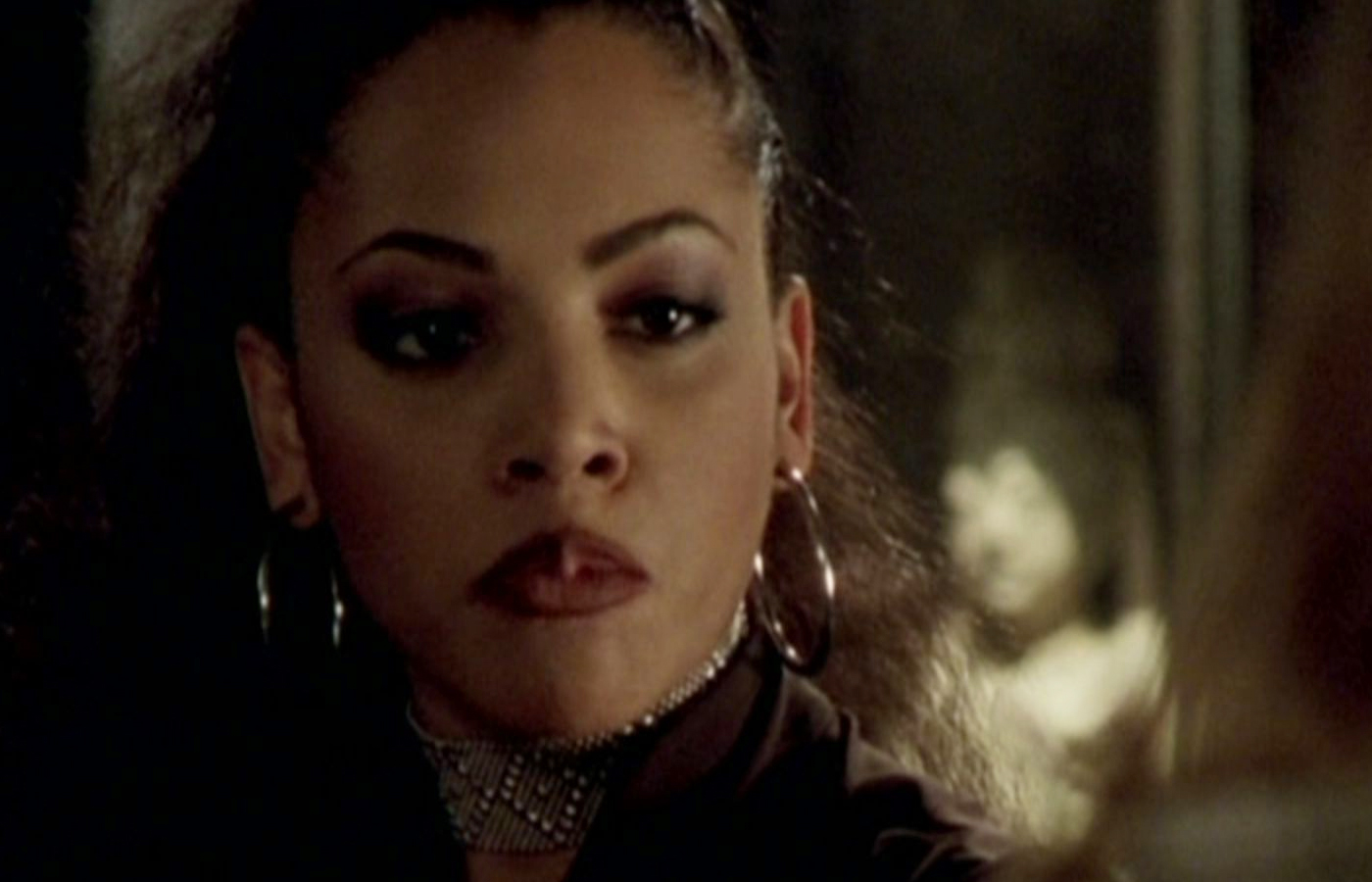
Kendra represents a narrative threat against Buffy. She is just as much a Chosen One as Buffy, just as much a Hero in the structural sense. She introduces herself as “Kendra the Vampire Slayer” because she threatens to replace Buffy in the show’s title. As the Slayer, she has the potential ability to take on the role of protagonist, and lead the show instead of Buffy. And Buffy is tempted by this.
We see throughout the first half of this episode how Buffy is deeply frustrated with her assigned role. She does not see any future for herself outside of slaying. She grouses about Careers Week, and how it mocks her with the idea of an unattainable future. She snaps at Willow, Giles, and Angel for not recognising this. She sees her only options as being between “Slayer” and “Dead”. In fact, she equates this lack of choice with death itself.
“I don’t have to be the Slayer. I could be dead.”
Buffy Summers and Rupert Giles, 2×09 What’s My Line?
“That wasn’t terribly funny. You notice I don’t laugh.”
“Wouldn’t be much of a change. Either way I’m bored, constricted, I never get to shop, and my hair and fingernails still continue to grow. So really, when you think about it, what’s the diff?”
She is actually wrong about not having a choice. As we talked about in the Prophecy Girl essay, she does always have the choice to give up being a Slayer, and walk away into the sunset. Or even, she could die. This is key to Buffy’s existentialist foundations. Sartre suggested that all humans always have a choice, even pointing to the enslaved subjects of a colonial force as an example. They can choose to remain enslaved, or to throw themselves into the sea. Buffy is the enslaved person in this example – she is restricted by her circumstances, but still retains the ability to choose.

And yet, it is a fundamentally privileged view to not recognise that the choice the slave has is miles away from being a reasonable choice. The fact that choice still exists does not eclipse the basically unfair and discriminatory nature of the choice. Buffy’s suffering is similar. She does not have to be the Slayer, I remain firm in that. But her other options are death, or allowing deaths that she could prevent to occur. It’s the flipped version of the Lie To Me quote – she has a choice, but it is a fundamentally shitty choice.
Xander lays out this trap in the opening scene of the episode.
“’Are you a people person, or do you prefer keeping your own company?’ Well, what if I’m a people person who keeps his own company by default?”
Xander Harris and Buffy Summers, 2×09 What’s My Line?
“So, mark ‘none of the above’.”
“Well, there are no boxes for ‘none of the above’. That would introduce too many variables into their mushroom head, number-crunching little world.”
In his aptitude test, Xander is faced with these two options, and he is perfectly free to choose between either one of them. But they are a false binary, unable to express the complexities of human existence. He can’t decline to choose, or select a third option, because that doesn’t exist on the form. It is a choice, but not a fair one.
Buffy is trapped in the same structure. She has a choice, but not a reasonable one. She is a “people person” who loves spending time with others, whose life before Sunnydale revolved around being popular. But her role as the Slayer demands isolation, and loneliness. It demands she keep her identity a secret and not form attachments with those around her. We will see more throughout the series how being the Slayer is a constant isolating force, that will make her “keep her own company by default”.
The fate of the Slayer is sisyphean in the most horrifying way. They live, they fight evil, they push that boulder up that hill, they die, the boulder rolls down, and the next girl pushes it up again. So on it goes for eternity. They are much like the Order of Taraka – the absurdly overhyped and unthreatening assassin order introduced in this episode, who do at least serve an important metaphorical purpose. As Giles describes them, they are essentially unstoppable – if one dies, then another is sent, and another, until the job is complete. They represent the endless force of evil, and the endless struggle of existence. There is no end, until one day you die.
They are also representative of Slayers. Kendra clues us in when she uses very similar language to describe herself – telling Buffy that if she is killed, then another Slayer will be sent to take her place. Both the Order and Slayers are meant to have “no earthly desires”, other than to collect their bounty (read, in the Slayer’s case, to kill vampires). Good and Evil are locked in an endless sisyphean meat-grinder, sending more soldiers to replace the ones killed, battling and dying for the sake of nothing at all. It’s a Camusian Western Front.

The eventual solution that Buffy finds to this problem is to share her power, to make it so that she is no longer the One Girl In All The World. And despite the fact that we have 85% of the series remaining before we get to that point, we are already being told the answer in this episode right here. Kendra’s existence enables a full spectrum of choices for Buffy. Other people have pointed out before the parallel of Willow bringing Buffy back to life in Bargaining with Xander bringing her back in Prophecy Girl, but the latter is also a parallel to Willow’s spell in Chosen. Both of these other Scoobies do their part in creating more Slayers, and opening up Buffy’s options beyond two limited check-boxes on a page.
Buffy is of course tempted by this – by letting Kendra take over and going off to Disneyland, or finding a career, or any other hallmark of a “normal life”. It’s a perfectly reasonable temptation, but clearly one she must avoid. To give up her Slayer title would be to give up part of her identity, of who she is. More than that – it represents narrative collapse; a threat against the show itself. If Buffy gives up being the Slayer, then the show we are watching – the reality we perceive her through – ceases to be. We would be watching Kendra the Vampire Slayer instead.
Perhaps then we should consider – why aren’t we watching Kendra the Vampire Slayer? If Buffy is no longer the Chosen One, then what makes it essential that she is the Hero of this story? Why should she be the protagonist? Kendra is the theoretical perfect Slayer – a strong, skilled warrior, obedient, dutiful, well-trained and well-read. She follows the Slayer Handbook to a tee, and describes her sole duty as killing vampires. She avoids friends and lovers. She applies a black-and-white morality to everything, declaring that Angel should die because he is a vampire, with no other considerations. She has no other earthly desires, other than to fight evil, and one day die, to be replaced.

Buffy on the other hand, is someone who Giles immediately pegged as someone for whom the Slayer Handbook would have had no use. She is rebellious, slippery, prone to rejecting typical wisdom and finding her own way. She is by her own admission, “not that scourge-y” against the underworld, and her technique is worse than Kendra’s. She loves the creature she is meant to kill, and she keeps friends and family close. She does not in any way live up to the ideal of a Slayer as designed. And that is her strength. Her ability to challenge and reject her assigned role, her ability to morph and shape the narrative around her. She is more powerful than the life she was meant to lead.
There can be no Kendra the Vampire Slayer because Kendra does not allow herself to be that. When Giles asks her name, she simply calls herself “the Vampire Slayer” – just one half of the show’s title. Compare that to how Buffy claims the whole title as her self-identity in Anne. Buffy the human girl is just as powerful a force as Buffy the Slayer, and so both gain equal footing in the show’s title, both as important as each other. Kendra denies her human desires and emotions, and so she cannot be worthy of the same. Buffy insists on her own self-identity, which is why we are watching Buffy the Vampire Slayer.
“And you are called…?”
Giles, Kendra, and Buffy, 2×10 What’s My Line?
“I am the Vampire Slayer.”
“We got that part, hon. He means your name.”
“Who are you?”
Demon Guard and Buffy Summers, 3×01 Anne
“I’m Buffy. The Vampire Slayer. And you are?”
It falls to Buffy therefore to teach Kendra the way of things, to show her how to break out of her restrictive, emotionally repressed role. She goads Kendra into getting angry, into allowing herself to feel human emotions and therefore become a complete person – more than just The Slayer. That is necessary to be the hero of this story. Buffy even states that it literally gives her more power, and would have allowed her to beat Kendra. It is this expression of emotion – and her unlearning of some of her black-and-white morality when she comes to help save Angel – that allows Kendra to win her fight at the climax, after her “favourite shirt” is torn.
Specifically, this expression of emotion is tied to the concept of ‘fire’, a motif that we have tracked to symbolise passionate love and reckless romance. Angel uses it himself in this episode, when he mocks Spike. In this season all about Buffy’s tragic doomed romance, this episode holds said romance up as an essential part of being human, and of Buffy’s status as the hero of this story. Her love for Angel, and her embrace of fire, makes her stronger. It is something to hold on to and draw power from, not something to flinch away from.
“You feel it, right? How the anger gives you fire? A Slayer needs that.”
Buffy Summers, 2×10 What’s My Line
“Take care of her, Spike. The way she touched me just now? I can tell when she’s not satisfied.. Or maybe you two just don’t have the fire we had.”
Angel, 2×10 What’s My Line

There is a tinge of queer subtext in this story that is helped along by this idea of Buffy drawing strength from her non-normative love for Angel. Buffy’s existence as the Slayer has always had intense resonance with the queer experience. She had a sudden realisation in her teenage years about herself, which made it impossible to live the “normal” life she had expected to live. She spends a large part of her arc coming to terms with this, and learning to accept it and own it as part of who she is. Her experience is so often one of isolation. She is the only person like her in the world, the chosen One, and nobody else is capable of understanding it. This is the exact same experience of queer teenagers everywhere, especially ones growing up in the nineties.
Kendra’s existence is therefore so important to remind Buffy that she is not alone. She might be a “freak”, but she’s not the only freak. There is a sense of queer solidarity, of unified pride, as they draw strength from their shared loneliness. And even without the queer lens, this is a vital step in Buffy’s character journey. This is the moment where Kendra reminds her that The Slayer is not a distinct, disparate section of herself to be attended to occasionally. It is part of who she is. Just as Kendra can’t be whole if she’s just ‘The Vampire Slayer’, Buffy can’t be whole if she’s just ‘Buffy’.
With all this juicy symbolic stuff going on with Kendra, it becomes sad to admit that I don’t find her incredibly engaging as a character. There are good bones of an arc there, with her learning to embrace her emotions and break out of her disciple, but her potential is undermined at several turns. It starts with her costume design. She is written as a sensible, by-the-book fighter, who prioritises efficiency over expression. And yet her crop top, shiny trousers, and chunky necklace say less ‘disciplined warrior’, and more ‘Destiny’s Child reject’. The visual doesn’t match the text, and that creates a disconnect.
Also not helping is the bizarre decision to give Kendra a Jamaican accent – or rather, an uncanny-valley approximation of a Jamaican accent. There are conflicting reports on the exact background to this – some say that the decision was made late and so Bianca Lawson had barely any time to prepare the accent, others that the voice coach brought in for her happened to be from a very specific part of Jamaica with an idiosyncratic accent that sounds strange to outsiders. Whatever the story, it is undeniable that this accent severely hampers Lawson’s ability to give an appropriate performance, as much as she does her best.

It’s a special shame, because Kendra is one of the precious few characters of colour on this show. She is the first of any note, on a list that if you counted on your fingers would almost use up an entire hand. This is a shameful failure on the show’s part, that it should’ve done a much better job at addressing. Kendra kind of deserves extra attention for this reason, and the writing and acting grants her plenty of potential – but the choices made for her outside of that hold her back..
Kendra never really had a chance, not least for the fact that she only gets to appear in three episodes (and in the first of those she’s a mostly mute red herring), before she is killed off with little fanfare, to be rarely mentioned thereafter. This is just in time for the show to introduce a brand new – white – slayer character, who will become the central focus of a season, and go on to have major guest appearances on both shows for several more years. I can’t honestly say I am upset by this development – anyone who follows me on other platforms will know how I feel about the character of Faith Lehane – but it should be acknowledged how Kendra was sacrificed on her altar.
Over the course of Buffy (until the final ten minutes of Chosen of course), we see a total of six slayers. Four of these are non-white characters, which seems like a decent return – until you note that all four of them are dead, and total a grand seven appearances between them. The other two are the main character of the show and her most important Shadow Self, who both come back from the dead and survive until the end of the show. As do the two white vampires responsible for the murders of three of the former slayers. It’s not just that Buffy doesn’t have enough black characters, it’s also that it treats the ones it does with an excessive disposability. They die in service of the stories of white characters. How great and beloved those characters are (including to me personally) doesn’t change that uncomfortable fact.
The dynamic between Buffy and Faith shapes the entire third season, while the dynamic between Buffy and Kendra is a minor subplot at best in the second. One is clearly far more engaging, layered, and emotionally complex than the other. But that’s because one of them never had a chance. Before all other issues that crop up with Kendra as a character, is the fact that this show was never going to grant such a major role to a black character. Yes, the metaphorical reason that there can never be a Kendra the Vampire Slayer is because Kendra denies her own desires and does not insist on her own identity like Buffy does. But the other sad reason is because of Buffy’s racism. This show does not, as a rule, respect black characters – and that is ultimately why we would never get to watch Kendra the Vampire Slayer.
* * *
Thanks for reading!
If you enjoyed this piece, please consider supporting me on Ko-Fi!
* * *
References:
[1] https://en.wikipedia.org/wiki/Bad_faith_(existentialism)
 Insect Reflection