
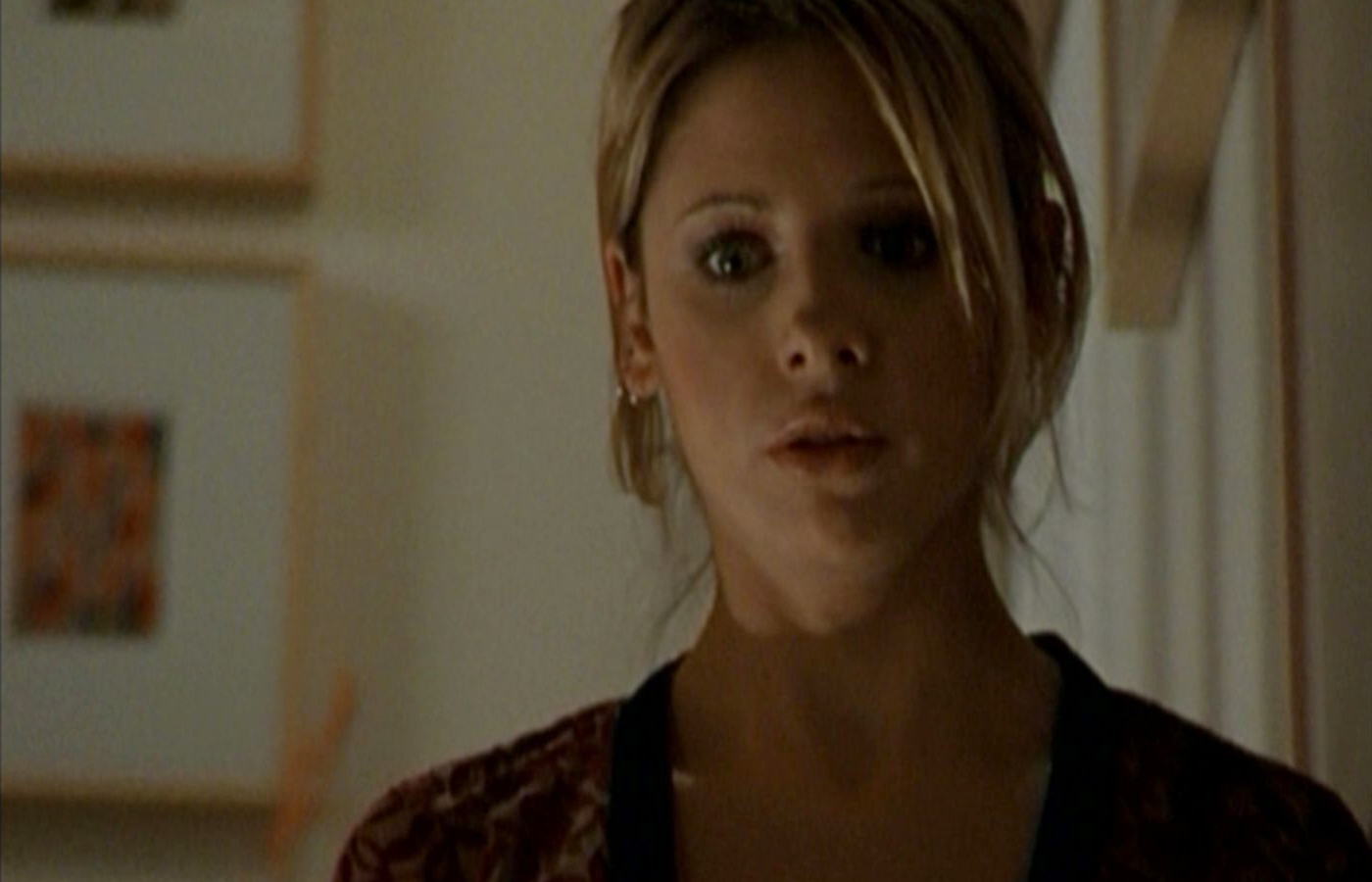
This episode opens with the gang lamenting how quiet the town has been since the apparent deaths of Spike and Drusilla (a topic I swear I will get into come the Surprise essay), and Buffy enjoying her brief reprise from the trials of the supernatural. Of course, this is Buffy, so no reprise can last longer than an opening scene. Buffy arrives home to find the door unlatched and ajar, and hears a sound from the kitchen. Our genre-savvy senses tingle, as do Buffy’s, and we expect some horrible monster to be lurking in the kitchen, waiting to attack. Unfortunately, Buffy opens the door and finds it’s much worse than that. Her mother has a new boyfriend.
This episode is all about the intrusion of domestic turmoil into Buffy’s magical world. Buffy has grown so much in her strength as a slayer – perhaps at the peak of her powers now she has (apparently) vanquished the Big Bads and gained an equal ally in Kendra. But for most of this episode, she is forced to deal with the purely mundane – first with an irritating new presence in her life, then with this presence turning abusive, and suffering gaslighting from the people around her, and finally with sudden, unexpected death.
The show handles these sudden verges into mundane terror with aplomb. The mini-golf scene is genuinely unsettling, with the bright, sunny lighting (always notable given its necessary rarity on this vampire show) reflecting Ted’s image as a bright, positive person. Both are undercut by his sudden threat of physical violence. This scene lives vividly in my head – as does the later one in the kitchen, where Buffy attempts to apologise to Joyce, who is simply not ready to hear it. Gellar and Sutherland play the aching chasm of grief and regret perfectly, capturing the essence of the fractured nature of this mother/daughter relationship, and the secrets underlying it.
For a while, we are made to squirm with the possibility that Buffy has indeed killed a human man, that she may suffer dull criminal punishment for it, and that it might irreparably harm her relationship with her mother. Ted’s “death” comes just after he reveals evidence of Buffy’s slayer side, and she uses the strength of that side of her to fight back, kicking him across the house with precision. This is a perfect example of one of Buffy’s major fears – that her slayer life may emerge and destroy her domestic life.
The episode does end with Buffy fighting a magical robot – a comforting return to normality for Buffy the Vampire Slayer – but the show holds off on letting us into that comfort for a while. We are made to watch Buffy handle it as purely an interpersonal issue, rather than a supernatural plot that needs solving. While Buffy does suspect Ted, we are held in ambiguity as to whether this suspicion comes from Slayer intuition, or her child-of-divorce trauma (“parental issues”, as Xander and apparently Freud suggest). Buffy does even state that she would be happy with her father returning – and given what we later find out about Hank Summers, I think that this indicates Buffy resenting a change in her life more than being an excellent judge of character.
The aforementioned mini-golf scene that ends with Ted’s threat starts off with his fussy insistence on “the rules”. It indicates a black-and-white morality, much the same as the one Kendra struggled with last episode. This is important because the strict rules and the physical threat are the same – a method of patriarchal control over young women. Kendra got hers from the Watchers, the ultimate symbol of patriarchal control. Ted gets his from being the patriarch himself.

The threat to Buffy comes from the very image of the nuclear family with its ideal patriarch. He is the breadwinner, the disciplinarian, the head of the table. When we see Ted’s apartment, we see that he lives in a simulacrum of 1950s nostalgia – a time that many fools and propagandists insist was perfect, but that apparent affection was covering up the skeletons in many people’s closets. Ted has actual skeletons in his closet. He has stepped right out of that idealised (and fictional) world, where father knows best and women keep quiet. So of course, he has to be destroyed, even if he wasn’t a robot.
With John Ritter’s charisma imbusing the character with an unsettling affability, Ted feels like a prototype version of the Mayor – a charming, straight-talking symbol of patriarchal Americana. Many of his lines could have come straight out of Richard Wilkins’ mouth. As we will explore later, this episode is in many ways a dry run of season three.
“Well, you know, little lady, it’s not just for looks, it’s for building strong bodies.”
Ted, 2×11 Ted
“Drink up. There’s nothing uncool about healthy teeth and bones.”
The Mayor, 3×17 Enemies
Ted is an abuser, with a noted pattern of moving in on vulnerable women, exploiting them, and killing them. Joyce notes her own vulnerability, talking about how little choice she has romantically as a single parent. Giles notes in this episode how vampires tend to resort to the “easiest feeding grounds”, and it is the same for abusers. Buffy is right to go off on her barely-subtextual rant about vampires and their annoying mini-pizzas. Ted is, in this metaphor, a vampire.
There is one particular vampire that Ted reminds most of – the ultimate abusive boyfriend, Angelus. Ted is another in the long line of monster boyfriends this season that are meant to metaphorically represent Angelus, looming in the background of the whole season, ready to emerge. He even comes back from the dead at one point. His threats, abuse, and gaslighting behaviour towards Buffy all prepare us for the threats, abuse, and gaslighting that this season’s Big Bad will inflict upon her.
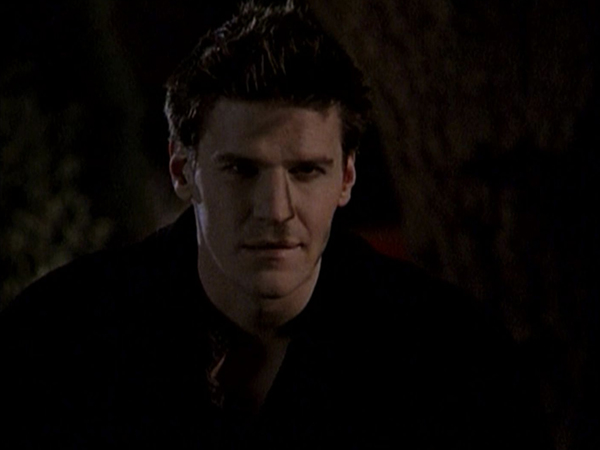
Buffy manages to overcome and defeat her abuser by way of one simple trick – claiming ownership of her domestic space. It is the same thing she does to Angelus in Passion, when they magically revoke his invitation. She kills Ted and tells him that this is her house. She destroys this patriarchal abuser by kicking him out of the role he assumed he was entitled to. Buffy is the head of this household, and he is no longer welcome in it. The conflict this episode was between the domestic world and the supernatural world, as they infringed on each other. Buffy resolves this by using her slayer powers to take control of her domestic world.
“Hey Teddy… this house is mine.”
Buffy Summers, 2×11 Ted
“Sorry, Angel. Changed the locks.”
Buffy Summers, 2×17 Passion
This episode is notable for kicking off two trilogies. Firstly, the Absurdly Realistic Robot trilogy, consisting of Ted, I Was Made To Love You, and Intervention. Second and more crucially, the threesome I like to call the You Killed A Man trilogy – Ted, Consequences, and Dead Things. In each of these episodes, the constant presence of death that surrounds the Slayer is accidentally unleashed on a non-combatant, and they are forced to reckon with the fact that they have killed a human. The exact details of the event differ, and in some cases it transpires that they did not, in fact, kill a man – Ted is revealed to be a robot and we knew Katrina was dead already by Warren’s hand – but each of them return to this same idea, to explore it from a slightly different angle.
A pertinent question here is this: what sort of consequences should a Slayer face for a human death at their hands? Should they face punishment, and if so, what kind? Even if we suppose that the American criminal justice system is an appropriate method to deal with this kind of thing in the non-supernatural world (it’s not, but let’s assume it is), it is clearly woefully inappropriate in this case. As Buffy says in Becoming – cops can’t fight demons, she has to. The magical world does not have its own laws and structures, so what is the answer here? Should Buffy should be allowed special rules by virtue of her heroic destiny? In each of these episodes, a theory is posited that yes, she should.
“I don’t get it. Buffy’s the Slayer. Shouldn’t she have…”
Cordelia Chase and Xander Harris, 2×11 Ted
“What, a license to kill?”
“Well, not for fun. But she’s like this superman. Shouldn’t there be different rules for her?”
“Anyway, how many people do you think we’ve saved by now, thousands? And didn’t you stop the world from ending? Because in my book, that puts you and me in the plus column. (…) Something made us different. We’re warriors. We’re built to kill.”
Faith Lehane and Buffy Summers, 3×15 Consequences
“To kill demons! But it does not mean that we get to pass judgment on people like we’re better than everybody else!”
“A girl is dead because of me.”
Buffy Summers and Spike, 6×13 Dead Things
“And how many people are alive because of you? How many have you saved? One dead girl doesn’t tip the scale.”
The three characters that make these arguments – Cordelia, Faith, and Spike – are Buffy’s three clearest Shadow Selves, and that is no coincidence. It indicates that there is some dark part of Buffy that agrees with them, that believes that she should be allowed special dispensation because of her status as the slayer, and because of the moral buffer that saving so many lives on a weekly basis grants her. She eventually comes to explicitly agree with the former at least.
“It is always different! It’s always complicated. And at some point, someone has to draw the line, and that is always going to be me. You get down on me for cutting myself off, but in the end the slayer is always cut off. There’s no mystical guidebook. No all-knowing council. Human rules don’t apply. There’s only me. I am the law.”
Buffy Summers, 7×05 Selfless
It is no surprise therefore in this episode that Buffy’s prime shadow self (Faith) emerges in her behaviour. She excessively beats down a vampire rather than stake him to get out her own anger, just as Faith does in Faith Hope and Trick – and both specifically claim afterwards that they are “just doing their job”. We get one of the first glimpses of Buffy’s suicidal tendencies – her death wish, as another shadow self might put it – when she tells Ted that him marrying her mother would make her want to kill herself. The death of Allen Finch is what sends Faith into her own suicidal spiral, and the death of Katrina catches Buffy in the middle of her own. The shadow is present before its own entrance, and lingers long after it appears to have gone.
The retort given to Cordelia is that allowing her special powers that aren’t given to normal humans would be fascistic, and I have to agree. In a truly free society, no one person would have special power over the lives of other people. But unlike reality, where fascists are utterly wrong in their belief that certain people are superior than others, this is a world where Buffy does undoubtedly have power and responsibility that nobody else in the world has (apart from Kendra of course, but she is narratively irrelevant). She is quite literally an Ubermensch. Buffy pushes back on Faith’s belief in their own superiority in Consequences, but it’s hard to say that either Faith or Cordelia are entirely wrong – Buffy is special, and has power over others whether she would like to or not.
Back in the Some Assembly Required review, we talked about how the villain of the week used a clearly flawed argument of utilitarianism to justify his actions. Faith and Spike do the same, though it is less clearly flawed. Buffy clearly would be morally wrong to murder someone and use the argument that she saved ten unrelated others. But accidents happen, and sometimes innocents die. A mind may immediately go to the idea of “collateral damage” in warfare, a term admittedly often used by politicians to justify the unnecessary slaughter of civilians in forgein countries, but nonetheless a concept that does exist in moral philosophy. Buffy is fighting a war against the legions of the undead, and sometimes people who don’t deserve to are going to die in the crossfire. It is up to her to work out what level of that is acceptable to her.
In that essay, I put a pin in a particular line, and said we would get into it after What’s My Line. So let’s take that pin out now.
“You can’t just give and take lives like that. It’s not your job.”
Buffy Summers, 2×02 Some Assembly Required
“You talk about slaying like it’s a job. It’s not. It’s who you are.”
Kendra Young, 2×10 What’s My Line?
As the Slayer, Buffy is forced to make these kinds of decisions, to have power over life and death. But it’s not because that’s her job. She has not been appointed into this position of power to decide who is permitted to die. Her power, and her ability to make that decision, comes from an innate power. It is an expression of who she is, of her priorities and moral foundations. The Slayer doesn’t make these choices; Buffy does, and Buffy’s selfhood is the result of her choices.
(Now we’ll put a pin in that until Becoming).
This episode comes under a bit of slack from fans for letting Buffy off the hook somewhat in its reveal that Ted is a robot, and to be fair that does lessen the emotional ordeal on the characters. Buffy is freed from having any human casualty on her conscience. But I would argue that morally, it doesn’t make much of a difference.
When Ted hits Buffy, she reacts with a smile. She hoped he’d do that, so that she’d have an excuse to fight back. And when she does fight back, it is with the precision and skill of a slayer, not holding back at all. As far as Buffy knew, he was a human being that could not take that kind of assault from a superhuman. Xander tries to give her an easy out, claiming that she knew deep down that he wasn’t human, but he already dismissed her suspicions earlier with the equally valid observation of Buffy’s parental issues. The fact that Buffy’s intuition was right doesn’t actually change anything, and Buffy knows that; that’s why she confesses to the police. She’s the slayer, and she hit him. With the kind of power she wields, she must be responsible for what happens with it.
Honestly, I don’t blame her at all for this. Ted was an abusive murderer; even if he wasn’t a robot, I would not be sorry at all that he was dead. Buffy had a right to fight back. The point is not to say that her choice was right or wrong, but that she chose. It doesn’t matter that he died accidentally, or that he didn’t actually because he was a robot. As always on Buffy, the consequences matter less than the choice.
Remember, Ted is foreshadowing Angelus in this episode. And Buffy chose to hit him. Buffy chose to kill him.
* * *
Thanks for reading!
If you enjoyed this piece, please consider supporting me on Ko-Fi!
* * *
 Insect Reflection
One thought on “You Don’t Get It – You Killed A Man (Ted)”