
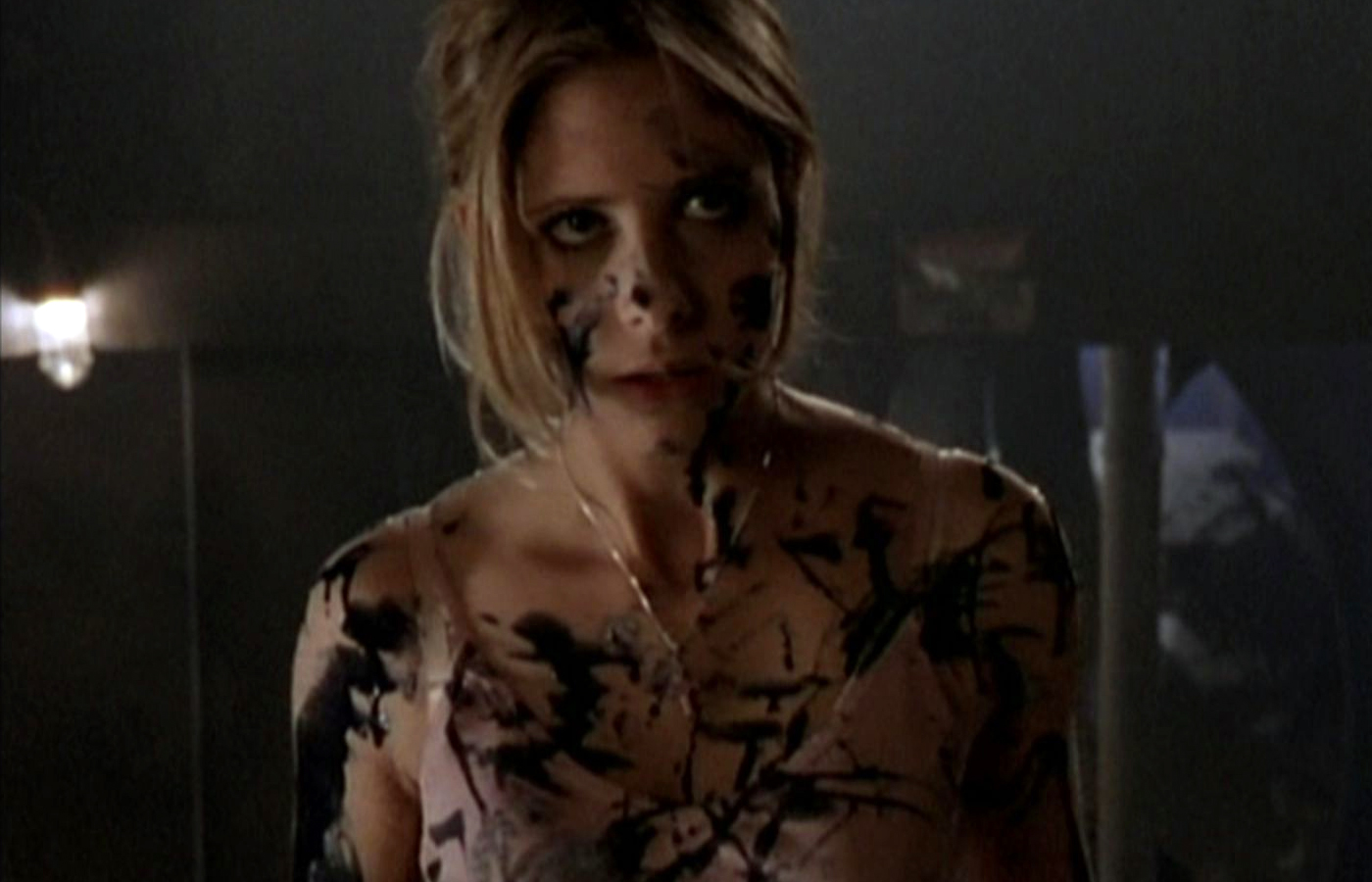
In case you haven’t noticed, season two is about sex.
A teacher underlines the point at one point in this episode when they literally underline the word on a chalkboard, harkening back to when another teacher underlined season one’s central theme – death. There is little that Buffy’s high school years like doing more than using a classroom scene to plainly state the theme of the episode.
This theme has been building all season, from the endless string of murderous undead beaus that various side-characters have received (Cordelia with Darryl, Xander with Ampata, Joyce with Ted, Spike and Drusilla with each other), through Buffy and Angel’s push-and-pull dalliances with their fiery passions, to the terrifying Penis Metaphor that threatened to devour Buffy in Reptile Boy. It will of course climax next week with Buffy and Angel’s passionate embrace, and all the tragedy that stems from it.
It is natural that the show would explore this avenue. Season one was metaphorically dealing with Buffy accepting adulthood, so it makes sense that the show would then handle one of the most pressing issues that most young people deal with as they face oncoming adulthood – the emergence of sexual desire, and the dangers that can stem from it.
The danger this episode is most concerned with is pregnancy, and it makes that abundantly clear. In the aforementioned classroom, Willow lists pregnancy as one of the biggest unwanted consequences of sex. The kids are tasked with looking after literal eggs that represent children. From those eggs emerge life-sucking demons that control their “parents” and force them to serve a vagina-dentate monster under the school that is referred to as a “mother”. Xander complains of receiving a “big bump” from Cordelia. It’s not a theme that is burdened with subtlety.

This is the first of a series of episodes that touch on the idea of pregnancy as a terrifying, dangerous force – episodes that spread across the Buffyverse, though most commonly on Angel. That show will give us Darla’s mystical demon pregnancy plotline, Cordelia’s mystical demon pregnancy plotline, and Cordelia’s other mystical demon pregnancy plotline. It is a tired trope that so often reduces female characters to passive receptors, with little function beyond their reproductive organs. This episode saves itself a little in that regard – there is no actual pregnancy inflicted upon any character – but it does play a little too close to that sandbox.
One of the fears central to the Mystical Pregnancy trope and how it is used is the fear of transformation – of a woman’s body changing because of pregnancy, in a way that terrifies men. This ties very much to the wider patriarchal fear of sex being something that fundamentally taints and changes a woman’s nature, that transforms her between two states of being – Virgin and Whore. This would be a warning sign that we are about to dive into some deeply problematic tropes, as we know that next episode, the act of sex will taint and transform a character. Yet, mercifically, it does not happen to Buffy. She remains the same person she ever was. The person who is transformed, who is moved from one state of being to another by this act – is Angel.
The parenthood theme continues through what we see with Joyce and Buffy. This is a Joyce that is unfortunately being written at the more aggressively judgemental of her spectrum. She doesn’t really have a setting in this episode outside of admonishing Buffy, inflicting increasingly severe levels of control upon her, and opining on how burdensome and irresponsible she is. A generous interpretation might say that she is fearful for what path Buffy might be going down after the events of Ted, or even holding some subconscious grudge against her for it – and that would be an interesting angle, if it wasn’t contradicted by the fairly warm reunion Joyce and Buffy enjoyed at the end of that episode. A more accurate interpretation might say that the writers often struggled to use Joyce as a obstructive force in Buffy’s life and stay honest to how in the dark she was, while also keeping her fully rounded as a character, and keeping her sympathetic.
Joyce criticises Buffy’s lack of responsibility in this episode, and it is understandable, given the limited information she is working with. Buffy is prevented at multiple points from fulfilling her responsibilities to her mother by her magical destiny. The opening scene, where Buffy fails to pick up Joyce’s dress because she has to go fight Lyle Gorch, is one such example (though it does make me wonder why Joyce asked Buffy to go to this shop apparently about ninety seconds before it closed).
Buffy is not irresponsible, as we know. She is caught between responsibilities, with no reasonable way to resolve them. Anything she does to fulfil one will forsake the other. She can either disappoint her mother, or disappoint her magical destiny. It’s the conundrum from School Hard again – Buffy struggling to live in multiple un-meshable worlds. This is why at the episode’s climax, Buffy is attacked by both her parental figures, at the same time as she is attacked by vampires, at the same time as she is attacked by the vagina dentata under the floor. She is being consumed on all sides, and the only way out is to literally hack and slash her way.
It’s no wonder that she exerts what little independence she has and indulges her fiery passions with Angel – making out on patrol and indulging in a little through-bedroom-window affection at the episode’s end. They find space to exist within the boundaries of control. With everything else Buffy has to deal with, it’s honestly a moment that inspires the use of a Lucille Bluth meme.
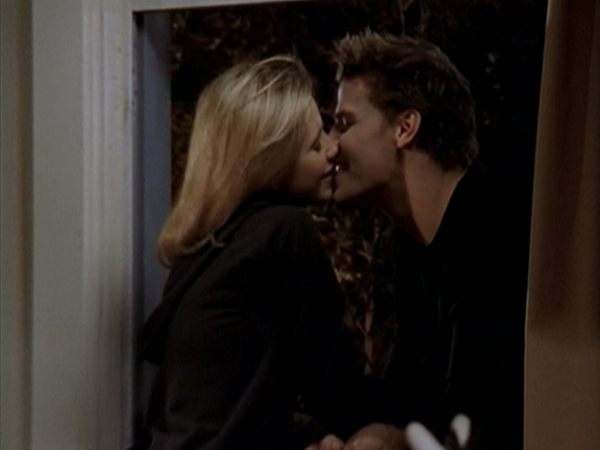
And yet, as it always does this season, the tragedy lurks under the surface, like the Bezoar, waiting to strike. Buffy and Angel remain blind to any warning the episode is trying to deliver about the dangers of sex, only getting more physically intimate as we reach the edge of Surprise. Buffy’s wide-eyed naivete shows its face as she declares how Angel is the only thing she sees in her future – an issue that will ultimately trigger their break-up in The Prom. The camera at one point pans from their passionate kissing to a gravestone that reads “In Loving Memory”. And yet the biggest warning sign might be when Buffy declares that her and Angel are “not helpless slaves to passion”. We will of course see soon, the hurt and pain that can emerge from Passion.
There are not many episodes that touch on Buffy’s feelings on potentially having children one day, but this is one of them. There’s not much to go on – she states that she’s certainly not planning on it now, though it may be something she wants well into the future – not an unusual stance for any sixteen year old. Whether or not Buffy actually wants to have children though is made moot by her material conditions. As the Slayer, she would be rendered far too busy to effectively care for a child, even if she didn’t die young. Nikki Wood will eventually give us a glimpse into those challenges.
And even if she wasn’t the Slayer – the man she has fallen in love with is physically incapable of fathering a child (unless a fallen Power steps in, but we’re well off that), and so nixes that possibility. And even not considering that – Buffy says herself how ill-equipped she is at caring for things, citing the time she literally killed her Gigapet by sitting on it. Her responsibilities, her chosen lover, and her general personality all point towards motherhood possibly not being something Buffy is predisposed towards. Which will of course be a major challenge for her when we get to seasons five and six, and her forced performance of motherhood for Dawn.
We have talked before about how this second season is one of transformation and expansion for the show, growing through its adolescence into its true self. This episode exposes how this is not a linear process. We have enjoyed School Hard’s radical redefinition of what it means to be a villain on this show, and Lie to Me’s exploration of the show’s philosophical core. At yet, just as we are turning a corner into Surprise and Innocence, the point at which almost all fans agree the show has fully come into its own, we are treated to one of the series’ most unpopular episode – one that can be ungenerously lumped with a milieu of other episodes this season, as a fairly forgettable “Monster of the Week”.
I have no desire to rail against this episode’s unpopularity. This series isn’t really about sorting individual episodes into Good or Bad, but if it was, I would saddle this with Bad. It has Inca Mummy Girl’s problem of waving its metaphor too blatantly, but lacks Reptile Boy’s appeal of waving it even more blatantly. Buffy herself doesn’t have much emotional investment in the stakes. But the most glaring issue remains the frankly bizarre insertion of two vampire cowboys.
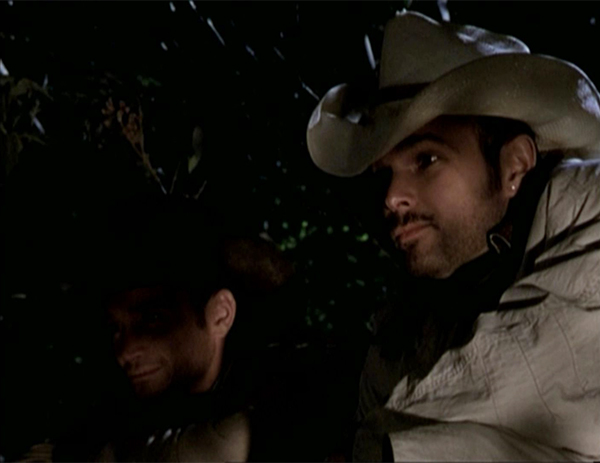
There are very few returning villains in this show. Outside the Big Bads, which exist within a season’s structure, the villains that the show feels worthy to bring back in different episodes consist of Faith, Spike, Drusilla, The First Evil, Ethan Rayne, and Harmony – all of whom are rich characters with great potential, beloved by the fandom. And also Lyle Gorch, who is not. I can only presume that the actor was particularly enjoyable to work with, because I cannot see anything else here that would make a writer feel that this character is worthy of a second shot in Homecoming.
I hesitate to use the word “filler”, as it implies a negativity that I don’t think always should apply – whether or not an episode is relevant to an overarching plot is actually irrelevant to its quality. But there is a real sense of lacking purpose in the Gorch brothers’ inclusion. I don’t know why they’re here, and my best guess is that at some point in the script’s lifetime, they were Spike and Drusilla, but got changed when this episode got shifted in the running order, and they were shoved in at the last moment. Buffy is a show that always has such intentionality – everything is included because it is driving at some central metaphor or thematic point. And yet, outside of one small mention that Lyle “practically raised” Tector, which threatens to tie it to the parenthood theme, there seems to be no point to them. They don’t even raise the stakes – vampires are a smaller threat than underground body-snatching demons at this point. I have not been so stumped for an answer to “what is the point of this part of the episode?” since the Fork-vampire in Teacher’s Pet.
And so, I would like to state my theory on why season two is riddled with episodes such as this. Because it needs to be. In order to complete its transformation and birth its true self, the show must first exorcise the demons of season one. It must get all its worst impulses out of its system. It must deliver us sledgehammer metaphors and even “filler”, to rid itself of those toxins. To purify, we must bleed. We must binge, so we can purge. Before we can get Innocence, we must wade through this odd little monster-of-the-week waste of cowboy hats.
Oh well. It’s still better than Teacher’s Pet.
* * *
Thanks for reading!
If you enjoyed this piece, please consider supporting me on Ko-Fi!
* * *
 Insect Reflection