
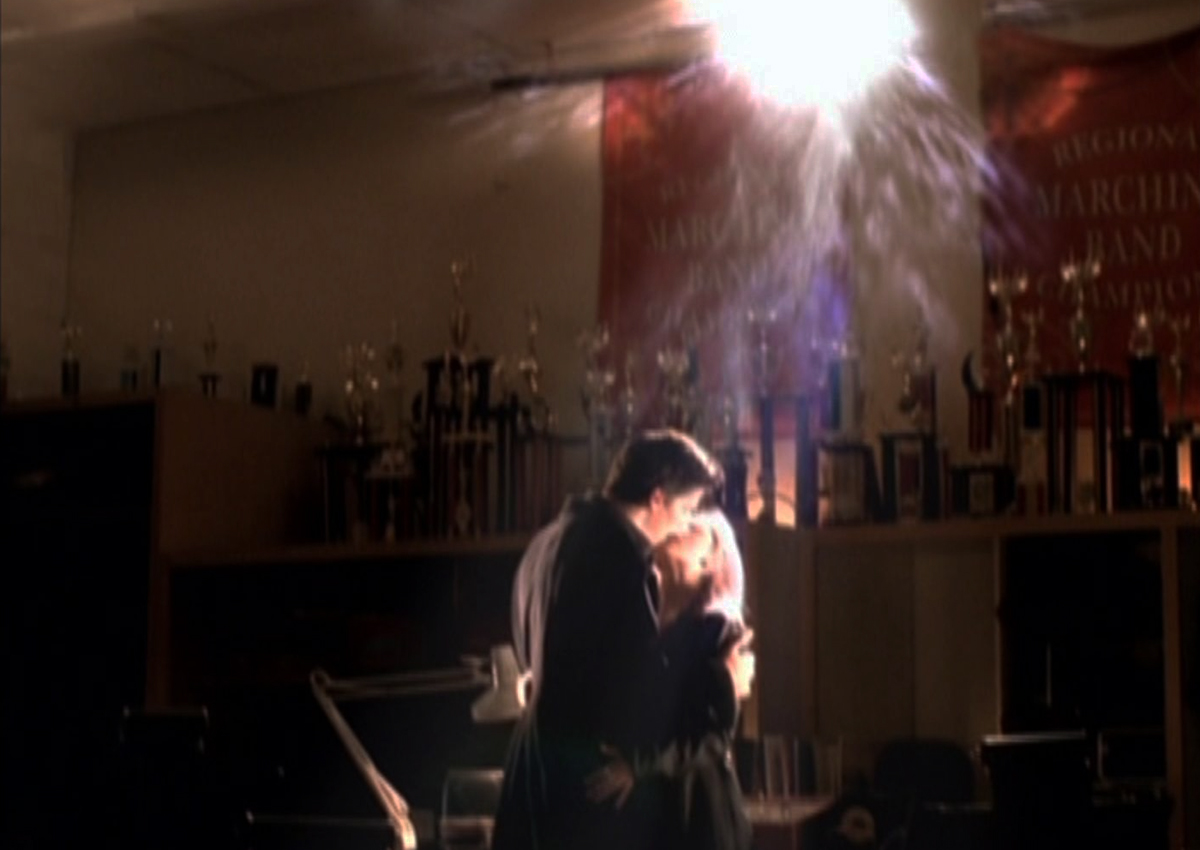
My love must be a kind of blind love.
I can’t see anyone but you.
Are the stars out tonight?
I don’t know if it’s cloudy tonight.
I only have eyes for you dear.
The moon may be high.
But I can’t see a thing in the sky.
I only have eyes for you.
On the night of the Sadie Hawkins dance in 1955, a boy from Sunnydale High shoots and kills his lover – an older woman named Grace. In his ensuing grief, he goes to the music room and, as he prepares to kill himself, plays The Flamingos’ 1957 song ‘I Only Have Eyes For You’. Yes, those years are correct.
The temporal impossibility of this event is a fun little continuity error, but it is oddly appropriate too. The reality of it matters less than the meaning. The story of James and Grace is held at a purposeful distance, and we see only a fraction of it. We don’t know the importance of this song to them , or how a 1957 song was played in 1955. This is a world where the Russian revolution canonically occurred in 1905, so perhaps in this universe, this song really was released a few years earlier.
Perhaps they danced in secret to it once. Perhaps it was playing when they met. Perhaps it was just the only song available in the music room. Perhaps it was never played at all, and Buffy hearing it in this episode is just her getting a scrambled flash of the past, a moment distorted by time and memory, filtered through her own traumas and projections. Perhaps Buffy hears this song not because it was actually played in 1955, but because of its relevance to her own situation.
That’s the important thing to remember – that James and Grace in themselves do not matter at all. Their story only matters insofar as it relates to the doomed, tragic lovers at the centre of this season. We should view everything that James and Grace say to each other in this context, and consider each line in how it relates to the characters whose story we really know – Buffy and Angel. They end up being the actors in James and Grace’s play, but the story is still really about them.
In this play, Angel takes the role of Grace, while Buffy plays James. This gender reversal makes sense. It is foreshadowed by the structuring of this incident around the Sadie Hawkins dance: an event based upon the reversal of traditional gender roles, where female students must ask male students out instead of vice versa (which is obviously expected and mandatory otherwise (God, cis people are simply bizarre, aren’t they?)).
It is also parallel to the foundation of Buffy. The show is built upon that very simple inversion of the gendered horror trope – the blonde girl in an alley kicking a monster’s ass instead of being killed by it – so it should be no surprise at all that the genders are inverted here. It’s a clever mislead on the show’s part, suggesting that James and Grace must be portrayed by a man and woman respectively, before pulling that away and showing that no, it is the details of the person that matter more than the gender.
Angel is paralleled by Grace, as the older, more experienced member of the couple, who is more reluctant to pursue the relationship. These parallels even come down to their names – ‘angel’ and ‘grace’ both being ideas relating to heaven and divinity. Angel/Grace is the victim in this tragedy – killed by their lover. Just like back in What’s My Line and Surprise, Angel is taking on the feminine role, one associated with passiveness.
Buffy and James do not have such a clear naming parallel, but they are both young, more naive teenagers who have fallen in love with an older person. They have allowed that love to blind them, and have become unable to see any future outside of their relationship. So when that relationship ends, they completely break down. They take the role of killer here – the masculine, the active.
“He couldn’t make her love him, so he killed her. Sicko.”
Buffy Summers, 2×19 I Only Have Eyes For You
Buffy’s over-identification with and hatred of James starts straight away, long before it is spelled out by Cordelia. The first thing she says about him is that he killed Grace because he “couldn’t make her love him”, which is a fairly accurate description of the journey Buffy herself has undergone. She tried to make Angel love her again, to get through to him and bring out the old him in Innocence, and when she realised that was impossible in Passion, she resolved to kill him.

And she hates herself for that.
Buffy is faced with the idea of forgiving James, and cannot abide it. She tells the group that he doesn’t deserve it, and even after two pep talks from Giles, she still ends the episode not really being able to understand why he would be forgiven by Grace. This is all based upon her own projection, her hero/martyr complex, and her compulsive sense of responsibility. She takes responsibility and blames herself for events from all chronological angles – past, present, and future. She blames herself for “destroying” Angel and releasing Angelus back in Surprise. She blames herself for having presently made the decision to kill Angel. And before it has even happened, she is already blaming herself for killing Angel in Becoming. Her self-blame complex transcends time itself.
Underneath all this self-hatred, we see an even darker undercurrent. James and Buffy are not only doomed to kill their lovers. The event tying them together is not just a murder. It’s a murder-suicide. We have seen glimpses of Buffy’s suicide complex so far, such as her spiral in When She Was Bad or her declaration in Ted that she would “kill herself” if he married Joyce, and it raises its head again here. James identifies with Buffy not just because she has to kill her lover, but because she too is driven to destroy herself afterwards. It is a pattern that Buffy repeats. She is trapped within it, doing the same thing again and again – like a ghost.
Buffy’s eventual murder of Angel will be borne out of duty rather than emotion, while James’ kiling of Grace is al about emotion. As Passion told us, a murder driven by emotions really makes the killer just as passive as the victim. James kills Grace because he loses himself and loses control – he becomes a slave to his passions.
“James destroyed the one person he loved the most in a moment of blind passion.”
Buffy Summers, 2×19 I Only Have Eyes For You
“My love must be a kind of blind love”
The Flamingos, ‘I Only Have Eyes for You’
Passion and love are both present here, not exactly the same, but related, and linked by the concept of blindness. Buffy suffered with her own blindness in the first half of the season, literally being unable to see any part of her future that did not involve her current relationship. She suffered the short-sightedness of youth, just as James does. He is prepared to use a gun to stop his relationship falling apart. She was prepared to give up her future.
It should be worth noting that both Angel and Grace must shoulder at least part of the blame for this. Both are fully-grown adults with much more life experience, engaging in relationships with people who are, factually speaking, children. Now, I don’t want to get too much into this because it’s a complex issue that can’t really be tackled straight-on in this situation. It seems churlish to complain about a centuries-old vampire dating a high-school-age woman in a supernatural teen drama. It’s basically a genre staple at this point (although Buffy did its fair share of making it a staple). It pretty much comes with the territory. The presence of vampirism and supernatural destiny heightens the whole thing and lifts it away from reality.
However, mirroring it against a relationship between a teacher and her student grounds it back down – I think intentionally. The Bangel age difference is something that has become slightly toxic to talk about in fandom, given how often it is levied simply to bash one romance to (rather hypocritically) prop up another. However, I think that the show does want us to keep it always in mind, and let us consider it. I believe we are meant to be a little bit uncomfortable. This will be relevant when we see a certain flashback in Becoming.
The important thing here is that Buffy’s blindness – her naivety – does not last. Her experiences this season are a big step in her growing up. By the end of the season, she will no longer be a child, and she will no longer be naive. Her eyes will be wide open, and it’s someone else who will be blind.

This episode is built to preemptively recreate the events of Becoming, as Buffy “kills” Angel with a wound through the chest. His last words will be the same as Grace’s – his lover’s name – and Buffy’s reaction will be the same as James’ – stunned, horrified silence, and a tearful sense of what have I done? This season’s tragedy is so complete in drenching every moment. It’s not just that the tragedy is inevitable. It’s that the tragedy already happened, is happening, will happen again. Buffy cannot stop killing Angel. They are ghosts in reverse, re-performing their own tragic ending before it has even happened.
The two components of the James/Grace scene – the breakup and the murder – are both reflected in Buffy and Angel – the latter in Becoming and the former in The Prom, where their relationship truly ends. We will explore their break-up in full when we get to that episode, but it’s interesting that this episode is called back to repeatedly. Season Three is where Buffy and Angel deal with more mundane relationship difficulties – planning for a future, sexual incompatibility, the possibility of children, and so it makes sense to call back to this event, this very mundane tragedy between two normal human people.
“Before you know it, you’ll want it all, a normal life.”
Angel and Buffy Summers, 3×20 The Prom
“I’ll never have a normal life.”
“I just want you to be able to have some kind of normal life. We can never have that, don’t you see?”
Grace and James, 2×19 I Only Have Eyes For You
“I don’t give a damn about a normal life!”
“Who are you to tell me what’s right for me? You think I haven’t thought about this? (…) I’m just some swoony little schoolgirl, right?”
Buffy Summers, 3×20 The Prom
“Don’t. Don’t do that, damn it! Don’t talk to me like I’m some stupid kid!”
James, 2×19 I Only Have Eyes For You
“I want my life to be with you.”
Buffy Summers and Angel, 3×20 The Prom
“I don’t.”
“Then tell me you don’t love me! Say it!”
James and Grace, 2×19 I Only Have Eyes For You
“Is that what you need to hear? Will that help? I don’t.”
Of course, Buffy and Angel are not the only tragic love story present. This episode does everything that Killed by Death didn’t to deal with Giles’ grief and the aftermath of Jenny’s murder. We see him spiralling, conjuring up a vague, half-baked theory about her ghost, just so he will have something to cling onto.
Giles and Jenny form the third point of a trifecta of tragic couplings along with Buffy/Angel and James/Grace, and include major parallels to both. We see Giles receiving a posthumous gift from Jenny (via Willow) of a rose quartz necklace, and he is later seen treasuring it in his office – evoking Bangel’s jewelery-gifting motif, and how Buffy mourns over the cross necklace and claddagh ring in Innocence. Meanwhile, Giles and Jenny’s own motif of gifting books, as we saw in Passion and Some Assembly Required, is referenced by the flashback Buffy sees of Grace and James, where they bond over a Hemingway book that she has leant him.

Buffy is summoned to the school for the episode’s climax by James’ ghost, calling out “I need you”, and this is not the first time we see this tactic from the ghosts. The first is when Giles hears a female voice call out to him – again the words “I need you” – and mistakes it for Jenny, just before the ghosts possess the janitor and teacher. The simple conclusion we can make here is that the voice Giles hears is in fact that ghost of Grace.
This would suggest that, just like James relates to Buffy and calls out to her because of that, that Grace relates to Giles, and is trying to call out to him, to get him to re-enact her part. Giles is the older member in his romance (Jenny’s age is slightly ambiguous but is likely somewhere around Robia LaMorte’s (at the time) 27 years, 17 years younger than Anthony Stewart Head), and is mourning the death of his love, just as the ghost of Grace is. It is appropriate that Giles becomes the voice in favour of forgiveness in this episode, as it is Grace’ forgiveness of James that allows them both to resolve their trauma and move on. They are both icons of forgivness – of salvation – of, well, grace.
“A part of me just doesn’t understand why she would forgive him.”
Buffy Summers, 2×19 I Only Have Eyes For You
“To forgive is an act of compassion, Buffy. It’s not done because people deserve it. It’s done because they need it.”
Rupert Giles, 2×19 I Only Have Eyes For You
Giles eventually lets go of his “Jenny’s ghost” theory, and therefore part of his grief over Jenny, when Willow points out to him that Jenny “could never be this mean” after the ghost attacks her. Her hurting Willow is proof enough that it is not her. Which, as well as being an important step for Giles, is also a meaningful point to remember in the ongoing “is soulless Angel still Angel?” debate. This would be a strong argument that he is not. Angel protected Willow, while one of Angelus’ first acts was trying to kill Willow in the school corridor. Angel could never be as “mean” as he is being to Buffy, so it’s not Angel.
However, the episode also makes some gestures in the direction of Angel still, on some level, being in love with Buffy. This is the episode with the line “a person doesn’t just wake up and stop loving someone”, and in its own context, that line is true. Grace didn’t wake up and stop loving James – she is purposefully lying about the fact that she does still love him in order to make it easier for them both. It’s possible that Angel’s claim that he no longer loves Buffy is also a lie.
At the episode’s end, Angel is furiously scrubbing himself, disgusted at this feeling of “love” that infected him, that was inside him. He is visibly tortured by it and exaggeratingly derisive of the concept. However, he is no longer possessed by the ghost, and even when he was, there is no indication that possession would actually spark feelings of love – it just dictates the vessel’s actions. If Angel is feeling “love” in that moment, then it is love that was already there.
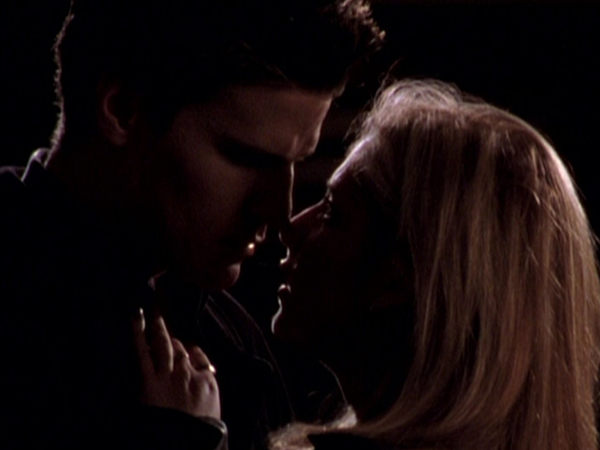
The moment that this scene most reminds me of is Something Blue, where Spike will dramatically spit and protest about how awful it was to kiss Buffy under the influence of a spell. If Fool for Love’s flashback is to be believed, then Spike was already in love with Buffy at that point, and so his disgust was clearly a moment of he doth protest too much. We will talk more about Spike in a couple of episodes, but it is interesting that this is the point where he effectively re-enters the narrative. He has been on the sidelines since What’s My Line, mostly just there for smart one-liners, but now he re-enters as an active character, ready to make alliances and upset the status quo – and it is directly in the wake of a soulless vampire declaring how disgusted he is at the idea of loving Buffy Summers.
It is my belief that Angel, even when soulless, still “loves” Buffy. Deep down inside his twisted dead heart, there is a feeling that resembles love, that it is coming out in expressions of cruelty and murderous devotion, and that its existence is driving him insane. It is this moment, this sparking of this feeling as he is forced to engage in a romantic kiss with Buffy and be recognised by her as “Angel”, that drives him over the edge. When we next see him (outside of Go Fish, which doesn’t count because it’s Go Fish), he will be ready to send the entire world to hell. This is the grand version of what he states he needs at the end of this episode – a particularly vile kill to wash the “love” out of him.
This would be a horrifying end to the world, and so there is only one solution to create a “happier” ending – Buffy must kill Angel. Grace and James’ play is all about trying to create their “happy ending”, and it is one that they cannot access unless James reanacts his killing of Grace. The murder is a necessary ingredient in their happy ending. So too for Buffy.
The happy ending they eventually create is a lie. It never happened. James wasn’t stopped from shooting himself in the music room. Grace never told him that she still loved him. They never shared that last kiss. It is a lie that they tell each other, so that they can move on, so that they can find some peace at the end of their hell.
Buffy and Angel have no happy ending. They act out their own lie, where Buffy gets to hear all the things that she wants to hear from Angel – that it doesn’t matter that she will kill him, that he “never stopped” loving her. But at the end of it, there is no peace. There is no fairytale ending, where the gods come down and bless Angel with a new soul. The romance gives way to horror. The spell ends, the truth is revealed. He pushes her away, and they are back in reality. There is no happy ending to this story. The rock rolls back down the hill.
In this world of suffering, these moments of peace, these little lies – they are all we have. And though they may end, they are what makes the journey worth living. Buffy is doomed to kill Angel. He is doomed to break up with her. There is nothing that can change that. But on the way, they can have these moments, where they can be in love, and happy. In their brief time together, they can love a lifetime’s worth. All they have in that moment is each other, and it is only for a moment. Two people looking at each other, and being in love. Despite everything, despite all this death and misery – that is something worth having.
I don’t know if we’re in a garden
Or on a crowded avenue
You are here
And so am I
Maybe millions of people go by
But they all disappear from view
And I only have eyes for you
* * *
Thanks for reading! If you enjoyed this piece, please consider supporting me on Ko-Fi!
* * *
 Insect Reflection