
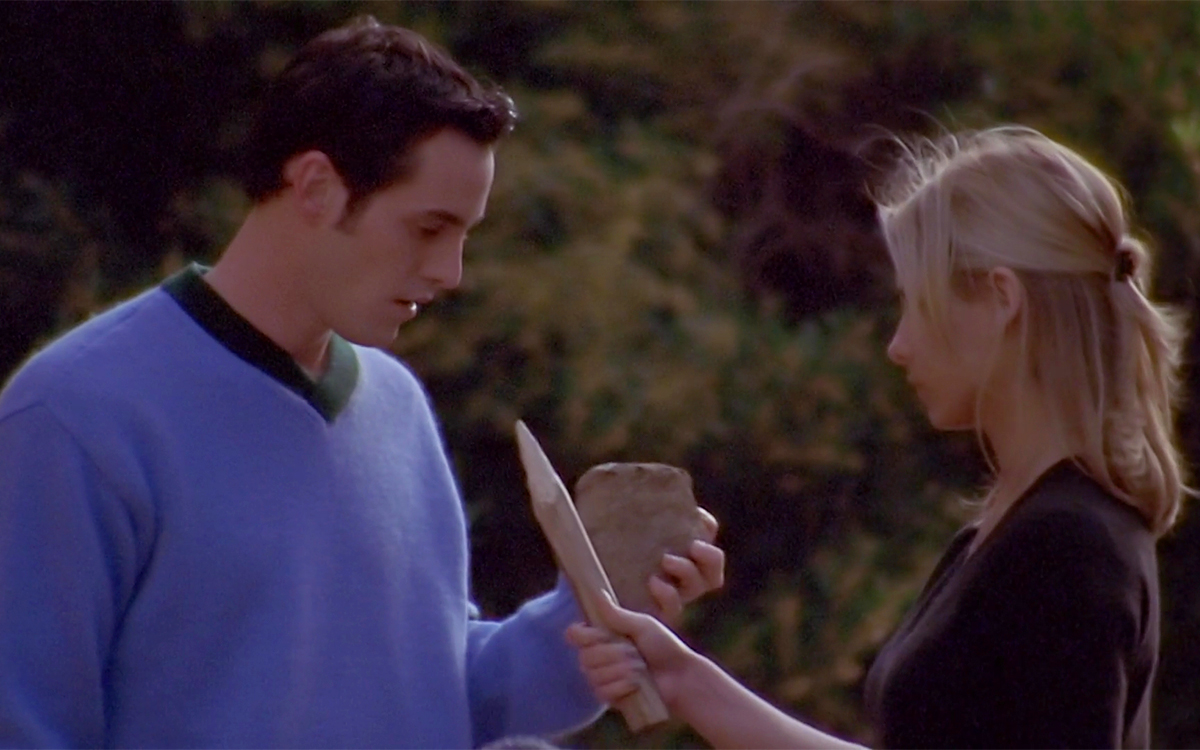
This is the third of four essays on Becoming. The first focused on Willow’s arc; the second on the journeys of Angel, Spike and Drusilla; the fourth will focus on Buffy’s arc and final choice.
I feel like we should acknowledge, at this point, two big clouds of controversy hanging over this episode: the debate over whether to re-soul or kill Angel, and relatedly, Xander’s lie to Buffy, where he leaves out Willow’s message and instead tells her to “kick [Angel’s] ass”. Both are very divisive topics within fandom, and while I agree with the general fandom leaning on them, I think both sides have fair points that are worthy of discussion. I also believe that the show takes a side, and the side it takes is illuminating. We can only untie this knot by really getting into it and considering each area of the debate in turn. Of course, this means devoting an entire essay to it, so we never have to talk about it again.
(Disclaimer: we will absolutely talk about it again).
“He’s a vampire. He should die. Why am I the only person who sees it?”
Kendra Young, 2×10 What’s My Line?
The perspective spearheaded by Xander – and supported by Kendra and Cordelia – is one based in moral simplicity. “Angel’s a killer” Xander says, and he is not wrong. Angel is, factually speaking, a killer. He has killed before and he will kill again. He is killing right at that moment (the episode makes sure to cut to Angel and the gang murdering people at the museum immediately after this discussion, lest we forget).
The unspoken assumption of Xander’s view is the same one that Kendra made back in What’s My Line? Angel is an evil vampire, and should therefore die. “Angel’s a killer”? Fact. “He’s a vampire”? Fact. “He should die”? There is the assumption. Xander’s argument presumes that because Angel is a killer, that means that the morally correct action is to kill him. This can either be considered as a method of prevention – to prevent him from killing more people. Or a method of punishment – as retribution for what he has done.
My personal standpoint on retributive justice is that it is cruel, pointless, and does nothing to help anyone. It may be satisfying in the moment, but it neither helps victims heal nor protects. My personal opinions obviously colour my take, which is why I’m disclosing them, but I think it is an angle that the show generally agrees with. Season six presents retributive justice towards Warren – vengeance, as it names it – as an evil act that corrupts Willow and only worsens her pain in the long-run. This season’s main advocate of vengeance is Uncle Enyos, who as we said in the Innocence review, is positioned as a fool who is counter to the show’s tenets of existential philosophy. The fact that Xander is positioned on the side of retributive justice is our first clue that we are not meant to be on his side here.
A large part of the discussion re: Willow’s vengeance against Warren hinges on the fact that he is a human, and killing him is morally different to killing a demon. This is an aspect of the show that I very much would like to unpack – and will eventually – but here it’s simply interesting to note that this season doesn’t put too much stock in the idea. When Kendra suggests that Angel should die because he is a vampire, it is evidence of her limited moral outlook, and one she outgrows by the end of the episode. Xander agrees with pre-character-development Kendra, and he is not made sympathetic in doing so.
The argument for preventative justice is Xander’s more sympathetic angle, and seems to be the part that post-character development Kendra agrees with. Angel will kill more people if left unchecked. He is actively trying to cause the apocalypse at that moment. Even if imprisonment would be a moral option in this case, human prisons would not be able to hold him. As a soulless vampire, he is presumed incapable of free will and choosing to better himself. He cannot be restrained in other ways – it’s not like they can just put a Don’t-Kill-Humans chip in his head or anything crazy like that. The only option remaining, to prevent him from killing again, is to kill him first.
The immediate counterpoint to that is the curse. Giving him a soul is in itself a preventative measure. I don’t think it’s useful to talk about Angel and Angelus as two separate people, and so I skip over any argument that starts and ends with “but Angelus killed people, not Angel”. But I think this is just an oversimplification of a very true point. Angel is not immune to sin, even with a soul (as we will see far more in AtS), but it’s demonstrably true that Angel having a soul makes him extremely averse to killing people or causing apocalypses. Giving him a soul prevents future deaths.
The counterpoint to that would be that the re-souling ritual is an untested and inconclusive solution, based upon a translation of a centuries-old text that may or may not be correct, due to be performed by a seventeen year old with barely any magical experience. Even if it works, it does not account for the potential of him losing the soul again. The perfect-happiness loophole can, beyond Buffy, apparently be invoked by vivid hallucinations, shamanic spells, and even artificial drugs. I think it’s important to keep in mind that the re-souling is not a perfect solution long-term.
Where Xander’s potentially valid point here is completely undermined, however, is in the fact that he doesn’t even consider the alternatives. There is valid strategic advantage to having multiple separate methods of restraining Angel.
“I tend to side with your friend Xander on this one. Angel should be eliminated.”
Kendra Young and Buffy Summers, 2×21 Becoming
“Oh, I’ll fight him. I’ll kill him if I have to. But if I don’t get there in time, or if I lose, then Willow might be our only hope.”
I can’t fault this conclusion – from a purely military standpoint it makes sense. Plan A, and then Plan B if A fails. But even this is not without its drawbacks. The key sentence from Buffy is: “I’ll kill him if I have to.” This clearly positions ‘Kill Angel’ as a secondary stratagem; Plan B. This follows when Buffy goes to fight Angel, and she does not go in with the intention of killing him. She specifically holds back, focusing on delaying him instead, to give Willow time to complete the ritual, and this is so obvious that Angel even points it out.
“Jeez, is it me, or is your heart not in this?”
Angel, 2×21 Becoming
Usually, delaying rather than fighting to the death would be a dangerous game that would present a risk to Buffy herself. The tragic part is that wasn’t the case here. Buffy wasn’t in danger of dying in this fight at all. A delay was exactly what Angel wanted. She unintentionally played right into his hand. If she had gone in with the intention of killing him, then, as Angel was fighting to delay her, he would have been at the disadvantage. She might have been able to stake him quickly and get back to the school in time to stop Drusilla. But she doesn’t. Her choice allows their attack to go ahead as planned. Kendra dies because Buffy delayed.
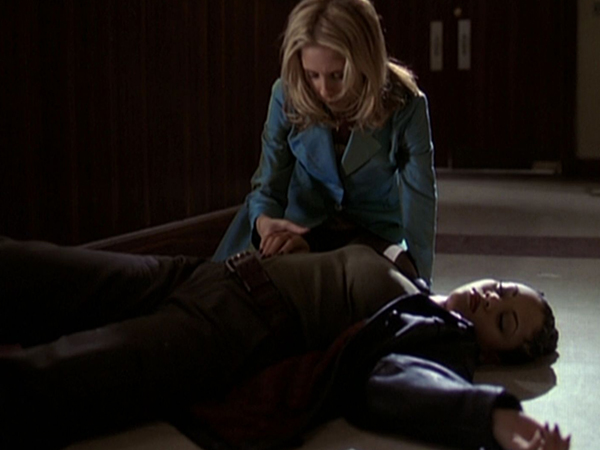
This isn’t to blame Buffy, or to say that Xander is right. Buffy made a fair choice given the information and resources she had. She could not have predicted Angel’s plan, or that it would end the way it did. The point here is to emphasise the power that Buffy has, and the fact that her choices impact everyone, whether she would like them to or not.
It would be far too generous to Xander also, to assume that his motives are entirely strategic. They are based on emotions, and ugly ones at that. Hatred; envy; resentment. Grief. I think suggesting that Xander is entirely driven by his romantic jealousy towards Buffy and Angel would be myopic – but it’s not not a factor. Similarly, the common fan headcanon of Xander holding a vendetta against vampires for what happened to Jesse is overly sympathetic, and ignores the fact that Jesse simply hasn’t mattered or existed since episode two.
Rather, I would focus on the general fact of Xander’s character that he always thinks in absolutes and tries to deal with complex emotions by simplifying them; sanding down any nuance and focusing only on one core aspect. In four years time, we will see the positive side of this, when Xander is prepared to ignore that Willow is destroying the world and focus on the simple fact that he loves her. Here, we are seeing the ugly side. I would also remind everyone that Xander comes from an abusive household, and his tendency to see the worst in people and mistrust violent men specifically is not a character trait that has evolved out of a vacuum.
With all that in mind, let’s get to the core of this one simple fact: Xander is, in this scene, being a dick. He is harsh, flippant, and insensitive. He invokes Jenny’s death in order to strengthen his argument against Angel, and then dismisses her relevance when Giles points out that re-souling Angel appears to have been Jenny’s dying wish. He accuses Buffy of being blinded by her romantic feelings, when his own are somwhat of a factor. He steamrolls over the fact that not only is she also trying to control an apocalyptic scenario, but is also clearly on the fence about the situation. Importantly, Buffy does not argue wholly in favour of the re-souling. She’s openly torn.
“You can paint this any way you want. But the way I see it is that you wanna forget all about Ms. Calendar’s murder so you can get your boyfriend back.”
Xander Harris, being a dick, 2×21 Becoming
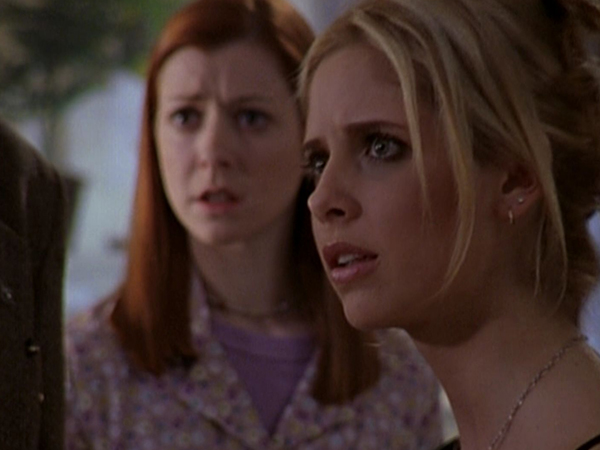
And here’s the point that I feel gets missed in most discussions of this scene: Xander is meant to be a dick. We are not meant to agree with him, or sympathise with him. His points are not unfounded, and there are some things in his argument worth considering, but the way he presents them is out of line, and the show makes that very clear. Giles admonishes him, Buffy and Willow are both clearly appalled by his words, and on the phone later, Willow calls him a word that apparently shocks Buffy. Our sympathies are not meant to lie with him, and so it surprises me when I see people who dislike Xander in this scene presenting this as a criticism. Disliking Xander here is the show’s intended emotional response. The fact that he is sometimes a dick, and is a dick here, is part of what makes Xander, to me, a compelling character. I will always defend the legitimacy of characters being allowed, sometimes, to be dicks.
Buffy is torn, but ultimately decides to re-soul Angel. It is a fair decision, given the options available to her and the information she has. She doesn’t entirely rely on it and pin all her hopes on getting Angel back – she simply allows it as one plan, while still preparing for another. It would be foolish to say that her love for Angel isn’t influencing her decision at all – of course it is. She’s human, and humans make decisions based on emotions. The fact that we see her pick up the Claddagh ring just after discussing the decision with Willow I think clues us into her emotional state too. But she is also clearly keeping in mind the moral debate, practical concerns, and the risks to innocent lives, and factoring all of this in.
All of this discussion and debate pertains to Angel and his soul, but there is a clear elephant in the room here. It’s one that we need to address before we can move on.
Why just Angel?
As soon as the Scoobies have a method of restoring souls to vampires, and the resources to do so, then why do they not do this for all vampires? The ritual provides them with a rehabilitative method of justice that is roundly ignored in favour of a mortal one. There are justifications that fans have suggested – it’s tough for ensouled vampires to handle the weight of their crimes, and some of them may choose to carry on committing murders anyway. These are true, but they ignore the facts that freshly-risen vampires could be ensouled before they’ve had a chance to commit crimes, and that ensouled vampires in this series have at least a 66% record of not being evil.
(Oh, and any argument that suggests that life as a vampire would be hard and therefore not worth living is eugenics propaganda infiltrating fandom spaces, and should be dismissed out of hand.)
So why not re-soul all vampires? Well, the answer is rudely simple. Because it breaks the show. Buffy the Vampire Slayer would not longer exist – we would instead be watching Buffy the Vampire Ensouler. Buffy the Vampire Rehabilitator. That sounds like an interesting show, sure, but it’s not this show. This show has different ambitions and different aims, and to carry them out, it needs Buffy fighting and killing vampires. Sometimes, it is necessary to simply accept that.
Angel gets a pass, because he is a main character, he’s Buffy’s love interest, and we want to keep David Boreanaz around to give him a spin-off in a year’s time. Spike is not cursed, but he gets to have a soul for similar reasons. The average mook does not have these factors in their favour, so they will continue to be slayed without mercy. There doesn’t seem to be much benefit in fretting over this any further – the show needs us to ignore the Orb of Thesulah in the room in order to reach its emotional and thematic goals, and given how well it generally achieves those goals, I am prepared to do just that.
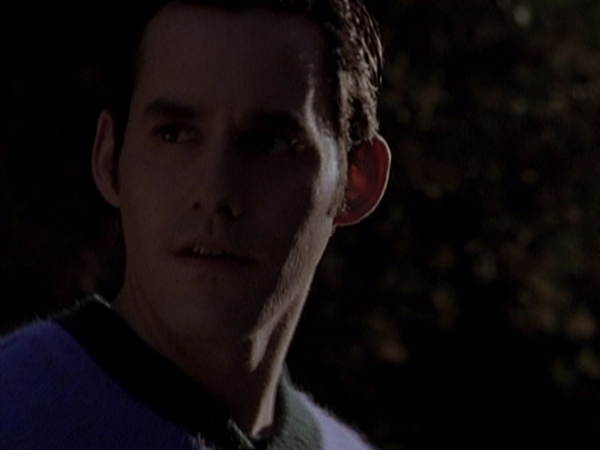
So this brings us to The Lie.
Everything that was relevant in the previous scene is relevant here. Xander still has a modicum of a point in wanting Angel dead. It would still be a risk for Buffy to, as she did in the previous fight, hold back in hopes of stalling him until Willow’s spell activated. And, contrary to an accusation I sometimes see bandied about – The Lie does not cause Angel’s death or increase Buffy’s trauma. Buffy could not have actually done anything differently had she known about Willow’s spell. Angel pulled the sword out of Acathla pretty much the moment she arrived, and from that point, their destiny was set in stone. Acathla’s portal was going to open, Angel was going to get his soul back, and Buffy was going to have to either kill him to let the world end. The Lie did not, actually, matter.
However. Withholding information from Buffy prevents her from making a fully informed choice. It takes away options and makes her less able to predict events. Xander had no way of knowing that his lie would not actually have a negative impact. It was still the wrong thing to do. From a military perspective, it’s a strategic disaster. From a personal perspective, it’s a dick move to pull on a friend. I truly believe that Xander is doing it out of what he perceives as kindness, but that does not make it okay. What Xander did was wrong.
Again, I would like to emphasise that he is meant to be wrong in this moment, and that it is a realistic and understandable wrong for Xander to commit. There is nothing bad about letting characters do wrong things sometimes. It is frustrating, however, that there is never any follow-up to this (the brief reference in Selfless being woefully insufficient). That’s not a criticism of this episode, but mainly a criticism of early season three, and all ensuing episodes that do not provide full closure to this moment.
All of this discussion has focused on the in-universe motivations and ramifications surrounding Angel’s soul and The Lie, but there is a symbolic meaning here too. It’s one that I belive justifies the inclusion of The Lie as part of this episode.
Xander is Buffy’s Heart. He is himself too, but as a character he will always exist as an aspect of Buffy. In this season, Buffy’s heart belongs to Angel. She is in love with him, and wants to devote her life to him. A necessary part of being able to kill Angel, and take another step on the metaphorical journey towards adulthood, is being able to let him go. To let him out of her heart and see a world without him. Whether he is part of her future or not, she needs to be able to look into the future, and not only see him. Remember Angel’s words?
“Jeez, is it me, or is your heart not in this?”
Her heart needs to let him go. And so here is her Heart, the whole episode, screaming at her to do just that. To cut him loose and do what needs to be done. This is heart against Heart. It is what William Faulker once said was the only thing worth writing about: the human heart, in conflict with itself.
When Xander tells his Lie, this is Buffy’s heart symbolically letting go of Angel. It clinging to hope, stops clinging to a future that only contains him. She is giving herself permission to do what she needs to do – to “kick his ass”, and go on living without him. The metaphorical purpose here is superseding the interpersonal dynamics. Xander, the character, is pulling a dick move and doing Buffy a disservice. Xander, the symbol, is giving Buffy exactly what she needs.
* * *
Thanks for reading! If you enjoyed this piece, please consider supporting me on Ko-Fi!
* * *
 Insect Reflection
A lot of people like to use this among other circumstances to point and say, “hey, that guy is just the worst character.” But it’s not true. This was a good analysis. The show has always pointed to Xander being her heart and what I think a lot of fans miss is that sometimes your heart can tell you what you’re doing is wrong/not the right direction to take, but we can be too stubborn to hear it sometimes.
I like that heart aspect of his character, but I also would’ve preferred if the showrunners actually developed the character instead of keeping him in the same place all 7 seasons. If Buffy’s heart is strong, Xander should be too. He should’ve evolved with Buffy, not stayed the same all 7 years.
LikeLike
Excellent analysis. I always assume that they couldn’t use the same spell on other vampires for three very big reasons. One, based on what Willow tells us, it’s an insanely difficult spell to do correctly, and if it’s not done correctly, the consequences could be bad. Who knows what they would even be since the spell itself is almost lost. She’s not a terribly experienced witch at that point, but Jenny was, and it’s not like she just casually attempted the spell in the classroom once she finished it. Obviously there isn’t a whole lot of time left for her to do that to allow for her death, but it doesn’t seem like something you could just pick up and do.
Two, this is a non-permanent solution. One of the biggest issues would be that if another vampire was given the same curse and then either chose or by accident, like Angel, to lose their soul again, and they’re in a place where they’re trusted, they’re going to kill people. That isn’t a reason not to try, but it is a reason to perhaps seek a more permanent solution before it’s mass applied.
Three, I always read this as a spell specific to Angel himself. Simply by matter of numbers, it’s very unlikely that every vampire sees a soul as a curse, but Angel specifically, who was raised Catholic in Ireland in the 1700s, absolutely does because of the things he’s done. This is extrapolation to some degree, but a lot of the magic in the show seems to work on choice and will, and I’m not sure something that specifically assigns a soul as a curse would work on every vampire. I also don’t know that every witch would see it as a curse, but the people who originally created it did. It feels Jenny’s people had skills that allowed them to craft a spell directly in response to Angel’s crime, so as much as it would be interesting for it to translate to other vampires, I doubt that it does. I think that’s why it’s so effective. When Spike gets a soul back later, it’s not specifically a curse, and he’s not specifically carrying around a ton of guilt for the things that he did the way that Angel does. If you use the same spell on the Master, for instance, would he recognize the very Christian-coded sense of repentance that comes with it? We don’t know how old he is. Maybe he’s older than that, and maybe he wouldn’t see it that way. Morals and guilts are by no means universal to the human experience.
This is giving the show a lot of credit, but I can’t help but imagine this conversation happened somewhere in the writer’s room. I think if it were easy to “fix” vampires, someone would have done it already. After all, somebody went out of their way to create a Slayer for them approximately a bajillion years ago, but in the time since, no one has tried to find a way to prevent them from being dangerous in the first place, which would always be the smarter move. That leads me to believe that either they don’t know where to start, or people have tried before and failed.
LikeLike