
“Love isn’t brains, children, it’s blood. Blood screaming inside you to work its will. I may be love’s bitch, but at least I’m man enough to admit it.”
Spike, 3×08 Lovers Walk
The nature of love is an impossible thing to distill. If it were possible, then the poets would have done so already – they’ve been trying for thousands of years after all. For this reason, I do not believe that any strict definition or way of categorising love exists, and that any attempt to do so is, by virtue of existing, moot. It cannot be summed up in one word or ten thousand. Love is a fractal gem, unexplainable without all its facets.
Still, one poet gives it his best shot here. Spike defines love as an inherent primal force. It does not involve the mind, but is physical in nature – tactile and instinctive. Buffy is extremely concerned with the idea of Choice, but Spike positions love in opposition to Choice. Love, according to him, controls the inhabitant and denies them choice, forcing them to enact its will, not their own. Since free will is the cornerstone of humanity (under Buffy’s existentialist framework), then love, by taking away that free will, makes the lover less than human. The term “bitch” here isn’t being used only colloquially – it is meant to invoke its literal meaning, of being an animal. A Dog.
“All in your head. I can see it. Little bit of plastic, spiderwebbing out nasty blue shocks. And every one is a lie. Electricity lies, Spike. It tells you you’re not a bad dog. But you are.”
Drusilla, 5×14 Crush
Spike’s arc can be summarised simply as a struggle between two sides of himself. Between Monster and Man. Villain and Hero. Animal and Human. Many other characters exhibit similar dichotomies, but what’s interesting about Spike is that he has always and will continue to exist in the ambiguous space between them. He blurs the lines between his own extremes. He knows he’s a Monster, but can behave like a Man. He can be both Evil and Good at the same time. Even here, in his big speech of Season Three, he is simultaneously an animal (“love’s bitch”) and human (“man enough to admit it”).
Even with all the changes that Spike’s character goes through, the dog motif never stops being relevant to him. It comes up over and over again throughout the seasons, from his Pavlovian conditioning in Season Four (described by Spike as a “trip to the vet” that means he “doesn’t chase the other puppies anymore”), through his love and loyalty to Buffy that can only be described as dog-like in its obedience, even to his darker aspects, as in Doomed he associates his ability to do violence as being “a bloody animal”. Spike is driven by love in all his actions, good and bad, and in the same way, all his actions reveal him as some kind of dog.
“I thought I could change you, Spike. I thought maybe if I gave and I gave and gave, maybe you’d come around. Maybe be a little nicer. Stop treating me like your dog. But now I see it’s you. You’re the dog.”
Harmony Kendall, 5×14 Crush
I bring up Spike despite his lack of presence in this episode (and indeed this season, being one of only two where Spike is not a regular fixture) because I want to highlight how consistently this association between animals/dogs and Buffy’s love interests is throughout the series. The purpose of this motif is not to evoke wild romanticism – love as something dangerous and uncontrollable, as prone to ripping out your heart as it is to soothing it – but also to evoke poisonous loyalty – the kind that will make someone wait around their entire life for something that never comes. The show returns to the Dog/Love motif again and again, with this merely being the episode in which it is most explicit, and most centred around the character making his return – Angel.
“Maybe we shouldn’t be too couple-y around Buffy.”
Willow Rosenberg and Cordelia Chase, 3×03 Faith Hope and Trick
“Oh, you mean ’cause of how the only guy that ever liked her turned into a vicious killer and had to be put down like a dog?”
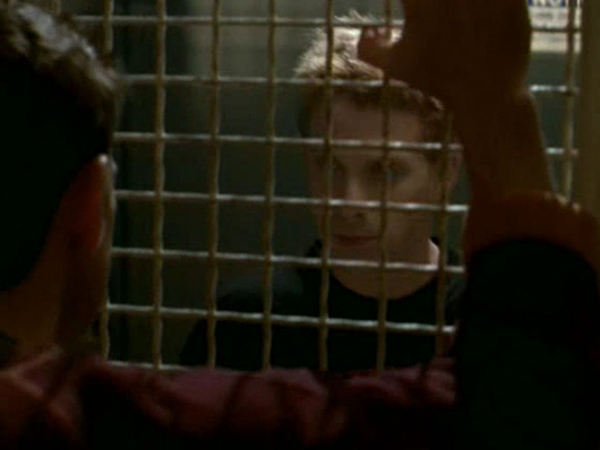
Buffy finds Angel when out on the hunt for the latest monstrous killer, attempting to clear Oz’ name. This episode is hypothetically more Oz-centric than many others but, typically for this character, isn’t really about Oz at all. Neither is it about Pete and Debbie, as much as their insipidity attempts to hijack the final third of this episode. It’s about Angel, and how he relates to Buffy’s journey. The mystery of the “animal” killer parallels the events of Phases, with Oz being the initial suspect before the discovery of Angel’s involvement (the only difference here being that there is then a third suspect revealed to prove Angel’s innocence too). Oz is a suspect because Xander – Buffy’s Heart – fell asleep around him, which is also a very rough description of how Angelus was released in Surprise.
The link between Angel and animals has been a major part of his character since its inception. We discussed it heavily back in his titualar episode. Like Spike, he lives with a dichotomy, but his is separated more distinctly into two parts of himself – the hero/human/Angel part and the vampire/animal/Angelus part. He will never proudly identify himself as a monster or an animal, but it will be a term that is assigned to him by antagonists who wish to discredit him, dismiss his goodness, or dehumanise him in some way. Vampire Willow calls him “Puppy” in The Wish, as does Spike in In the Dark. Holtz refers to him as an animal on multiple occasions, as does Connor and the Watchers Council. Angel’s main drive in his own series is to fulfil the Shanshu Prophecy and become human, thus removing the animal part of himself that he is ashamed of.
Yet this episode is still allowing for some ambiguity. When Angel returns, he is feral, capable only of growling and snarling instead of speech. He doesn’t seem like Angel, but he has a soul and is demonstrably not Angelus. He is at his most animalistic in his first scenes – the one where Buffy finds him and the one where she ties him up – but notably in both these scenes he only wears his human face, not his vamp face. The first time we see him in vamp face all episode is when he saves Buffy from Pete – aka. when he demonstrates that his humanity and love for her still remains.
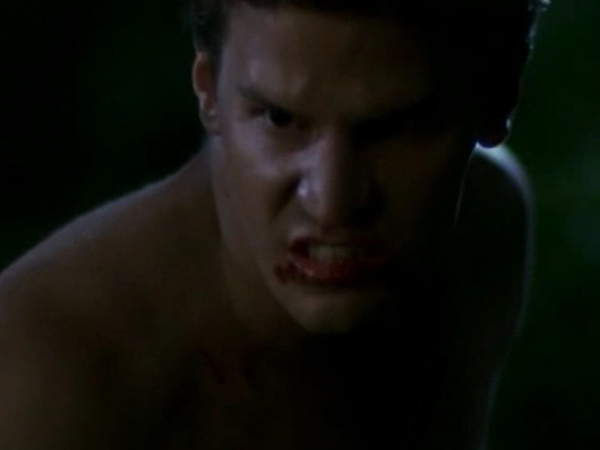
While Angel’s vampirism is so often linked to animalism, it’s never actually his base instincts driving his evil. It was actually his human self, Liam, who was driven by his desires for food, drink, sex, et al. Angelus was instead driven by artistry and twisted love. A love for death itself primarily, but the more we see of his history in Angel, the more we see how much of it stemmed from his affections for Darla, and we already saw in Season Two how Angelus’ torture of Buffy was driven by some twisted kind of love. This is the realisation that Angel comes to in Amends, when he tells Buffy that it’s not the demon inside him that is driving his evil and needs killing – it’s the man.
“But you see, that’s what makes you different than other beasts. They kill to feed, but you took more kinds of pleasure in it than any creature that walks or crawls.”
The First Evil, 3×10 Amends
I think Buffy would rather the separation was simple. It is simpler for her to compartmentalise Angel into two discrete beings. 1) Angel: ensouled, good, capable of love, loves her, wouldn’t hurt her. 2) Angelus: soulless, evil, incapable of love, doesn’t love her, would hurt her. Her insistence to Debbie that anyone that really loved her couldn’t hurt her might be a fair thing to say to a victim of domestic abuse, but it’s also something she is telling herself. She wants to believe that what Angel did to her in Season Two was because he did not and could not love her. This attitude is understandable, and helps her survive for now, but we will see that when she tries to apply the same logic to Spike in future seasons, it doesn’t work quite as well.
There are two characters who strike Buffy in this episode (other than the obligatory villain Pete). The first of these is Angel, who instinctively lashes out at Buffy when she approaches him from behind. The second of these is Faith, who in the library does exactly the same. The reason for both of these attacks is the same – it’s the instinctive, defensive reaction of a cornered animal. For Angel, it is because hundreds of years of torture have rendered him temporarily feral, and this is now his default reaction to touch. For Faith, it is a less extreme version of the same thing. She might not have spent a century in hell, but the abuse she has suffered has led her to the same default reaction. The parallel here is purposeful; to include Faith within this theme of animalism – and love.
“See, when I was a kid I used to beg my mom for a dog. Didn’t matter what kind. I just wanted, you know, something to love. A dog’s all I wanted.”
Faith Lehane, 3×17 Enemies
The ‘dog’ line in Enemies is significant not only for emphasising love as Faith’s fundamental motivation, but as another example of the show identifying Angel as a dog. Faith is positioned alongside Buffy as a lover of the inhuman. And yet, the aforementioned parallel scenes clearly show Faith as aligned with the animalistic – a ‘Dog’ herself. Faith performs double duty as a foil for Buffy and as a foil for Angel, so she parallels both. The Love/Dog motif connects the three of them, but none of them are strictly contained in one box or any other. Instead, they are in flux, their roles and parallels between them remaining malleable.
One of the main ideas connected with Faith this season is the idea of hedonism – taking the things one desires without heed for any morals or consequences, much as an animal would. It’s all about the satisfaction of base urges. Faith exists to encourage these base urges – sex, food, material possessions, etc – and is aware of this, even describing it herself in Who Are You as giving in to her “animal instincts”. She represents these urges within Buffy, and purports a great pride in them. She tells Buffy how great it is to give into these urges, because she does and she’s having a great time.
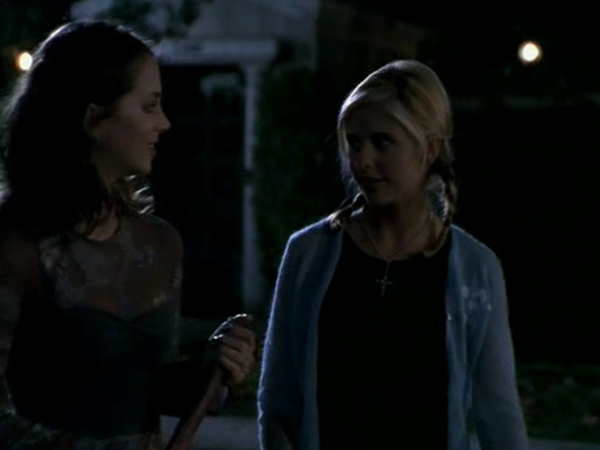
This is only half the truth. Beneath her bravado, there is clearly a deep-seated insecurity in Faith surrounding her “animal instincts”. The term “animal” is levelled at her again and again and again – by the Watchers Council, by Cordelia, by Wesley, by Angelus – and every time, it seems to strike a nerve with her. It seems like her “animal” nature is less the sign of freedom that she claims it to be, and more reflective of a repulsive view she has of herself – as something less than human. This exposes the core of her self-hatred, and it’s her self-hatred that drives her repeated attempts at suicide. She wants to die because she thinks she deserves it, and always has, because she is nothing but an animal.
“You’ve always been sick. It goes right down to the roots, rotting your soul. That’s why your friends turned on you in Sunnydale, why the Watchers’ Council tried to kill you. No one trusts you, Faith. You’re a rabid dog who should’ve been put down years ago.”
Wesley Wyndam-Pryce, Angel 4×14 Release
In both of the ways that Faith relates to the Dog motif – as a lover of dogs and as a dog herself – the idea of Love remains present in both. Or at least, its lack does. Dogs represent both the lack of external love that Faith has received in her life, and her lack of self-love. She wants a ‘dog’ to love – but her problem is that she is the dog, and she refuses to love herself. It is this self-hatred and lack of self-awareness that puts her on her dark path, ending up the same way as Angel did – put down by Buffy like a rabid dog.
The only one of Buffy’s current love interests not associated with the dog motif is Scott Hope. He is the opposite: an attempt by Buffy to avoid such animalism. She lists her favourite thing about him as being that he is not a “hell beast”, and in her meeting with Mr. Platt, he talks about “hope” – a favourite buzzword of early Season Three – as something that can be used to fight her demons. Scott Hope is the alternative option to Angel and his inherent beastliness, and a large part of Buffy’s arc this season is about moving away from Angel.
“Look, lots of people lose themselves in love. It’s no shame. They write songs about it. The hitch is, you can’t stay lost. Sooner or later, you… you have to get back to yourself. If you can’t… well, love becomes your master, and you’re just its dog.”
Mr. Platt, 3×04 Beauty and the Beasts
It rather puts a squash to Faith’s claim that “all men are beasts” that Scott is, thematically speaking, not one (and she, thematically speaking, is). This is the third instalment in the “Men Are Beasts” trilogy that started with The Pack, and is the one that gets closest to unpacking the rotten guise of feminism that underpins such a concept. The idea that beastliness is inherent to masculinity or male bodies is clearly a nonsense idea that only serves to demonise trans women and excuse male abusers, and that no intelligent human should consider. More importantly for a Buffy retrospective, it is an idea incompatible with existentialist principles. This is a show that believes in the power of Choice, and so an idea that supposes that certain attributes are inherent and immutable is clearly antithetical to it.
The show simultaneously holding existentialist principles and a Whedonesque understand of feminism leads it to a bit of a halfway house in regards to this issue. While several men in this episode are driven by their “animal” sides, they are also capable of controlling it. Pete succumbs entirely to it, but of his own accord and not because of the potion that initially triggers it. (A potion that is rumoured in the school to be stolen estrogen, it’s worth noting.). Oz chooses to lock himself up every night – notably in this episode doing so instead of doing his self-proclaimed “guy thing” of storming out dramatically. Angel breaks out of his confinement, but is gentle and kind towards Buffy when he recognises her. Though animalism is related to maleness, the episode makes clear that men have a choice in whether or not they allow themselves to be ruled by their ‘animal urges’.
The gender aspect is complicated further by Buffy herself, who yet again straddles these gender lines. She possesses her own dichotomous parts – the Girl and the Slayer, and though they aren’t always, these parts can be gendered. The alliance of Slayerhood with Animalism and Animalism with Maleness here puts Buffy in the position of possessing two supposedly incompatible elements – Girlhood and Slayerhood – simultaneously.
Like Spike, she blurs her own dichotomy, and it’s Spike who will work hard to bring that acceptance out of her. Much of this work is done in the later seasons when he steps into the role of her Shadow Self, but it’s present in kernels here too. The “love’s bitch” speech has him claim both the feminine (“bitch”) and the masculine (“man enough”) as part of his identity, and swaps them from their previously associated aspects – with femininity now alongside animalism and masculinity alongside humanity. He blurs supposed opposites, and through his example, Buffy must do the same.
“I’ve never been with such an animal.”
Spike and Buffy Summers, 6×13 Dead Things
“I’m not an animal.”
“You wanna see the bite marks?”
This is what this season is all about for Buffy: self-discovery, and self-acceptance. Her love for Angel is a barrier to this. In Season Two, her romantic desires were an impediment to her growing up, and had to be sacrificed in favour of her Slayer (read: adult) duties. In Season Three, it’s more of an impediment to ongoing self-discovery. If she remains tied to her love for Angel, then she cannot experience new things and develop as a person. She cannot allow one relationship to rule her forever. The fate of the Dog, mastered by Love, is one for Buffy to avoid. Instead she must, as Mr. Platt says, find her way back to herself.
Here’s where again, these fascinating ambiguities live. Buffy must avoid Being a Dog and make sure to Find Herself, but the unstated twist there is that if Buffy Finds Herself then she will discover that she too is a Dog. Faith and Spike are both Dogs driven by Love, and as Buffy’s Shadow Selves, they both represent this as part of Buffy herself. The “animal instincts” that Faith spends much of this season encouraging in Buffy are the desires that Buffy has to accept in herself by the end of this season in order to reach the end of her character arc.
“Buffy’s like a dog.”
The Mayor, 3×19 Choices
The show is developing a more complex view on love than before. It’s not something to be embraced uncritically or rejected outright, but, like the Shadow, has to be incorporated healthily into the conscious self. She cannot avoid it, any more than she can avoid the wildness that comes with being a Slayer. It exists as a push and pull within Buffy, and she has to find a way to balance it.
She attempted to chain Angel up this episode – metaphorically, restricting her animal side – but it proved to be useless. He escaped, just as repressed desires are wont to do. These chains will make a reappearance when they are used by Faith and Angel to tie up Buffy, and they are just as useless then. While not necessarily the same chains, Spike completes the set in Crush when he attempts to win Buffy over by chaining her up, an effort that is equally as doomed. The Dog motif is invoked in all these scenes involving chains, reminding us how foolish it is to chain up a part of oneself. It’s an attempt at control that actually renders one beholden to whatever it is they’re attempting to restrict.
The episode closes just as it opened – with a voiceover passage from Call of the Wild that evokes this tension. It speaks of the uneasy balance of civilised and feral urges that exist within Buck (the dog at the centre of this novel). ‘Faithfulness’ and ‘wildness’ both exist inside him, just as they exist in men, just as they exist in everyone. The final shot, shown to us alongside this voiceover, is not of Angel, or Oz, or Pete – or Faith or Spike for that matter. It’s of Buffy. She’s the Dog here. She is the one who will have to deal with this tension. She has to accept the two parts of herself, and understand the ambiguities between them. She must control both parts without restricting either. She must indulge her desires without being beholden to them. She has to find the animal inside herself and tame it – but find a way to love it too.
* * *
Thanks for reading! If you enjoyed this piece, please consider supporting me on Ko-Fi!
* * *
Thank you to juanabaloo on Tumblr for her help proof-reading this essay.
 Insect Reflection
Thank you for another amazing analytical essay. I had never thought of these parallels before.
LikeLike
You’ve described this episode as the final part of a trilogy with The Pack and Phases. There’s a parallel between Xander and Pete in their unwillingness to take responsibility for Hyena!Xander and Hyde!Pete respectively; Xander feigned amnesia about his attempted rape of Buffy instead of apologizing for it, and Pete dodges responsibility by shifting it onto the woman he just hurt “You know you shouldn’t make me mad. You know what happens.” Willow and Buffy lie to Xander to spare his feelings and Debbie cradles the man who just hit her.
I think the main purpose of this episode was to set up the events of Revelations, and the Pete/Debbie melodrama is part of that. In the same episode where Buffy learns Angel is back but doesn’t tell anyone; there’s a girl who both dooms herself and selfishly endangers others by protecting her murderous and abusive monster boyfriend. Debbie is Buffy from the perspective of the other Scoobies in Revelations.
LikeLike