

It’s April 2004; the sunset days of Web 1.0. A new website has just been created: a cross-media wiki known as TVTropes. It’s a site for fans of all manner to identify and record common storytelling conventions as they recur throughout different pieces of media, and it will grow to become a dominant knowledge-base for fandom over the next decade.
It’s a controversial resource for media writers in 2023, often derided by people who don’t appreciate the archeological usefulness of being able to tap into the combined archival efforts of a thousand pattern-noticing obsessives, and also often over-praised by small thinkers who believe that noticing a pattern is the same thing as analysis. Perhaps the most interesting thing about the site is simply how little it has changed since its creation and heyday. Since 2004, the internet has moved away from Web 1.0, fully into the SEO-driven bog of Web 2.0, and now swims eagerly towards the will-o-wisp-ish promise of Web 3.0. Fandom has generally followed this wave, away from fan-hosted forums and LiveJournals, towards social media sites like Twitter and Instagram. But TVTropes remains aggressively un-modern, in form as well as presentation. It is still here, looking just like it did in 2009. Outside of its heyday but still present, it is a slip of mid-00s internet culture, preserved in amber.
A little-known about TVTropes is that it was originally created to focus on one show in particular, and that that show was, of course, Buffy the Vampire Slayer[1]. The site was born from the petri dish of Buffy fan debates. For better or worse, both this site and the works of Joss Whedon were an incredible influence on this era of nerd culture, and even two decades later, we can see their impact. The post-Avengers hegemony of superhero blockbusters and cinematic universes, as well as the increase in spoiler-phobia and efforts to subvert expectations among creatives, can all be traced back in part to this site, and this show. There may be no more succinct demonstration of what 2000s nerd culture was like than this particular intersection of media history, and if we zoom in a little further, there is one trope that is of particular interest to this episode. The page for Badass Decay has existed for over a decade, and has three separate pages of examples, but older readers may recognise it by its original title – Spikeification.
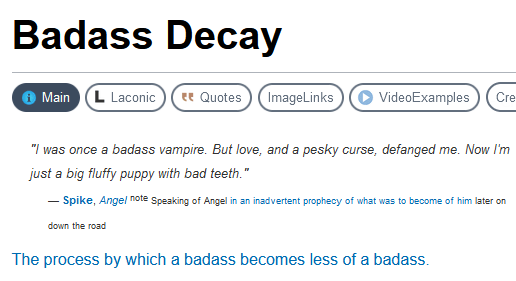
The concept of Spikeification presupposes two things. Firstly, that from the point he is introduced in the show until the point he leaves, Spike becomes less “badass”; secondly, that this is a bad thing. I am introducing TVTropes into this conversation because I think it’s demonstrative of how dominant this line of thinking was in fan culture of the time. This was a presumed fact about Spike’s character, and the only debate was whether his “badass decay” began with his chip, his soul, his love for Buffy, or some other point in the show. It became such a piece of received wisdom that it gave the trope its name, and still today, he is referenced in the page’s headline quote. This received wisdom escaped the confines of Buffy fandom to influence nerd spaces far beyond the show itself.
It’s also, of course, a load of bollocks.
At the point that Spike crashes into this episode, he has been missing from the show for seven episodes, and will be gone again for another sixteen. At which point, he is absorbed into the show’s main cast, where he remains for (if you include Angel) one hundred and five. No season of Buffy has more Spikeless episodes than season three, so naturally his presence in this one is the main selling point of the episode. He is the central attraction. There is little plot to the episode outside his existence, and there doesn’t need to be. James Marsters is watchable enough in this role that simply letting him Be Here is enough. He is a fan favourite character in a fan favourite episode that exists for little more than letting him be on screen for as long as possible.
So it is significant, given how early this is in Spike’s arc, that this episode features Spike at his most outrageously pathetic. He falls unimpressively out of his Cadillac, in an inverse of his original entrance. He stumbles drunkenly around Sunnydale, falls asleep in a fountain and wakes up on fire. He vents about his love life to his own hostages. He drinks cocoa with Joyce, and asks for extra little marshmallows. This episode is dedicated to undercutting all of the swagger and menace that we saw from Spike when he first came into the show. Not only is this a great choice given the entertainment value of seeing James Marsters in this mode, but it’s also not remotely new.
You could well argue that if Spike’s “badass decay” began at any point, it began six minutes into School Hard. In his first full scene, when his macho bragging was interrupted by the entrance of Drusilla, and his vamp face dropped away to reveal a soft man filled with concern and affection for his sick lover. That scene receives a reference in this episode, as Spike tenderly caresses one of Drusilla’s dolls in human face, before switching to vamp face and smashing it to pieces. This is the duality that has always defined Spike. His brashness and villainy has always been undercut with expressions of genuine love and vulnerability, and that doesn’t ever really change.
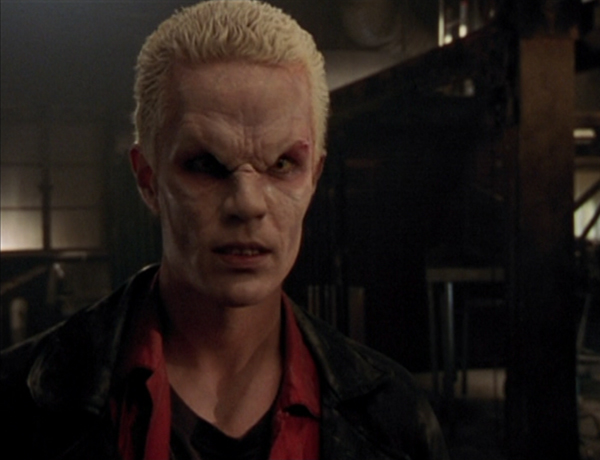
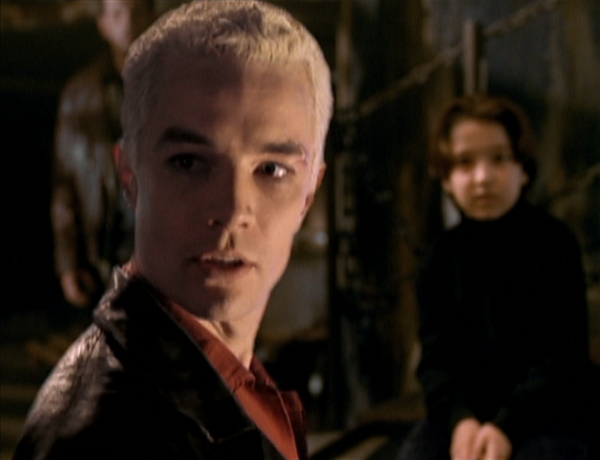

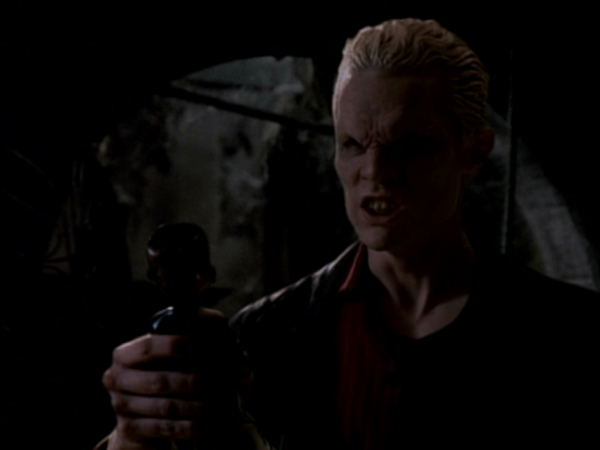
Spike likes to hype himself up as a “Big Bad”, but as we discussed last season, not only is he not the Big Bad of Season Two (at best he’s one of three Little Bads), he’s not even a villain much of the time. He is only a full Villain for four episodes of Season Two, and will only be again for one more episode (The Harsh Light of Day, arguably the weakest of any Spike-centric episode). He’s certainly not the villain of this episode. He drives a fair bit of the plot, sure, but the actual peril in this episode comes from the Mayor and his minions.
“Y’know, he was up to all sorts of shenanigans last year. We had a world of fun trying to guess what he’d do next. […] But I guess we’re past that now. This year is too important to let a loose cannon rock the boat.”
The Mayor, 3×08 Lovers Walk
The Mayor – in a lovely meta line that implies his presence just off-screen in Season Two, watching the season unfold with giddy glee – has taken up the Big Bad mantle, and does his best to make sure that Spike does not reclaim it. And he succeeds. Sending goons after Spike ensures that Buffy and Angel must fight alongside him, pushing Spike right out of Villain territory and into the role of Reluctant Ally, a role he stepped into in Becoming, and will remain in for most of Season Four. This episode is not about overcoming Spike’s evil plan. The climax is battling the minions alongside Spike, and his half-baked Evil Plan is waved away in a puff of post-hangover clarity by Spike himself.
Spike is not being used as a villain because he’s no longer useful as one. Villains on this show have a strict shelf life. They can either be defeated and killed by Buffy after she mentally overcomes whatever obstacle they symbolise (see: every Big Bad), or they can be written off and kept on ice for increasingly sparing cameos (see: Ethan Rayne). Spike is too interesting a character to be wasted, so the show has to find something else to do with him.
“Now you can leave and never come back! […] Get out of Sunnydale. That’s a good thing. What kind of moron would ever wanna come back here?”
Cordelia Chase, 3×08 Lovers Walk
His eventual dual role as Shadow and Love Interest takes a while to land on, but the show is setting the stage for it. His re-introduction sequence doubles as a neat bit of foreshadowing in this regard. Cordelia, having just graduated from her role as Shadow, encourages Buffy to leave Sunnydale and never return – at which point Spike makes his dramatic reentrance. In less than a season’s time, Cordelia will have left Sunnydale for a new life in LA, never to return, and Spike will again come back to Sunnydale to pick up Cordelia’s role as Snarky Truthteller, and eventually her role as Shadow too.
Spike is already acting in both of those positions here. He is the one to tell Buffy and Angel the truth that neither of them are able to accept – that they are not “just friends”, and cannot repress their desires for each other. His “love’s bitch” speech, as well as his extremely Faithlike reminder to Buffy of how enjoyable violence is (“That was fun! Oh, don’t tell me that wasn’t fun?”), both speak to a sense of passion inside Spike – deep, primal, and unignorable – that is extremely Shadowlike in its nature. Both love and violence are the shadow-urges inside Spike, screaming at him to work their will, and it is his acknowledgement of these urges that make him such a perfect shadow-foil for Buffy. As Buffy says in the final scene: she can’t lie to herself, and she can’t lie to Spike either – because, on some level, he already exists as part of her. He is Buffy.
The central joke of this episode is that Spike, in his post-breakup depression, is acting hilariously out of character. His moping, his drunken clumsiness, his softness with Joyce – this is all stuff that would have been unthinkable for the character we saw in School Hard. And yet, it also meshes perfectly with what we saw in Season Two, and what we will see going forward. In many ways this is less about Spike behaving out of character, and more about revealing a new truth to his character.
Parallels could well be drawn with When She Was Bad – another episode built around the concept of a character acting “out of character” due to recent events. Buffy’s un-Buffyness in that episode is indeed a stark contrast to her behaviour up to that point, but it’s also revealing of this darker but very real side of Buffy – one that can be mean, and selfish, and reckless. She became her own shadow in that episode, and the similarity in how these two episodes are structured not only cement the usefulness of Spike as Buffy’s Shadow, but also imply a hidden good side to Spike – a Light Shadow if you will. Just as there is an inherent darkness to Buffy, there is an inherent lightness to Spike that bursts to the surface, and takes control of him.
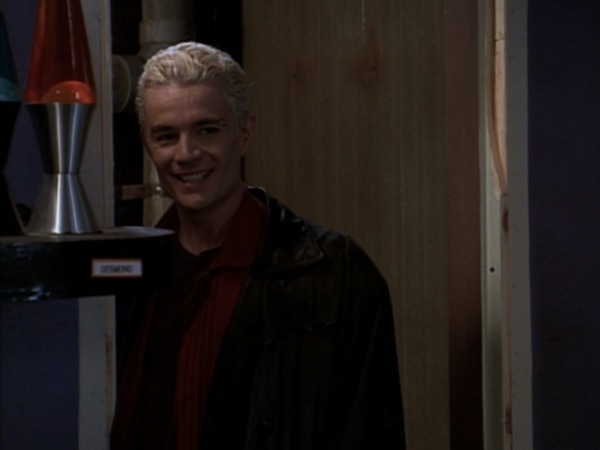
Speaking of things inside of Spike, waiting to burst free – this episode comes at an interesting point in the wider story of Buffy’s love life. Buffy and Angel have their first of what feels like a dozen break-ups for them this season. This time, it is technically less of a break-up and more of a pre-emptive separation, as they acknowledge that they cannot be friends. Spending time with each other will inevitably lead to romance, and they cannot allow that to happen for obvious reasons, so they split. Buffy/Angel is a romance on life support, grinding slowly towards its inexorable end. It is Spike who forces them to realise this – Spike who, according to Fool For Love’s retcon, is already in love with Buffy. The inevitable slow demise of Buffy/Angel begins at the same point as the slow rise of Buffy/Spike does. Watching this episode has the feeling of watching one train start to leave the station, just as you see another approaching in the distance.
Spike’s love for Buffy is the catalyst in his journey to becoming, in her words, “a better man” – or in the words of a TVTropes enthusiast, “less badass”. We should interrogate this concept of “badassery”. It is a concept without a strict definition – more of a you know it when you see it paradigm. While it is a moniker that is applied to characters of multiple gender, it is often expressed to celebrate qualities considered masculine in nature – strength, authority, ambition. Even more often, it celebrates qualities of the toxically masculine variety – violence, sexual aggression, recklessness. This ambiguity of “badassery” and how it relates to the celebration of toxic masculinity is worth keeping in mind when discussing a mid-00s Joss Whedon show. If there’s one thing that unites Joss Whedon and mid-00s nerd culture, it’s a fundamental lack of respect for women.
If Spike in School Hard is to be considered the peak of “badassery”, with his antics after that point a gradual slide away from that peak, then we should ask – what was “badass” about Spike in School Hard? Spike was a breath of fresh air in School Hard because of his humour, his lack of respect to tradition, and the depth that his love for Drusilla gave him. What he was not was especially impressive or successful in his aims. He loses. He gets beaten by a teenager and her non-powered mother, and he continues to have his plans foiled every episode thereafter. His moments of actual success in the show only come when he fights against evil, expresses his love, or when he uses typically feminine methods of combat like emotional manipulation (see The Yoko Factor). His levels of humour, and love are not especially high in School Hard – rather, they start high and remain high. What is different is that in School Hard, he is particularly violent, crude, and sexually aggressive. His higher level of “badassery” is actually just higher levels of toxic masculinity.
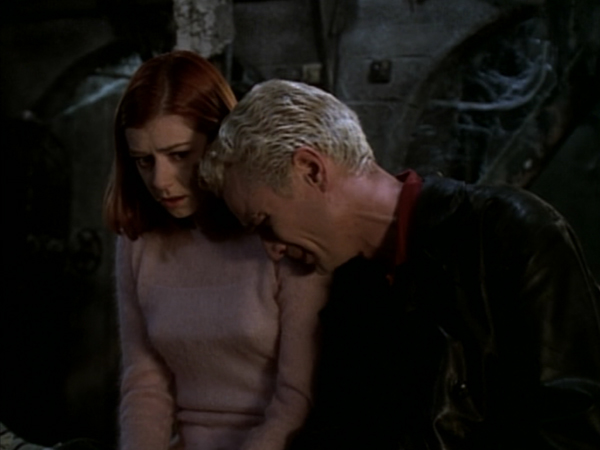
Spike’s relationship to gender will be an interesting thing to discuss going forward, but in very broad terms, I think what we can see with his arc is a gradual shift away from the toxic masculinity he exhibits in School Hard, to embracing a kinder, gentler version of himself. This journey can be tracked in his relationship to sexual aggression. It’s a journey from throwing sexually-charged threats at Buffy in School Hard, to getting a soul after seeing what he is capable of in Seeing Red.
Between these points we have two key scenes with Willow: first here in Lovers Walk, and secondly in The Initiative. Here, he drunkenly threatens to kill Willow, and it’s a threat laced with an undertone of sexual assault (“That smell… your neck… I haven’t had a woman in weeks…”). He manages to keep his id in check here, so that Willow stays alive and he can enact his plan to get Drusilla back. In The Initiative, he goes to attack Willow in her dorm room – again with heavy sexual assault imagery – and this time, his id is actively repressed by the chip inside his head. All of the things inside Spike that push him towards his better angels – be that love, soul, or chip – all drive him away from sexual aggression and toxic behaviours that so often control him, and away from “badassery”.
When Spike reclaims his confidence at the episode’s end and, according to TVTropes, becomes a “badass” again, it is specifically a promise of upcoming assault. He pledges to “tie [Drusilla] up and torture her until she likes me again”. I’m not going to suggest this is indicative of abuse or anything on Spike’s part – both him and Drusilla are evil demons with no concept of healthy consent, so applying those kinds of concepts to them seems an exercise in futility. But it is a capital-E Evil act, the kind of which is reserved for Big Bads. It’s worth noting that when we do see someone tied up and tortured by their lover this season, it’s specifically in a team-up between Angel and Faith: last season’s and this season’s Big Bads.
And that is useless to the show. Spike isn’t a Big Bad. He hasn’t been for a while, the show doesn’t need him to be now, and he will never be again. The version of Spike that is a Big Bad – that gleefully belts Sid Vicious as he roars down the highway, on his way to torture his ex-girlfriend – is wonderfully entertaining, but it’s a version of Spike that doesn’t fit on the show any more. So off he goes into the sunset. This “evil” Spike, this “badass” Spike – he might be a joy to watch for an episode, but as a long-term character project, we need a Spike capable of transformation. We don’t need a badass. In Season Four we will get a Spike less badass than we’ve ever seen before, and it’ll be one of the greatest things the show will ever do.
* * *
Thanks for reading! If you enjoyed this piece, please consider supporting me on Ko-Fi!
* * *
References:
[1] Newitz, Annalee (February 24, 2010). “Behind The Wiki: Meet TV Tropes Cofounder Fast Eddie” Retrieved January 8, 2023.
* * *
Thank you to juanabaloo on Tumblr for her help proof-reading this essay.
 Insect Reflection
Thanks for another jewel of a post.
Despite its self-contained quality I find it hard to write about Lovers Walk in big-picture terms, in part because Spike [he of the fists and fangs] is rather jarringly out of place amidst the tidy structure and slow burn of season 3, in part because Faith renders him redundant, but mostly because season 3 is The Season of Fluid POV and, well, as Fool for Love establishes, Spike is an unreliable narrator.
I’d certainly agree with your reading on the demon inside Spike mapping onto toxic masculinity but think that the line of analysis is incomplete unless we also view Buffy as along the same journey but in the opposite direction.
As Buffy’s trauma deepens over the course of the series, she increasingly seems to performs as masculine; due to her spiritual and moral excellence she never stays fully toxic in the leadership, violence, sexual aggression, etc. but the template is there, and it’s the same basic one as Spike’s, and we see in When She Was Bad, The Wish, and 6×01-6×17 where she would reasonably end up without a transformational change like Chosen’s.
Really, really interesting to describe When She Was Bad as a case of Buffy’s acting as her own anima. I had before read that episode described [by MikeJer, if my recall holds up] as a microcosm of season 6, but you have laid out why that take tracks.
LikeLike