

Part One: The Girl
It must really suck to be Cordelia Chase. She was created to represent the alternate life that Buffy Summers could have had, and the shadow desires that still live inside her. Everybody on this show exists in relation to Buffy in some way. She is the nexus of this universe, around which every other character orbits. But it was always especially so for Cordelia, as somebody who existed on the fringes of the core cast. She is the only title character in Season One who is not a member of the “Core Four”. It took her until the eleventh episode to discover she was in a supernatural show, and until the second season to become an active ally of Buffy. Unlike, for example, Willow, who takes a more active role in the day-to-day function of the show as Buffy’s best friend and magical practitioner as well as her role on the metaphorical plane as Buffy’s Spirit, Cordelia has not always had a literal in-text reason to be around for these stories, leaving her adrift in the abstract, with only her role as Shadow to tie her to Buffy
That alone is an unenviable task – for your only job in life to be a reflection of somebody else – but it’s even more appalling when you lose that job to somebody else. This is what has happened to Cordelia this season, as Faith has taken on the Shadow role and Cordelia’s function with it. Cordelia has developed other functions over her time on the show – principally as Xander’s love interest, and in another world she could have continued in this role. It would have been a demotion for sure – existence among characters that remain a consistent and entertaining part of the show while not being symbolically meaningful to Buffy’s journey (a grouping I like to call ‘The Oz Tier’) – but it would have been something.
The Xander/Willow cheating subplot puts a kibosh on this – though it’s important to note that it doesn’t have to. Xander/Willow as a romance is capital-D Done at this point. The show has no interest in pursuing it, and all tension between the two has dissipated (indicating how much of their attraction was more based in the thrill of transgression than actual substantive attraction). The show spends time repairing the Willow/Oz relationship, but for whatever reason, it chooses not to do the same for Xander and Cordelia. Their romance is dead in the water.
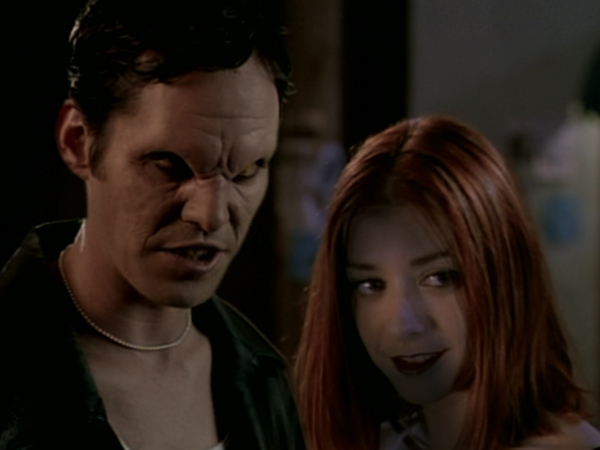
The result of this is that Cordelia gets functionally shut out of the show. Buffy has a very clear hierarchy of characters, where Buffy is at the apex and importance flows from her. As one of Buffy’s best friends and metaphorical Heart (not to mention Brendon’s second billing), Xander is clearly above Cordelia in this hierarchy. In one scene in the Bronze, Buffy mentions her discomfort with having to ally with Xander and Willow against Cordelia, but this alliance is inevitable. In-universe it’s a natural result of Buffy being closer friends with Xander, but the out-of-universe justification is that Xander is more important to this show than Cordelia is, so no matter the actual moral fault, Xander is always going to win out, and it’s Cordelia who will lose focus and screen time.
Cordelia’s loss of importance is not only true on a meta level, but is true within the universe of the show itself. Cordelia started the show as the most popular girl in school – Head Cheerleader and Queen Bee of Sunnydale High. Now we see that she is rejected from her former clique – taunted and branded as a social pariah. Where once she was the bully, now she is the bullied. The character development that was necessary to move her away from that archetype towards becoming a true member of the Scooby Gang in Season Two now prevents her from returning to that life. She has gone so far forward that it is impossible for her to go back, however much she might like to.
As if this wasn’t humiliation enough, Cordelia then suffers the pure indignity of being introduced to her own replacement. Though Emma Caulfield is clearly not playing the same Anya that we come to know later on*, re-watchers will obviously notice how much of Cordelia’s role is taken over by Anya – as Xander’s love interest, as the socially abrasive truth-teller of the group, and even in smaller, surface-level things like some of their interests and the type of humour they are typically mined for. Cordelia is being pushed aside by so many elements of the show, and coming face to face with her own successor as she does so.
*It’s also important to note that Anya was at no point a direct replacement for Cordelia – if anything she was an indirect replacement for Oz – but that’s for Season Four to discuss.
As Cordelia’s time on screen reduces, so does her depth as a character. She doesn’t have space within future episodes to show her viewpoint, and her feelings on events. The most major development in her life so far – the loss of her family’s wealth – happens off-screen, and we only hear about it retrospectively in the season’s penultimate story. The show falls back on the way she was used in the first season and a half – snarking at and criticising the leads from an unsympathetic distance, which will lead us to episodes like The Zeppo where she is (fairly uncritically) portrayed as the villain in the story of the man who cheated on her.

However, there is a ray of light in Cordelia Chase’s future. Angel the Series premieres less than a year from now – a show in which Cordelia is not only afforded a lot more screen time and development, but as its female lead is a central part of the promotion and intended appeal of the show. It is a promotion in every conceivable way. Amends is the very next episode, and it many ways functions as Angel Season 0 Episode 1, which only heightens the promise for her character. Since the existence of Angel requires both writing David Boreanaz off the show and waiting for next year’s premiere season however, Cordelia is necessarily put on ice until then. Angel needs the currency of showing us Cordelia’s character development, so we can’t waste it now on Buffy.
This is her last chance for serious focus, and the episode sets up well for her. We follow her through her post-Xander grief, her attempts to reclaim her life and the bullying that results, the embarrassment she suffers, and finally her entanglement with the demonic villain of the episode, who grants her the titular wish. She is transported into a parallel universe where she is the only one who remembers our original world. It’s shaping up to be an episode-in-the-spotlight for Cordelia, and by all rights it should be. We expect to follow her as the protagonist, as she restores the world to the way it once was.
And then she dies nine minutes into the Wishverse.

What Cordelia forgot when she wished to exist in a world without Buffy Summers is that a world without Buffy Summers has no need for Cordelia Chase. Remember, Cordelia only exists in relation to Buffy. Without her, she has no purpose. She can go back to being the pre-Buffy Queen Bee she once was, but that loses her the protection she once had from being important to Buffy’s story. She can’t exist in a show without Buffy, because Buffy is the reason she matters to the show.
She is only half a person. She represents Buffy’s Girl side – but without the Slayer, the Girl is helpless and vulnerable. This world has no place for her, and so she is drained and cast aside. She is literally devoured by the characters that caused the whole show to kick her to the curb – Xander and Willow in a sexually charged combined assault. We watch her, trapped between the two characters that hurt her so specifically – characters whose existence in the show innately takes precedence over hers – literally draining the life from her into themselves, and we are reminded of one literal, undeniable fact.
It really does suck to be Cordelia Chase.
Part Two: The Slayer
It could be a lot worse, however. She could be Buffy Summers.
We open on Buffy being choked and nearly killed by a demon – a demon we eventually realise has interrupted a pleasant midday picnic – struggling to overpower it until Willow hands her the weapon she needs to kill it. It’s an intentionally bog-standard Buffy opening, and it exists to remind us that Buffy survives the trials she undergoes each episode because of the help she has from her friends. Not literally because they are assistants that hand her knives, but because they are the ties she has to the world. It is these ties that grant meaning to the battles she has to fight.
The world of slaying is a deeply horrifying one. It’s a life that demands solitude, and the loneliness that comes with it. It demands erosion of the self in favour of a greater mission. It is a relentless slog against an evil that never abates nor ends. The only escape any girl has from this system is to die (which they will, young and tragically), at which point they are replaced with another cog in this machine. It’s a plug and play horror show. “We fight. We die,” states the Buffy of the ‘Wishverse’, espousing a Spartan worldview that normalises the magically-induced marginalisation that Slayers live under.

In order to survive in this world, Buffy needs her friends. The people around her provide emotional support, practical help, and tie her to something that looks like a normal life. Above all, they provide meaning – a reason to keep going in a fundamentally meaningless world. Without these ties, her life really would just be “fight and die”: a hollow arrangement. Just as the characters in Buffy provide a reason for the audience to care about the events on screen, the people around Buffy provide a reason for her to care about the world.
This requirement that Buffy has for an external support system demonstrates a deeper need. The reason she has this external support system is because she is in the TV show Buffy the Vampire Slayer, and the protagonist of a TV show requires supporting characters. There are many Watsonian qualities that set Buffy apart from other slayers, but the most important quality is Doylist. She is the first slayer with friends and family because she is the first slayer with a TV show about her. Buffy needs her friends, yes, but more fundamentally she needs Buffy the Vampire Slayer.
Lacking both, we see who Buffy becomes. She loses all the vim and wit that we associate with Buffy, and becomes just another Slayer, living fight-to-fight with no hope for escape. It is a sad and faithless existence. She is a shadow of her former self, and I mean that quite literally. She becomes her own shadow; she becomes Faith. She is bitter and cynical, snarky in a vicious way. She wears a tank top and combat boots, and sniffs her host’s bottles with all the politeness of a hungry racoon. She insists on a solitary nature, and operates on a “stake first ask questions later” policy. Her reminder to Giles that a stake kills most things that aren’t vampires is a comment that both foreshadows Bad Girls and implies a possible similar inciting event that this version of Buffy may have gone through.
“I don’t play well with others.”
Buffy Summers, 3×09 The Wish
“I’m on my side, and that’s enough.”
Faith Lehane, 3×07 Revelations
Faith is in many ways envisaged as a version of Buffy who does not get to be the star of Buffy the Vampire Slayer. She is a Chosen One whose Prophesied Destiny comes second-hand. Who came late to the audition, and found the role of Hero had already been taken. We see in Enemies how much this frustration drives her. It makes her the way that she is. And now this version of Buffy that we see here reveals another truth about their synonymity. Faith without the structures of Buffy the Vampire Slayer is who Faith is, and now we see that Buffy without Buffy the Vampire Slayer is also Faith.

This life of destiny without purpose is tragic for Buffy, but it’s also destructive to everyone around her. Without Buffy the Vampire Slayer, all its leads are lost. Giles is just a former Watcher, scrabbling to keep together a discount version of the Scooby Gang. Xander and Willow have to be sidekicks to someone, so they are sidekicks to an evil vampire. Cordelia is dead and forgotten. Angel is a helpless prisoner, as without Buffy he has lost his destiny. This is true both in the sense that Buffy inspired Angel to re-enter the world and fight for good, but also in that there’s no way for Angel and the destiny revealed for its title character in that show without Buffy the Vampire Slayer. Buffy is the hinge of not just this show, but the whole fictional universe, and without her protagonism they are all unmoored.
So she goes to die. It’s with the aim of stopping The Master, but even if she succeeded, it would be little victory in a world such as this. One must remember Spike’s words in Fool for Love about the “death wish” that each Slayer carries, and how much that wish might be driving her in this world. There is a vague sense of relief that comes with her death, that I think you can see on her face. The Master is useful here in this episode as a reminder to compare this to Prophecy Girl, and Buffy’s tearful, ardent resistance to facing The Master there, as opposed to her grim eagerness here.
“Every Slayer has a death wish. Even you. The only reason you’ve lasted as long as you have is you’ve got ties to the world… your mum, your brat kid sister, the Scoobies. They all tie you here but you’re just putting off the inevitable. Sooner or later, you’re gonna want it.”
Spike, 5×07 Fool for Love
Buffy was saved in Prophecy Girl by Xander, and more generally her ties to humanity – but now there is nobody to save her. She has no ties to humanity, and she kills Xander without a second thought. Without those ties, everything we see is meaningless violence. We fight, we die. The removal of what we recognise as the show has stripped meaning and emotion from events. Angel re-enacts the tragic climax of Becoming, whispering Buffy’s name and reaching out to her as he dies (killed by Xander no less), and Buffy barely blinks. Xander kills Angel. Buffy kills Xander. Oz kills Willow. The Master snaps Buffy’s neck. None of this means anything. We fight. We die.

Our last hope in this horrorshow is Giles. As Buffy’s Watcher, he is the last remaining tie to the original premise, which is why he takes up the role of protagonist in the second half of this episode. He is the Call that she missed; the herald of Buffy the Vampire Slayer. So he is the only one who can call her back to Sunnydale now, and can see the shape the universe used to have; that it is meant to have. It is his indomitable belief in a better world that drags them all back to it. He re-creates a world with meaning out of his simple belief that there must be some. He re-creates Buffy by sticking to the tenets of absurdism – choice in the face of nihilism, making this some kind of existentialist Resurrection.
“How do you know the other world is any better than this?”
Anyanka and Rupert Giles, 3×09 The Wish
“Because it has to be.”
This does not save the Wishverse’s Buffy. In fact it seems to doom her. The cross-cuts imply that Buffy dies at the exact moment that Giles smashes Anyanka’s amulet, which suggests a kind of cosmic intertwinement between Buffy and this world. This version of Sunnydale is destroyed at the same moment that Buffy dies, because neither can continue to exist without the other. Sunnydale cannot survive without Buffy Summers, and Buffy Summers cannot survive without Sunnydale. The existence of the show depends on both, and is only restored with both, as the wish disappears and the world we recognise – the world that Giles believed in – reappears. Buffy only exists because one person… had faith.
Cordelia is cheered up, the demon is defeated, and all now seems well. Giles checks in on the rest of the core group as they sit smiling in the courtyard. It’s a sappy ending that fully earns its schmaltz after the grimness of the preceding scenes. And as we move on from The Wish and its now forgotten world, we are left with a sense of fragile hope. For all the struggles and hardship that Buffy undergoes on a weekly basis, we now know one thing to be undeniably true.

It could be a lot worse.
* * *
Thanks for reading! If you enjoyed this piece, please consider supporting me on Ko-Fi!
* * *
Thank you to juanabaloo on Tumblr for her help proof-reading this essay.
 Insect Reflection
This is yet another of your excellent essays. I hadn’t thought of this episode in a very long time, let alone in the depth that you bring to it. Thank you so much for your eloquent insights.
LikeLike