

Doppelgangland is a very good episode.
There’s a version of this essay that is nothing but that sentence over and over again, phrased in different ways. It’s a nearly self-evident truth – this episode is uncontroversially and near-universally beloved. IMDB’s ranking has it as the best episode of Season Three, and 8th overall. It’s regularly mentioned as a season highlight by dedicated and casual fans alike. Vampire Willow is one of the show’s most memorable villains, and she only gets this episode to shine at all, after being criminally underused in The Wish. Even Joss Whedon ranks it among his own top 10. Fan ratings aren’t everything – the fact that Restless comes in at #33 is a clear indicator of the voters’ collective lack of taste – but when a fandom so clearly agrees on something, I think it’s worth asking why.
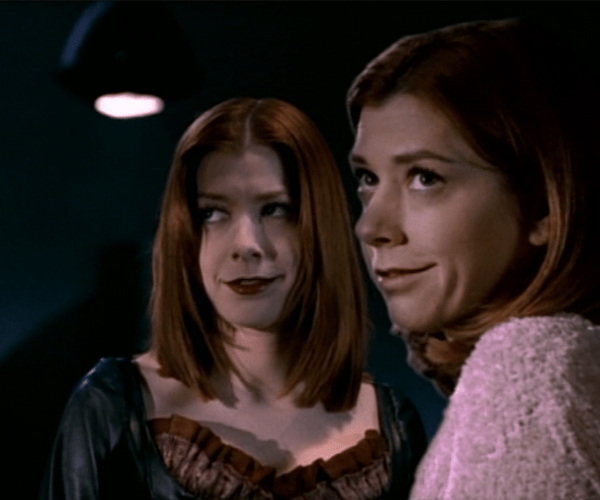
In one way, that question has a very easy answer: this episode is very fun to watch. Alyson Hannigan dazzles as the quietly charismatic Vampire Willow, dominating the screen with a very specific almost-awkward swagger. She then channels her inner Tatiana Maslany and delivers sparkling turns, first as Willow-playing-Vampire-Willow and then as Vampire-Willow-playing-Willow. She gets such joy from playing up the differences and similarities between both characters – perhaps my favourite bit coming in her demonstration of how terrible both Willows are at improvisation acting. Hannigan has been quietly improving as an actor since Welcome to the Hellmouth, and now shows herself to sit comfortably beside Gellar and Head as one of the strongest members of the cast.
“I was looking at books. I like… books… …’cause I’m shy.”
Vampire Willow, pretending to be Willow
“I killed her. And sucked her blood… as we vampires do.”
Willow, pretending to be Vampire Willow
And it’s more than just Vampire Willow – the whole show is singing. The humour is bright and zippy. Every character, now settled in the roles they’ll fill for the rest of the season, gets moments to shine. Anya is starting to emerge as a character who is recognisably Anya. The climactic fight in the Bronze is probably the best group action scene so far, and might have a shout to be the show’s best ever. Even the tertiary characters are in form: Devon’s insistence that only “fruity jazz bands” know more than three chords is quietly one of the funniest moments of the episode. This is an episode that starts being fun early on, and never stops.

But really, there’s nothing about this episode that’s unique to itself. Everything I can praise this episode for, I can also praise the rest of the season. Indeed, now is probably time to explicitly recognise something that has been true for a little while now: we are in a stage of the show that could very uncontroversially be called its best. One can quibble about when exactly this period began (the typical ranges go as early as Prophecy Girl or as late as Innocence), but there has clearly been a transition from the bumpy, awkward days of Season One to the sleek confidence the show has in late Season Three. This is the show in its imperial phase; a creative and commercial peak in which the show is seemingly unable to do anything wrong.
This is especially true of Season Three. While the show’s second season seemed unable to go more than 3 or 4 episodes without a dud, the third gets its single stinker out of the way early, and then delivers an uninterrupted stream of 7-8/10 episodes for the rest of the season. This is a show that knows what good Buffy is, and knows how to make it, week in and week out.
It is this version of the show that lives on in the cultural zeitgeist. Buffy is remembered as a high school show, despite the fact that it spent most of its lifetime not being set in high school, because what the show is right now is what lasts in our collective memory. In fan circles, opinions tend to bifurcate drastically on the later seasons, while this era is at worst remembered as a solid prelude to the series’ real highlights, and best remembered as the Golden Years the show never quite lived up to again. These are our Good Old Days. This is what we will remember as the base form of Buffy the Vampire Slayer; what the rest of the show will always, consciously or otherwise, be measuring itself against.
So there you have it: Doppelgangland is the best episode of the best season. Yes, best is subjective and meaningless, but I find it difficult to argue strongly against either assertion. The Zeppo would top my Season Three list, but this is definitely up there too. Season-wise, if we define “best” as having the fewest negatives, then this season wipes the floor with the rest, having none of the monster-of-the-week awkwardness of the early seasons nor the major arc missteps (e.g. magic drugs, the Potentials, everything around Riley) of the later. There are no major criticisms of season three, either from the fandom or myself personally.
Yet, ‘Doppelgangland is the best episode of the best season’ is a statement that fills me with an odd kind of disappointment. It’s damning, in a weird way, because yes, Doppelgangland is a very good episode. But it’s also just a very good episode. It feels out of place among the real top tier of classic episodes. It lacks the massive emotional punch of a Becoming or The Body. It lacks the daring inventiveness of Hush or Once More With Feeling. Even just looking at supporting cast character studies, it’s blown out of the water by Fool For Love, even Storyteller. For the truly pretentious Buffy aficionado, a solidly enjoyable all-rounder like this just doesn’t earn its place.

This is actually the major criticism of Season Three. Its own consistency is its downfall. It’s always good, but almost never great. While the show delivers 8/10s on a regular basis, it almost never manages to surpass that standard. This season is noticeably shorter on true classics than any season surrounding it. It’s as if a monkey-paw wish was granted, and a lack of high points became the trade-off for the comparative lack of lows. There is an aspect of fannish predeterminism here of course, and yes it’s not true that improving parts of a show necessarily means you lose something from elsewhere. But it feels true, and if it feels true, I think it’s worth exploring why.
The difference becomes most stark when you compare last season’s arc directly to this. The Faith arc is an intentional re-tread of the Angel arc, hitting the same beats at the same time, bringing us to a mirrored conclusion. But while Season Two, being the Epic Gothic Love Story that it was, could go all in on the high emotion, while Season Three’s preference to play in the subtext necessitates that it remains inside itself, unable to actually mine the emotions it wants to. Buffy can’t actually be as emotionally affected as she was last year. So the Angel arc ends up ten times as emotionally devastating as the Faith arc – and this is coming from somebody who is pretty much as invested in the Buffy/Faith dynamic as it is possible for somebody to be. This disparity in the season arc translates through to the key episodes of that arc, and only highlights itself more. Revelations, Consequences and Enemies are all good episodes, but they pale in comparison to their counterparts (Lie To Me, Innocence and Passion) from Season Two.
Moreover, Season Three is so clearly the archetypical version of Buffy, that it lacks a true identity of its own. While Season One ramped up the Horror, and Two the Gothic, Three has no distinct flavour of its own. The genre it is most interested in playing with is Teen Drama, and while it’s not unsuccessful, doing “supernatural teen drama that feels like a Supernatural Teen Drama”, does not lend itself to being an interesting vision. This is the version of Buffy the Vampire Slayer that feels most concerned with being Buffy the Vampire Slayer. That is a good thing to be, and Season Three is very good at being it. But it’s still an incestuous urge that leaves very little room for the show to grow and express itself creatively.
Through this lens, we can see Season Three as less of a nostalgic golden era, and more of a trap, one that threatens to keep the show locked down in mediocrity for its remaining days. Season Two had to take big swings because it still hadn’t completely worked out how to make great Buffy. Season Three can make great Buffy in its sleep. It doesn’t need to take big creative swings, so it doesn’t. The kind way to view the similarities between the Angel arc and the Faith arc is that it’s all intentional parallelism meant to invite us into comparisons. The unkind way to view it is as a retread; as the show being reluctant to divert from a winning formula and simply playing its own hits on endless repeat.
There is a version of the show that never comes down from this peak. It finds excuses to keep all the characters in high school, it introduces a new boyfriend for Buffy to turn evil in episode 14 every year. It’s funny, it’s quippy, and it lasts for a few more seasons. But that is a version of the show destined to implode in on itself. Its a version of the show that never attempts ambitious mix-ups. It never retcons in a younger sister for Buffy, or makes depression the Big Bad of a season. It’s a good show – but its not the kind of show worth writing essays 25 years later. That kind of cultural impact requires greatness, and that kind of greatness requires failures.
One of the main reasons that Vampire Willow has such a lasting impact on fans is how much additional resonance she gains from being retrospective foreshadowing for Dark Willow. The quote that becomes her catchphrase here (“Bored now.”) is used again, three seasons later in Villains to capstone Willow’s turn to the dark side. The real genius of this episode is only genius in retrospect. It shows us exactly what an evil Willow looks like, while also telling us, to our face, that the Willow we know and love is exactly like her.
“I mean, I know she’s not me. We have a big nothing in common, but… still…”
Willow Rosenberg, 3×16 Doppelgangland
“Willow, just remember, a vampire’s personality has nothing to do with the person it was.”
Buffy Summers and Angel, 3×16 Doppelgangland
“Well, actually…”
“It was exactly you, Will, every detail.”
Buffy Summers, 3×16 Doppelgangland
This is very much a hinge episode for Willow. With one hand, it calls back to the pilot, as Anya’s request for Willow’s help is directly paralleled with Buffy’s in their first meeting. The main difference is that while Willow was ecstatic to help Buffy with her schoolwork in Welcome to the Hellmouth, she is glum here when she assumes Anya is asking the same. The main similarity is how excited she is when she finds out Anya actually wants help with a spell. Willow is attempting to shed her nerdy old self and reinvent herself as a cool wicca, but what remains the same is the underlying desire: the desire to be of use to others.
With the other hand, it calls forward to the finale, where Willow’s fear of her dark side will form the backbone of her Season Seven arc. She spends that season desperately fearful of what she is capable of, but you can see that same fear here, as she comes face to face with the literal personification of her own dark side. This has clear resonances with the season arc (Willow and Vampire Willow are obvious stand-ins for Buffy and Faith), but it’s even more impactful when viewed as part of Willow’s entire show-wide arc.
This is an arc that would not have been possible if the show stuck to its current trajectory of “not fucking up”, because in many ways, Dark Willow is a massive fuck-up. It’s an arc that takes a big swing, and frankly misses as much as it hits. But it’s exactly that kind of ambitious swing that makes this show what it is. Doppelgangland exemplifies Buffy the Vampire Slayer at its best: confident, funny, engaging, and all around a great time. But the soul of Buffy lives in the epic, failures and successes alike. It needs to be knotty, and messy, and great If the show is to thrive, it needs to change course, and stop suffering the indignity of merely being very good.
 Insect Reflection