

The more I hear from other people in this fandom, the more I realise how unique each fan’s introduction to this show is. The majority of new fans will most likely come across Buffy on some streaming service, and be unfortunately subjected to the horrendous HD remaster. They probably started with Welcome To The Hellmouth and then proceeded in an orderly fashion from there. But if you were first exposed to the show when it was still airing, then your first episode was whatever happened to be one the week you flicked over to the WB.
This was a pre-streaming, pre-DVD world, and even VHSs were not ubiquitous. Re-runs were sporadic if they happened at all and there’s even some episodes that were aired out of order or massively delayed.. You might have started in the middle of season seven and have to go backwards; you might watch episodes or whole seasons out of order. Your viewing experience will be a Frankenstein, stitched together from whatever fragments of the show you can scrape together from the floor.
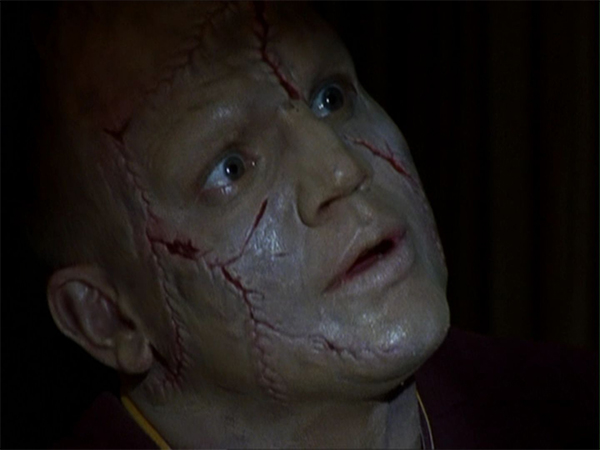
This will inherently affect the way you view the show. Every season of Buffy is unique, with its own style, themes, and even genre. The characters are at wildly different points in their arcs across different seasons, and so a viewer’s experience of them will change based on their own viewing order. Watching Willow in season one after having seen season six will be a wildly different experience to watching vice versa. Your feelings and opinions of what the show is, or should be, might be largely down to which season you happened to watch first.
Then there is also the deeply personal intersection of a viewer’s real life with this show. We are different people at different stages of our life, with different perspectives and concerns, and so our experience of Buffy will be guided by our experiences in life. A sixteen year old in High School will not be watching the same show as a twenty-eight year old with a job and a house. The Body might play differently before and after you experience the death of a relative. This is true for rewatches, and for first watches. The fabric of the show is interwoven with the fabric of your life.
We now come to a point in this series where my perspective unavoidably shifts. I feel like I’m kind of in the middle generation of Buffy fans; I started watching after the show was several years past its finale, but well before the streaming era, back when Netflix still posted movies in the mail. I had just turned sixteen, and had gotten into online fandom through my obsession with Doctor Who. When other shows were recommended, Buffy was almost always among them, so I was curious to watch it. I knew almost nothing about the plot of the show, but I did know that season one was shorter and, according to people, not that great, and so I asked for the DVD box set of season two for my birthday. That meant that When She Was Bad was my first episode of Buffy the Vampire Slayer.
My experience of season one is pretty clinical, even impersonal. I finally came to watch it after having seen through season five of Buffy, and several seasons of Angel. It was more an obligation, feeling like I really should go back and see what I’d missed before I carried on with season six, and of course I watched it fully spoiled for what would happen. Part of the reason I rarely rewatch season one, despite its good qualities, is because I never forged that personal bond with it. It was just a box-ticking exercise.
But my experience with season two is tactile. I remember the touch and smell of everything around me when I first watched this season. I remember the room I watched it in – the big bedroom with the lilac curtains, built as an extension over the garage so it was always cold and smelled like sawdust. I remember the laptop I watched it on: a bulky red thing that had to be opened with a paperclip. The plasticky crack of the DVD case when you popped out a disc. The comforting whirr of the CD drive that preceded the impressively overwrought CGI-graveyard menu. The gasp I made when Kendra revealed herself as “the vampire slayer” in What’s My Line. The silence that followed the end of Becoming, as I sat shaking with tears.
My first encounter with this show is scratched into the surface of my life, and my life is scratched into it. Its texture comes from the world I knew then. At a time when I felt deeply lonely and isolated, along came a show about isolation, with a protagonist defined by loneliness. It spoke to me. The show was an arm around my shoulder, telling me it was going to be OK. And despite its flaws, I will always love it for that. When I watch season one, it’s as a twenty-eight year old trying to dissect it. When I watch season two, a part of me will always be watching it at sixteen years old, in that too-cold bedroom, staring entranced at that red laptop. This season is imprinted upon me in a way that unavoidably shaped my perspective on the show.
One of the most significant ways that entering with this specific episode influenced me I think is in regards to Buffy’s character. This is, by design, one of Buffy’s most negative portrayals in the series. She is reclusive, reckless, short-tempered and occasionally even cruel in this episode. She pushes people away, lashes out at people trying to help her, and engages in a little Jack Bauer-esque torture for information. She is showing her flaws – and I love her for it. I have always seen Buffy as a flawed hero, someone who is deeply imperfect but still a heroic force for good. That’s part of what makes her special, that she is allowed this space to be messy, to make mistakes. It’s still kind of rare to see female heroes who are allowed to err and still be heroic even now, though flawed male heroes are the default setting. I tend to push back against readings of Buffy that tend towards the “she has literally never done anything wrong” side, because of how much I like this darker, meaner side of Buffy.
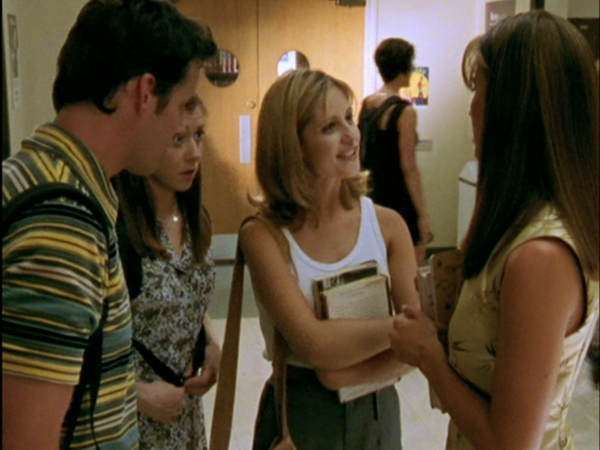
That darker side, of course, comes from her Shadow Self. This is why Cordelia has to be the one to confront Buffy over her “queen bitch of the year” behaviour. As the “reigning champion”, she is the only one who can really speak to Buffy on this level. The shadow recognises itself. This is another great moment for Cordelia, demonstrating her growing value to the show, both as a metaphorical reflection of Buffy, and a character who is comfortable speaking honest truths, which opens up opportunities for new kinds of interactions. This episode shows us how Buffy will butt up against her own shadow, even as she displays her common traits with them.
Cordelia isn’t the only shadow self present in this episode. A year before she will even exist in the show, Faith Lehane rears her head. Buffy’s behaviour in this episode is textbook Faith in the way she responds to trauma. Her excessive whaling on the training dummy is a straight copy of Faith with the vampire in Faith, Hope and Trick, and it’s also a habit we see Buffy return to a couple of other times, such as in Ted. Her seducing Xander in the Bronze seemingly just to show that she can is another classic Faith move, most obviously recalling The Zeppo or her lines to Spike in Who Are You.
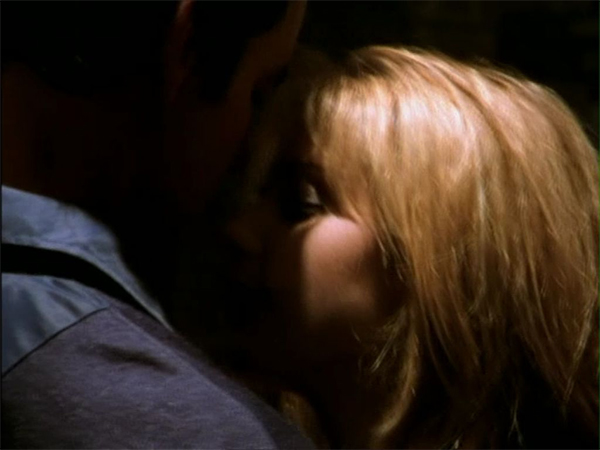
Sarah Michelle Gellar’s “kick my ass” to Angel in this episode is delivered with almost the exact cadence as the one with which Eliza Dushku delivers “give us a kiss” in Graduation Day. In fact, both these scenes are notable for how they refer to sex and violence interchangably.
Buffy: You think you can take me?
– Buffy Summers and Angel, 2×01 When She Was Bad
Angel: What?
Buffy: Oh, c’mon! I mean, you must’ve thought about it. What would happen if it ever came down to a fight, you vampire, me the Slayer, I mean, you must’ve wondered! Well, why don’t we find out?
Angel: I’m not gonna fight you.
Buffy: Come on! Kick my ass!
The sexual metaphor is obvious here, especially as we know how central Buffy and Angel’s sexuality will be to this season. Buffy’s lines here are as much a seduction as they are a threat. The line between fighting and another f-ing verb is barely perceptible in this exchange, as Buffy asks Angel if he can “take” her. We see here that slayers are just like vampires in how sex and fighting are tangled up as one very confusing ball.
It’s fitting that the first echoes of Faith are heard now, in the wake of Buffy’s death. As a slayer, Faith was born from the death of Kendra, and therefore from the death of Buffy. This is her origin story. Buffy’s death awakens the Faith that exists within her, as well as literally awakening the Slayer line that will lead to Faith. Slayers rise from the graves of those that came before them, and so when Buffy rises from the grave, she rises as another Slayer.
The knowledge of her rising haunts Buffy in this episode. She seems to understand that on some level, she didn’t just stop breathing for a few moments – she was dead. Like, dead enough to be recognised by the primal forces that guide the Slayer power. When she looks with anxiety at the Master’s grave, she’s not thinking about the Master, but about her own grave. She’s looking at where her bones should be buried, and wondering why they’re not there. We will see the themes of this episode explored in much greater detail in season six: Buffy’s depression, her reaction to trauma, and how painful rising from the grave really can be. Buried bones coming back to haunt Buffy is literally what almost happens in this episode, and metaphorically what triggers her depression in season six. In both cases, the real buried bones are her trauma, coming back to haunt her: in the form of the Master, and in season six in the form of herself.
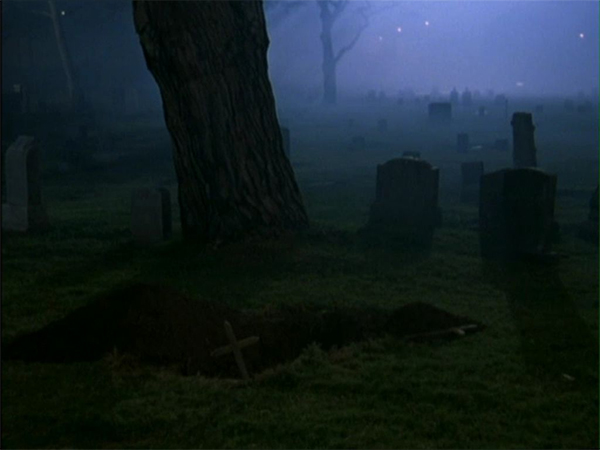
That is the beauty of a rewatch, to recognise these parallels and thematic threads that are woven into something greater in the future. The memory of the first watch is an enduring influence, but every rewatch brings something new. There is an ongoing process of recontextualisation; of seeing lines and moments in new ways once you take into account later events, or certain interpretations that you hadn’t considered before. One moment that is very much recontextualised by knowing the events of the whole season is the opening line.
“In the few hours that we had together, we loved a lifetime’s worth.”
This is, in a nutshell, Buffy and Angel. They will love intensely and overwhelmingly, but that time will be brutally cut short. It might as well be a few hours, especially in the context of Angel’s long lifetime. The writers often like to drop massive spoilers for the entire season early on, hidden in the context of a joke, and these lines are a joy to spot and recontextualise on a rewatch. Another example would be Snyder’s assessment of Buffy, which pretty handily predicts the events of Becoming.
“That Summers girl. I smell trouble. I smell expulsion, and just the faintest aroma of jail.”
Perhaps the most relieving part of viewing this as a rewatch is knowing what will happen with vampires on this show. One reaction I remember having on first watch is feeling like the villains were a little thin. They’re there chomping down more scenery than blood, worshipping a small child and making grand speeches about the weakness of man and how they’re going to do evil deeds for the glory of darkness and yadda yadda. It’s all very trite, uninteresting stuff. But while that was cause for concern on first watch, it now makes me a little excited – because I know who will be coming along in just a few episodes to sweep that style of villain off the table.
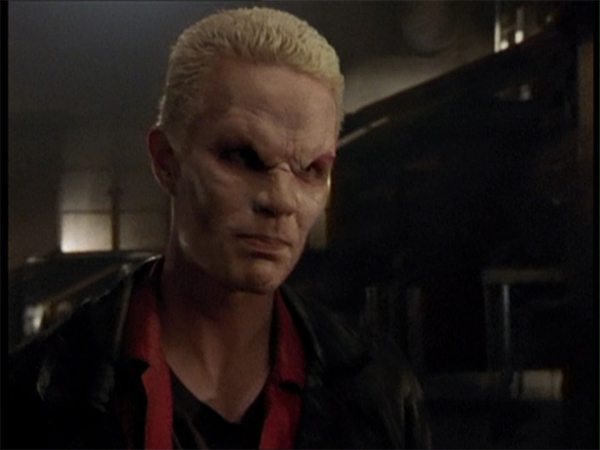
Another major theme of season two that is brought up here is the idea of blame and forgiveness. Who is at fault when bad things happen? Who feels responsible? Who should be punished? Who should be forgiven? These are questions central to the season, and ones we should be keeping in mind as we watch. And they’re relevant here, as Buffy openly blames herself for what happened.
Buffy: I don’t think I can face them.
– Buffy Summers and Rupert Giles, 2×01 When She Was Bad
Giles: Of course, you can.
Buffy: I can’t! What am I supposed to say? ‘Sorry I almost got your throat slit. What’s the homework?’
Giles: Punishing yourself like this is pointless.
Buffy: It’s entirely pointy. I was a moron. I put my best friends in mortal danger on the second day of school.
We have already discussed Buffy’s ongoing Main Character Complex and how that causes her to feel responsible for every event that occurs within her vicinity, especially in Nightmares. Here it is at work again, and here is Giles to remind her that just because something happened because of her, that does not mean she was at fault. Yes, she was reckless and dismissive towards her friends, and that put them in danger. But given what she knew at the time, and her emotional state, the decisions she made were understandable. She did not have sufficient information to be reasonably held responsible for what the vampires did to her friends. This again is a microcosm of future events, which we should remember come Innocence, Passion, Becoming, and I Only Have Eyes For You in particular.
We’re not there yet, and neither is Buffy. As she steps into that classroom at the end, she doesn’t know if her friends will forgive her, and part of her isn’t sure if she deserves their forgiveness. If you’re a first watcher, you’re perhaps wondering if this will be the start of a tension between the friends, one that grows into a conflict throughout the season. But, in a moment of beautiful simplicity, they do. They take their friend’s erratic behaviour in stride, and they forgive her without saying anything. They welcome her back, and simply move on with a joke. It’s a wonderful expression of acceptance, and of love.
“Well, we could grind our enemies into talcum powder with a sledgehammer, but gee, we did that last night.”
– Xander Harris, 2×01 When She Was Bad
This throwaway joke that Xander makes is everything. It’s that arm around the shoulder again. It’s the kind of comfort that does not ignore the pain that Buffy suffered, but re-contextualises it as humour, acknowledging but not dwelling on it. While there are other moments that made me realise how emotionally powerful this show could be, it was this moment in particular that I fell in love. And I will always remember that moment, sitting in my bedroom, watching on that little laptop screen, falling in love with the show that I would still be writing 2500 word essays about twelve years later.
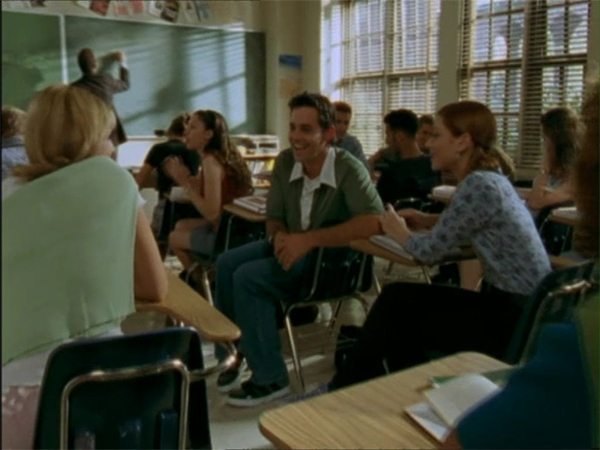
As we open the season that is shaped around a love story, this is a good time to remember that we all have our own love stories with television, and they’re always deeply entwined with the tactile essence of our lives. This is the moment I fell in love with Buffy. If you’re reading a 2500 word essay on this show, then you probably have your own moment too. And I just find that kind of beautiful.
* * *
Thanks for reading! If you enjoyed this piece, please consider supporting me on Ko-Fi!
* * *
 Insect Reflection
The way you describe the tactile experience of your experience with Buffy hit me so hard. I feel that way about S5 and S6, when I was in Year 11 and deeply depressed and trying to avoid the real hard choices and scary things going on in my life, I have such a visceral memory of watching Buffy on free streaming services and feeling like it was this halo/cave that made me feel safe in a world that felt so deeply unsafe. Crying deep tears for 20 minutes during the Gift, the crazy parallels with my own life, the metaphors and themes that spoke deeply to me.
LikeLike
I’ve been watching Buffy for the first time and ExplosionShark pointed me in your direction a while back but I wanted to finish series 2 at least, seeing how in depth your essays are and how much they’re about the themes of a series as a whole I thought it’d be best to have my own first impressions before checking in here. Despite starting from the very beginning I do have a bit of a Frankenstein to my viewing order way back when I watched the latter half of Series 3 of Angel, all of 4 and some of 5 so I did have some broad strokes. If I had to pinpoint the moment I started loving the show beyond just enjoying it I’d have to say that iconic scene with Buffy learning she’s prophesised to die.
Anyway truly great stuff here, it is fascinating looking at just how much there is going on under the surface that elevates an episode I already thought was really good standing alone as the fallout to Prophecy Girl rather than how it connected to the greater whole. But even beyond the analysis this was a really enthralling read you’re really good at this.
With how in depth these essays are and how much there is to dig into that you’ve inspired me to grab a notebook and jot down my thoughts as I’m watching to see if that’ll help me dig deeper myself.
LikeLike
So exciting that you’re watching for the first time! I will say, watch out for spoilers in these essays, but if you’ve already watched patches then I guess you’re probably already spoiled for the big stuff. Hope you enjoy the rest of them 🙂
LikeLike
I started watching when it was still airing, but I was NOT a TV person, so I only saw the episodes my friends showed me, which meant I watched The Gift, Once More With Feeling, and then As You Were (with AtS There’s No Place Like Plrtz Glrb right after The Gift). Such a lovely and interesting way to get into it. After As You Were, I started renting the DVDs from Blockbuster, starting with Season 1.
LikeLike