
There is a very meta line, early in this episode, where one of the Anointed’s vampire flunkies talks about how now The Master is dead, somebody has to take him place. The Big Bad of season one is dead, so we need a replacement for season two. Who will step up to audition for the role?
The vampire puts forward himself, talking in grandiose statements about the “Night of St. Vigeous”, and the crucifixion. It’s very opaque, pompous vampiric grandstanding; very much in the manner of season one, and even the 1992 movie. He represents one possible timeline for the show, where it continues to use these generic, interchangeable villains.
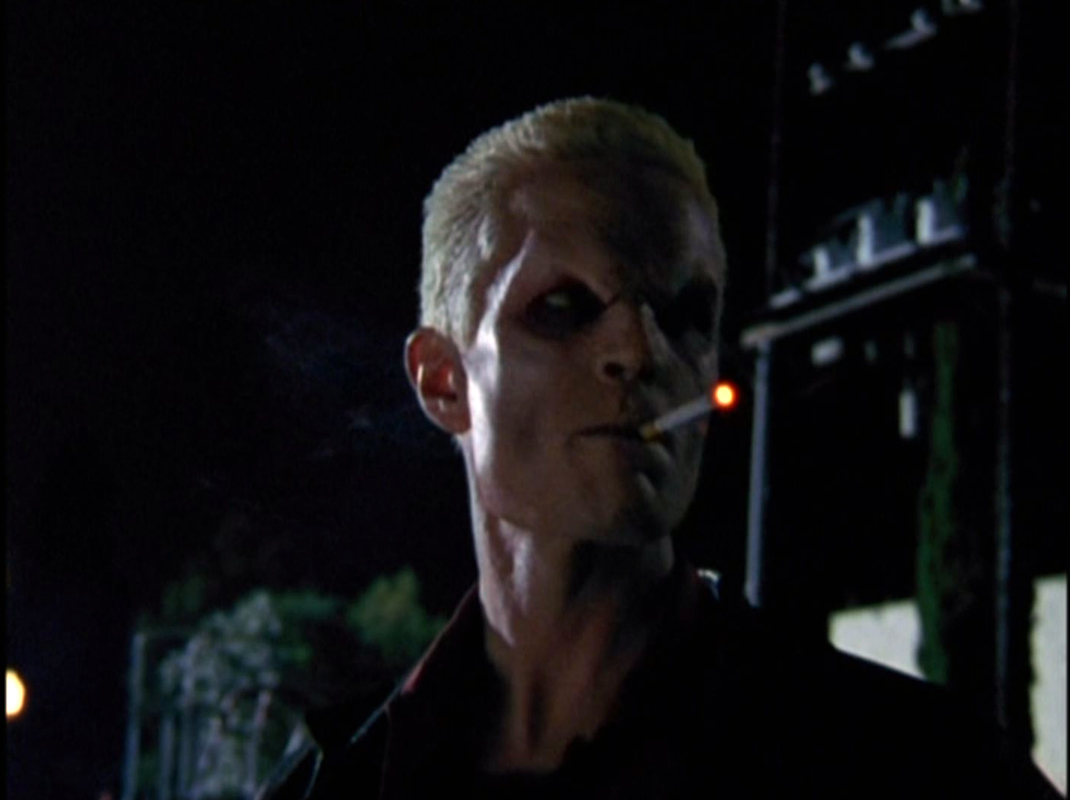
But then, a chuckle from behind him. Appearing from the background, we see another candidate for the future of the series. Enter: Spike.
This is a turning point for the show. Up until now, the show has had, at best, a mixed record with villains. As far as the main vampiric antagonists go, Luke, Darla, and The Master were played by charismatic actors but lacked real depth to their characters, while the Anointed One had neither. Outside of that, we had, in order: Bug Lady, Fork Dude, Not The Anointed One, Furry Zookeeper, Internet Demon, The Thing the Puppet Killed, Ugly Man, and Frankenstein’s Football Player. Catherine Madison and Marcie worked well as villains with a more human motivation, but they were very much tied to the specific metaphors of their respective episodes.
The show was very much built, at this point, to serve the monster-of-the-week format. Each week, Buffy deals with a new teen issue, and faces a villain that metaphorically represents that issue. Which is fine enough for those episodes, but it doesn’t lend itself well to returning villains. The returning villains we had were generic and malleable enough to service the episode theme of the week. As the show begins the process of moving away from that structure of monster-of-the-week episodes with occasional breaks for arc episodes, and towards the inverse, a new type of villain is required.
Spike and Drusilla are that new kind of villain. Immediately, they are charismatic, distinct, and deeply human. They are here to upset the structure of the show; to swoop in and destroy the status quo. From here on, we will see a litany of layered villains with honest, engaging emotions. They allow the creation of Faith, of the Mayor, of Willow. They are another necessary ingredient to transform this show into its fully actualised self.
We should focus on Spike, as he is the central antagonist of this episode. He is a character who vastly outstrips his original assignment. He was intended as a five-episode villain, meant to die in What’s My Line and never seen again. Instead, he manages to appear in nine seasons across the Buffyverse, five of those as a credited main character, and at least two of those as the protagonist’s main love interest. Going from villain to reluctant ally to hero, he remains one of the most complex and heavily discussed characters in the fandom, widely beloved by huge parts of it. His instantly iconic entrance, smashing down the ‘Welcome to Sunnydale’ sign, is itself a reminder of just how far this character will go over the years.

In this episode though, we should stick to analysing Spike as a villain first and foremost. This is what he is here for – to destroy the old style of villain, and take their place. He starts by doing this verbally. While the Generic Vampire talks of the Crucifixion, Spike talks of Woodstock. It’s Dracula .vs. The Lost Boys. The Classical against the Modern – and it’s clear from the conversation that only one of them is the real deal. Generic Vampire wasn’t at the Crucifixion – that’s just an image he’s projecting. Spike was actually at Woodstock.
Buffy herself is somebody who upsets the status quo with her modern perspective. This was made clear back in Welcome to the Hellmouth, and her scene with Giles on the balcony. She rejects the outdated way of doing things, and instead trusts her own instincts. So she must have an antagonist who matches that worldview. Like Buffy, Spike ignores the advice of elders to do his own thing, and is vindicated for it.
This classic/modern dichotomy is emphasised when we learn of his other name. ‘William the Bloody’ is a classic, moustache-twirling vampire villain, who could easily have fit in season one. ‘Spike’ is modern, is cool.
Whatever the essence of ‘cool’ is, it is clear from the first moment that Spike exudes it. James Marsters pours every ounce of his charisma into this character, and the revelry of the character allows it. He swaggers about the screen, leather duster flowing behind him, casually dismissing his opponents with a flick of his wrist. He revels in his own successes, openly bragging about killing Slayers. The whole time, we’re seeing him in full vamp face – a monster, celebrating his own monstrosity. Until…
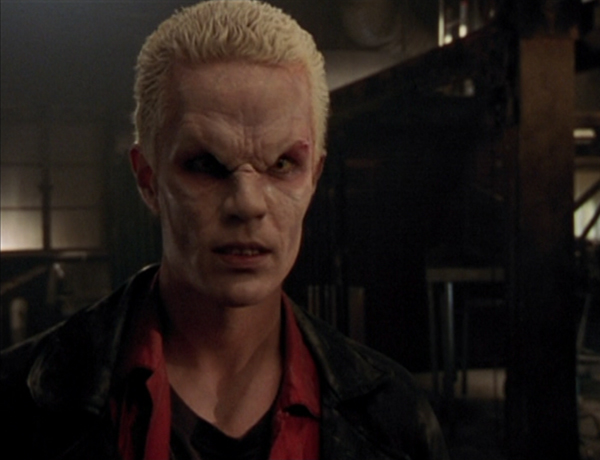
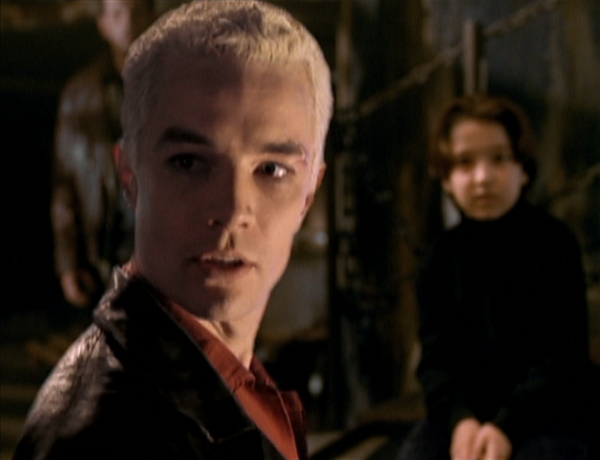
Drusilla enters, and the face of the monster falls away. We see a man, with tenderness and love in his eyes. This is the single most important transition in this very important scene. In two shots, we see everything we need to know about this character. The swaggering monster, and the soft lover. The duality that will define Spike for the rest of the show.
Back in the Angel review, we noted that the first time we ever see Angel in vamp-face, it’s in the context of kissing Buffy. His love and lust for her releases the repressed id, and reveals his monstrous side. Here, we have the opposite. Spike’s love for Drusilla releases the human side. For vampires, love is a double-edged sword; it can corrupt, and it can redeem.
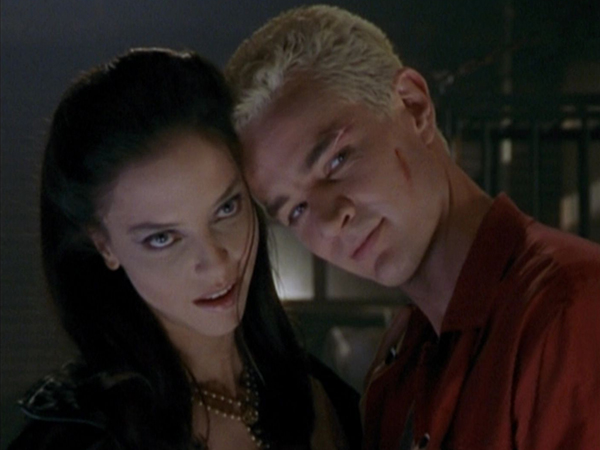
While we’re mostly focusing on Spike, Drusilla’s entrance is almost as iconic. She glides into the narrative like a panther. A gothic princess, dressed in pure white and speaking in quivering purple prose. In the mouth of a lesser actor, “everything I put in the ground withers and dies” would be grossly overwrought, but Juliet Landau deftly makes it work.
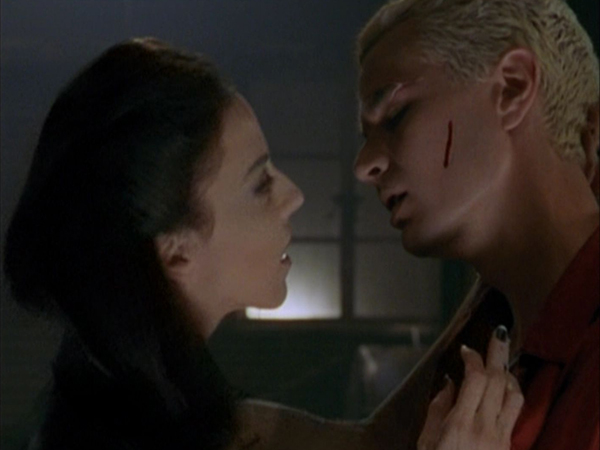
As she licks the blood from Spike’s cheek, we understand completely the twisted tenderness of their relationship. They are Morticia and Gomez Addams; two evil creatures completely devoted to each other. We see their dynamic as a comfortably married couple in a later scene, where Drusilla encourages Spike to go and be nice to his co-workers, and he entreats her to eat something. That the co-workers are vampires engaging in ritual chanting and the “something” is a teenage girl simply adds the twisted layer on the gentle tenderness.
In this three minute introductory sequence, we understand everything about these two new villains, and their relationship to each other. In one scene they have more depth and charisma than the Master or the Anointed acquired in an entire season. I think the creators understood the importance of this scene too, because they hold off on the cast & crew credits until the following scene in Buffy’s bedroom. Every effort is put into making this scene as pure and memorable as possible, and it pays dividends. Spike and Drusilla have successfully invaded the narrative.
The narrative they are invading is a pretty standard ‘Buffy tries to balance normal life with Slayer life’ episode, in the vein of Never Kill a Boy on the First Date and Witch. That’s not a knock against the episode – it’s arguably the most successful iteration of this story yet. Buffy’s desperation not to disappoint her mother while also being deeply aware that her duties as Slayer will inevitably cause that disappointment. Her sad “I have a job” is a moving expression of the secrets holding her down.
Although Buffy accepted her Slayer side in Prophecy Girl, we can see now that she is still viewing her Slayer self and Girl self as two distinct, irreconcilable entities. She has her own duality to handle.
“Cordelia, I have at least three lives to contend with, none of which really mesh. It’s kind of like oil and water and a… third un-meshable thing.”
Buffy Summers, 2×03 School Hard
She tries to resolve this balancing act by demonstrating the best possible version of her Girl self to her mother and Principal Snyder. She tries to pull off the best decoration and catering that she can, be the image of the perfect daughter, and hide her Slayer side. Of course, such a thing would be impossible, even if Xander hadn’t jinxed it. The Slayer side must always come out, because it is a part of Buffy.
Luckily for her, the fact that it does is what saves her. She pulls off her action-movie heroics, and saves most of the people in the school, and Joyce recognises that. Despite her efforts, Buffy’s efforts as the perfect student/daughter were going to be inadequate – Joyce was clearly going to punish Buffy after she spoke with Snyder. It’s Buffy’s Slayer side that redeems her in Joyce’ eyes, that demonstrates her kindness and bravery, and saves her from any retribution for her Girl side’s perceived failures. And before that, it is her human side as represented by Joyce that saves her from vampire attack. Clearly, these two lives are not as un-meshable as Buffy believes.
Buffy will continue to learn this lesson over her journey. For now, she is still young, and at a transitional phase in her life. She exists between childhood and adulthood. Season Two is very heavy with the emphasis on Buffy’s adolescence; on both the ways she is mature, and the ways in which she is not yet. In this episode, she “has a job”, but is also a schoolgirl fearing a telling off from her mother.
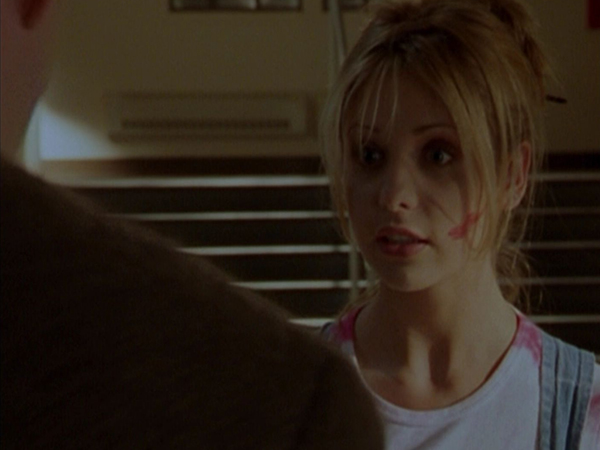
One of the other ways this theme is expressed is with the menstruation motif that is repeated throughout the episode. When Xander is pulling items out of her purse, he pulls out a tampon. As Mark Field noted years ago[1], this represents Buffy’s pubescence, alongside the other items: a yo-yo (her childhood) and a stake (her metaphorical adulthood). In the closing scene, Cordelia talks about her “time of the month”. Drusilla licks blood from Spike’s left cheek in their first scene, and later Buffy is seen with a smudge of red paint on her left cheek. Just as he is about to fight Buffy, it is implied that Spike can smell her menstrual blood.
“Fe, fi, fo, fum. I smell the blood of a nice… ripe… girl.”
Spike, 2×03 School Hard
Just as Buffy’s relative youth is emphasised in this episode, so is Spike’s. Giles tells us directly that Spike is “barely 200… not even as old as Angel”. Later episodes will actually put Spike’s age at this point at a mere 144. Again, he is the modern vampire, too cool and impulsive for the traditions and rituals of his elders. As well as being youthful, Spike also desires youth – he describes himself as a “veal kind of guy”, and decides that one of the teachers is “too old to kill”.
All vampires conflate sex and violence/death/feeding, that is well established. Dracula, if it didn’t invent it, at least codified the trope[2], and Buffy happily runs with it. Blood is sex for vampires. But no character so completely embodies this conflation more than Spike. He is pure violence, and pure sexuality, defined by blood in both its meanings, and that is obvious from this episode. When he first lays eyes on Buffy, watching her dance in the Bronze, it is as a predator on multiple levels. He wants to kill her, of course, but there is a sexual undercurrent to the scene also.
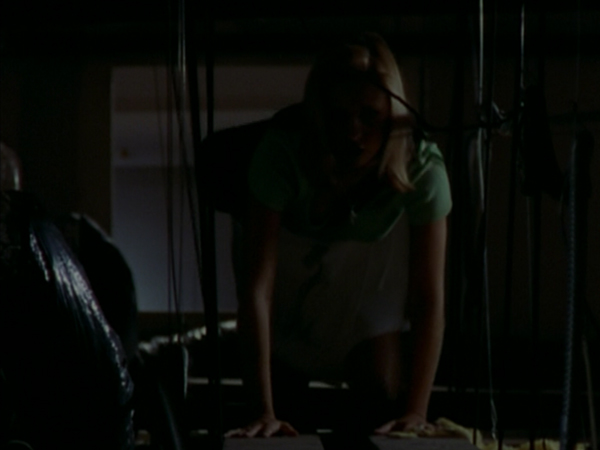
“Sexual undercurrent” might just sum up the entire episode. It is brimming with innuendo and sexual metaphors. From the dancing in the Bronze, to Spike’s phallic obsession with weapons, to him promising that his attack “won’t hurt”, a clearly erotic motif is occuring between Spike and Buffy (mainly, though not entirely, from Spike’s end). I also think that Joyce’s moment of saving the day with an axe (“Get the hell away from my daughter”) is a direct reference to the famous scene from Aliens[3] – another franchise with a villain famously imbued with sexual metaphor, and which Joss Whedon will have a big part in. (I mean, we already had Die Hard, why not another 1980s action movie reference?)
“I’ll do your Slayer for you.”
Spike
“No. But you said, ‘The cow should touch me from Thursday.’”
Willow Rosenberg and Buffy Summers
“Maybe that’s what I was feeling.”
“Here kitty, kitty, kitty…”
Spike, to Buffy
“Do we really need weapons for this?”
Buffy Summers and Spike
“I just like them. They make me feel all manly.”
“I’ll make it quick. It won’t hurt a bit.”
Spike and Buffy Summers
“No, Spike. It’s gonna hurt a lot.”
A major theme of season two is the looming danger of Buffy’s brimming sexuality, and the dangers that will unleash come Surprise. Unlike the puritanical Victorian mindset that obsesses over female expression of sexuality, or the gothic novels they enjoyed, I do not believe that season two of Buffy either condemns or fears Buffy’s sexuality. We’ll go into that in more detail come Surprise/Innocence. The important thing is that this theme of dangerous sexuality is being expressed, and so Spike is designed as a figure of pure danger and sex.
With this brimming sexual tension obvious from the outset, Spike seems to in fact be laying the groundwork for his own longevity as a character. Still intended to be killed off in seven episodes, Marsters and Gellar already display the chemistry that will justify the writers’ decision to bring back Spike and build him up as a main love interest in a few seasons’ time. This is a great example of how a character can be designed to metaphorically express sexual anxiety in our main character, and how that can also somewhat unintentionally imply an actual sexual interest from this character towards Buffy, and therefore code their dynamic as romantic. As we’ll see in season three, this won’t be the last time this show falls into this trap.
Spike doesn’t just grow into a love interest though. He also, for much of the later seasons, acts as Buffy’s Shadow Self, expressing both her repressed sexual desires and interest in the darker aspects of her own self. He’s the only one of the Shadow Selves who isn’t explicitly designed with that purpose in mind, but grows into the role. So at this point, we only see glimpses of it. We see how Spike is positioned as an equal to Buffy – youthful just like her, rebellious just like her, sexual just like she is becoming. They are equals, with a matching pair of red smears on their cheeks.
Spike quotes Othello in his opening scene. The next (and unless I am mistaken, only other) time that Othello is referenced in Buffy is in Earshot, where it is used to create a very apt description of the Shadow Self. At that point the show is symbolically referencing Faith, but it later becomes a fair description of Spike also. This is the first seed of Spike’s eventual role.
“I’ll chop her into messes.”
Spike, 2×03 School Hard & Othello, Othello (~1603)
“It’s like [Iago]’s not, he’s not really a person. He’s the dark half of Othello himself.”
Buffy Summers, 3×18 Earshot
That is a role Spike will grow into. Right now though, he has another one. He must step into the role of Big Bad, and do it by destroying the old one. Season Two has a constant habit of shuffling out its Big Bads, which total four in number (or, you could even argue, five). Every few episodes, one will be destroyed and another will replace them, keeping the season fresh and escalating the tension with greater physical and emotional threats. This final scene is the first of these shuffles, as Spike kills the Anointed One.
Before he does so, he kneels in submission, admitting that he failed in his mission, and is told to lay down his life. This evokes the scene in Angel with The Three, who kneel before the Master and allow themselves to be killed as punishment for failing him. The Three were built up as dangerous threats in that episode, to be feared, but ultimately proved useless and unmemorable to fans. They were no more than generic vampire goons. And we are done now, with generic vampire goons.
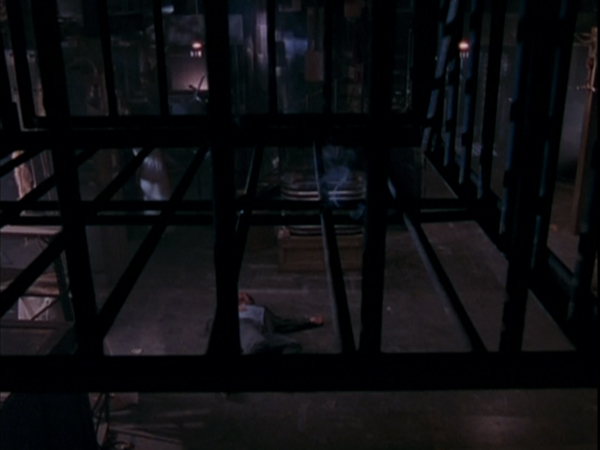
Spike stands up, seizes the Anointed, and places him in a cage. He hoists up the cage towards the sunlight like he is hoisting up a flag. A flag signalling a new age for the show, a new era of villains as worthy of our attention as the heroes. He raises the banner, and leaves us with a promise that the show will indeed fulfil.
“From now on, we’re gonna have a little less ritual… and a little more fun around here.”
* * *
Thanks for reading! If you enjoyed this piece, please consider supporting me on Ko-Fi!
* * *
References:
[1] Mark Field, Myth, Metaphor, and Morality, p. 65
[2] Nilifer Pektas, The Importance of Blood during the Victorian Era: Blood as a Sexual Signifier in Bram Stoker’s Dracula, https://www.diva-portal.org/smash/get/diva2:16204/fulltext01.pdf
[3] Aliens (1986), dir. James Cameron, https://www.youtube.com/watch?v=j51DfrLHUek
 Insect Reflection
love all of these especially your analysis of the Spike & Buffy parallels – mentioning the red paint / blood smear shots !! i remember noticing it on my second re-watch but not really having the brain power at the time to put all the Thoughts of why it was important together haha . can’t wait for more episode analyses !!!!
LikeLike