
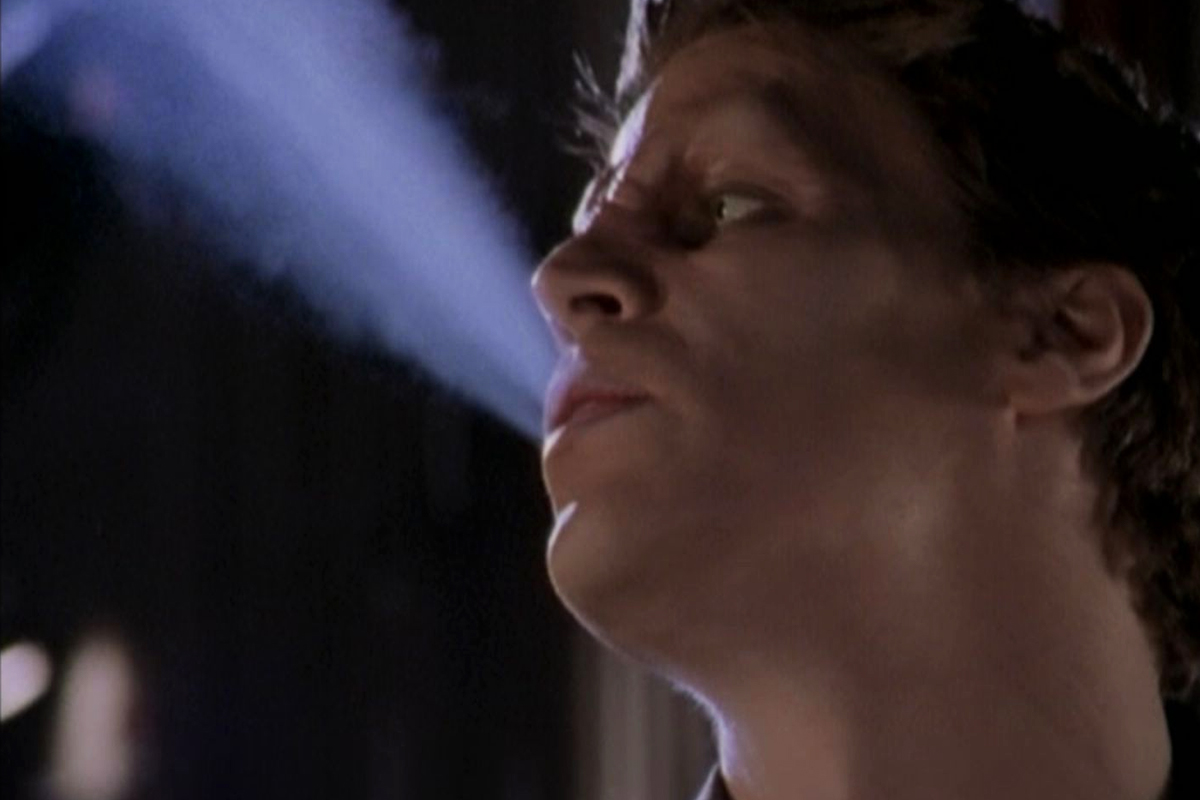
Buffy the Vampire Slayer always has very thoughtful episode titles, often working on multiple levels to indicate a thematic throughline, but it is rare that a title so completely captures an episode’s many ideas as Innocence. The concept of innocence defines this episode, in the manner of all its definitions. I don’t want to start us off with a very lame “Webster’s dictionary defines innocence as…” opening, but the question of “what exactly is innocence” is a good place to start when analysing this episode. The concept of innocence is a mirrorball, and this episode reflects off its many different surfaces, shining out a different light from each angle. So let’s ask the question – what is innocence, and what is opposite to it?
Innocence .vs. Sex
“Do you really think you’re ready, Buffy?”
We have talked about how much of season two up to this point has been about sex, and Surprise really ramped this up – quite literally climaxing in the scene where Buffy loses her virginity with Angel. In Surprise, Buffy was consumed with two major questions regarding Angel – will she sleep with him, and will he die? It’s the eternal conflation of sex and death that defines vampires – the Danse Macabre. In Buffy’s dream, Angel’s former lover and murder victim, and Buffy’s dark mirror in this season – Drusilla – holds a stake to his heart to further emphasise the connection of these ideas.
In Innocence, Buffy has another dream. It starts with what is implicitly a memory of sex with Angel (all we get is soft piano music and close-up shots of hands and lips, but that’s the assumption), and then immediately cuts to a funeral. We have these ideas again bound together – sex, death, and grief (and it will not be the last time the show plays with these ideas). But it begs the question – whose funeral is this? This is not made entirely clear. The mind instinctively goes to Angel – assuming the reading that he is dead and Angelus has replaced him – but that’s not quite right. Angel is in attendance – the man that David Boreanaz plays in this dream sequence speaks like Angel, and gives Buffy help like Angel. The three characters who are in attendance, and so we know are not meant to be the ones symbolically buried, are actually the only three major characters who by the end of this season will have died – Angel, Jenny, and Buffy herself.
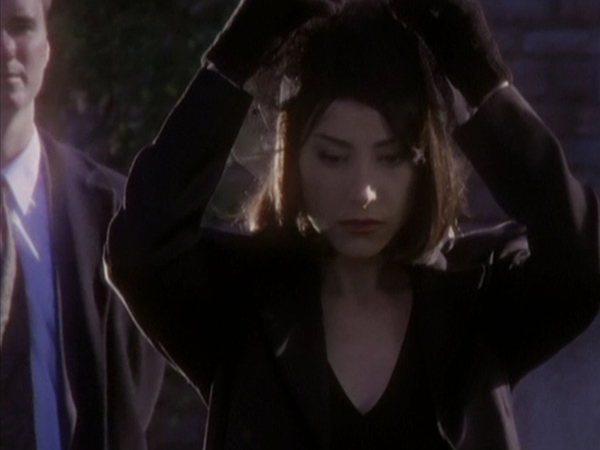
There is a long-standing and exhausting tendency in our culture to conflate virginity and innocence. It’s a Victorian, puritanical notion that assumes that sex inherently corrupts the body or soul in some way. It is of course, a notion always dripping in misogyny – it holds up the “pure maiden” as some kind of virtuous role model, opposed to the wicked sluts and whores that have sexual intercourse. It assumes that women can be sorted into Virgins and Non-virgins, as if that is remotely a meaningful method of categorisation. This false dichotomy infects popular culture at every level, and Buffy is absolutely no exception to this. The episode threatens to fully buy into it when Joyce questions Buffy about her whereabouts the previous night and comments: “You just look…” with the sentence remaining unfinished but implicitly wanting to end with “different”.
Buffy is rife with many so-called ~problematic~ elements that have not aged particularly elegantly over the last twenty years, so it is somewhat strange that the central plot of season two isn’t really one of them. If you described it to a layperson, it sounds like one of the most offensively misogynistic storylines ever written. “A woman has sex and it literally turns her partner evil, causes many deaths, and nearly leads to the entire world getting sucked into hell”. And yet, it doesn’t feel like that. It doesn’t entirely escape the trope of sex being somehow damaging – it can’t, it’s too close to it – but it is otherwise remarkable in how positive it still manages to be. There is no sense of judgement coming from the writing towards Buffy here.
It helps that the mentor figure explicitly refuses to condemn Buffy, in a truly lovely scene at the episode’s end. Giles refuses to endorse any notion of Buffy being responsible for what happened, and instead offers her total, unconditional support. It is not only a heartwarming scene for the characters, but is an indication from the show as to how we are meant to feel about it.
The dangers of sex so often focus on how it somehow alters the woman in the equation (we are assuming heterosexual sex here, because of course patriarchal notions like this only assume heterosexual sex). But while one character is undoubtedly altered by sex in this episode, it is not Buffy. It’s Angel. He loses his soul – he is corrupted. Just like he took the role of the maiden being held hostage, sacrificed for the power of his blood in What’s My Line, he takes that role again here. It is the man who is altered. He is the virgin who is made to become Something Else by sexual intercourse. This is the opposite of the kind of story we might expect. If there is any notion of sex as a corrupting force here, it is one that has a subversion baked into it.
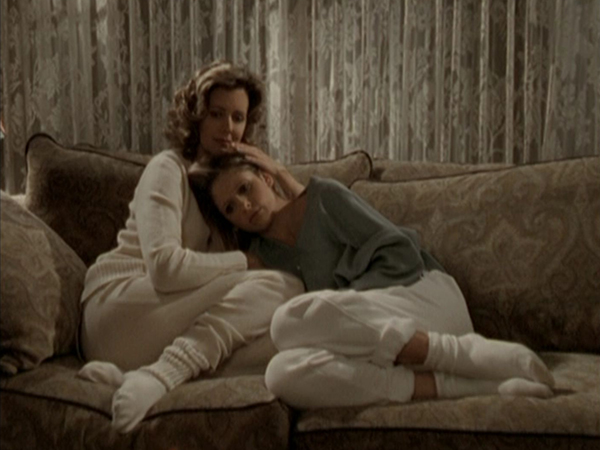
Ultimately, the idea that Buffy is altered or tainted by having sex is firmly rejected at episode’s end. Joyce gives the conclusion to her unfinished thought from earlier, and it indicates that Buffy is the same, is who she ever was – not transformed, or corrupted, or turned into a vampire as much of the season has symbolically threatened. She looks the same to Joyce, and as far as she, Giles, and the show are concerned, nothing has changed.
Innocence .vs. Guilt
“So it was me. I did it.”
If Angel has been altered, perhaps even metaphorically killed, then who is responsible for that? For much of this episode, Buffy lingers under the belief that she is. This is very in character for her, as we’ve talked about with her so-called “superiority complex”. She lives her life believing that anything that goes wrong is because of her, it is her fault. This goes way back to her life in LA and her parent’s divorce, and augmented by her designation as the literal protector of humanity and Most Important Girl In The World. But it is truly escalated by the events of this episode.
It is Angel who first seeds this guilt in her mind, even before she knows he has lost his soul. He delivers a truly sickening performance as a guy who Buffy saw as the love of her life, casually blowing her off after their night together. It is the literal version of the metaphor this season is built around – dealing with a boyfriend who seemed nice at first, but turns neglectful and mean after sex. It is terrifying for its mundanity, no better encapsulated than Buffy’s desperate, heartful “I love you” being returned with a sadistically casual “love ya too.”
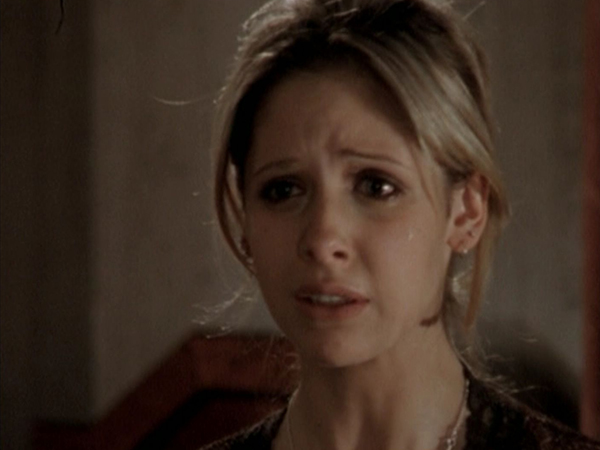
“I don’t understand. Was it m-me? Was I not good?”
Before there is any indication of magical shenanigans, Buffy blames herself for this turn. She worries that she did something wrong, that she wasn’t good enough. Her youth and naivety is weaponised against her – not just by Angel, but by herself.
Angel continues to twist this screw, to elevate the feelings of guilt. It is an indication of how well he knows Buffy, that he is perfectly aware of how easily it will be to grow the guilty feelings already present in Buffy. He waters those seeds again and again, emphasising at every turn how she is responsible, how she “made him into the man [he is] today.”
Later, when she gets the full story from Jenny, this only confirms in her mind that yes, she caused this, and Jenny herself agrees (“I think so.”). I don’t think this is meant unkindly by Jenny – she simply means that objectively speaking, event A (Buffy sleeping with Angel) has led to event B (Angel losing his soul), which is technically true. The leap that Buffy herself makes is that this implies responsibility on her part, that it is her fault that he lost his soul. This isn’t true, and I don’t think any reasonable person would say it was. She had absolutely no way of knowing what would happen, and she was in a loving, committed relationship with somebody who loved her too. But that doesn’t stop Angel implying that it is her fault, and it certainly doesn’t stop Buffy feeling it.
In the aforementioned scene between Buffy and Giles, he refutes her feelings of guilt, and tells her she has done nothing wrong. Though this seems to make her feel better in the moment, it does not permanently assuage her feelings of responsibility. She continues to blame herself throughout the season, as we will see when she breaks down every time Angel kills someone, and most explicitly in I Only Have Eyes For You, where she harbours intense over-identified anger at James for “destroying the person he loved”. She believes that she is responsible, and this trauma shapes every romantic relationship she has going forward. The show does not blame her, does not assign her guilt; but Buffy does not at all see herself as innocent here.
Innocence .vs. Culpability
“We control nothing. We are not wizards, Janna.”
If we follow the (correct) assumption that Buffy is not responsible for Angel losing his soul, then we should ask the question – who is, if anyone? I don’t think Angel can be held any more responsible than Buffy – he had no idea of the details of his curse (really, they should have given him a pamphlet. Possible side-effects and all that). Buffy holds some blame towards Jenny – slamming her into a desk neck-first, rejecting her attempts at help, and holding a grudge that remains until Jenny’s death. However, I don’t think Jenny can really be held accountable either. She did not have the full details either. She was not given adequate information, either to perform her duty as spy or to do anything that would have prevented this.
If there is any blame to be allocated, then it must lie with Uncle Enyos, and the elders of the Kalderash clan. They had all the information. They knew what would happen if Angel achieved true happiness, and they chose not to act on that information. Enyos’ defence of their actions here highlights some interesting aspects to the show’s ongoing discussion of choice and helplessness.
“You know what it is, this thing, vengeance? To the modern man vengeance is a verb, an idea. Payback. One thing for another. Like commerce. Not with us. Vengeance is a living thing. It passes through generations. It commands. It kills.”
One of the tenets of existentialism is that life is meaningless, and the world is defined by chaos. We cannot change or tame it. Enyos agress. “We control nothing”, he tells Jenny, and he is right. They did not determine what would happen here or shape its outcome. But they still had a choice. They had the information that they had, and they chose to do nothing with it. He reveals his blinkered perspective when he justifies what has happened by telling Jenny that it “was arranged to be so”. This is a denial of personal responsibility, in Buffy’s ethical framework akin to telling someone that you “don’t have a choice”. For all her self-flagellating, at least Buffy is never tempted to deny culpability in this way.
Though Jenny is unable to re-ensoul Angel at this point, it is suggested that Enyos might be able to – which is the reason Angel kills him, just as he will kill Jenny for the same reason in three episodes’ time. He had a choice here, and chose not to act, to not try and fix what happened. And not only does he die because of that, but so does his niece. He signs Jenny’s death warrant. His commitment to ensuring vengeance for his dead family results directly in suffering and death for his currently living family.
Vengeance is presented as a living thing, with actions and memories and choices of its own. But it is not. It does not live, it does not think, it does not breathe. It is only given life by those enacting it. Enyos and the Kalderash elders surrender to the will of this amorphous concept, and deny their own responsibility. They pump it up with their own hot air and then call it alive. They are wrong. Vengeance is not commerce, or justice, or a living thing. Vengeance is a choice. And they made theirs.
Innocence .vs. Evil
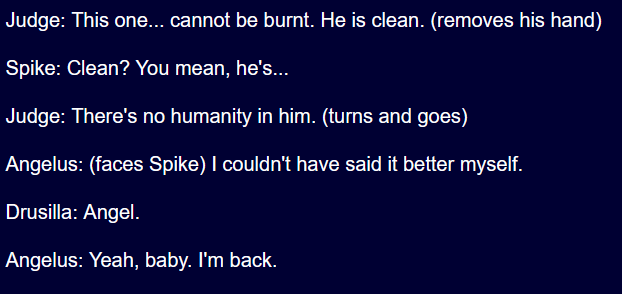
“He is clean. There’s no humanity in him.”
If we are going to talk about dualities here, then there is no greater duality than the one between Angel and Angelus. Right from the off, we are encouraged to think of them as different characters. David Boreanaz plays them entirely differently – gone is Angel’s soft, distant brooding, replaced with a manic, extroverted cruelty. It’s an impressive performance that really makes the audience feel the change. Boreanaz’ transformation from a pretty-boy former dog walker into an actor capable of this kind of range is even more impressive than the transformation the show itself has undergone.
While Angel was never truly innocent, he was undoubtedly a kind and heroic figure – being supportive to Buffy, helping her fight demons, and notably saving Jenny Calendar’s life. Angelus is not. If his murder of a woman in the opening scene didn’t make it clear enough, then the Judge explicitly declaring that he is devoid of humanity just about does the job. He then goes on to delight in murder, blood and cruelty, skipping merrily along to nearly end the world. He has delivered the most complete of Face-Heel turns, turning 180 degrees from love interest to Big Bad. He pushes Drusilla right out of the spotlight and takes her place in yet another transition point in season two’s Big Bad Carousel.
So this would point to the conclusion that Angel as a character is no more. As Buffy’s dreams of Angel’s death and a funeral might indicate, Angel is dead and Angelus is walking around in his skin. This is a common perception among fans, and it’s one that both shows, especially Angel, fully buy into later on, to the point of assuming that Angel and Angelus have different memories. But if we look at the evidence as it exists right now, here in season two of Buffy the Vampire Slayer, the issue is a little more complicated than that.
It is commonplace to refer to the ensouled version of David Boreanaz’ character as Angel, and to the soulless version as Angelus, but this episode doesn’t do that. Drusilla calls him ‘Angel’ when she realises his soul is lost, and he responds to it. He is continually referred to as ‘Angel’ almost exclusively for the rest of the season. ‘Angelus’ only appears as a name used for him when Spike and Drusilla see him for the first time. They switch to mainly using ‘Angel’ later on, and continue to do so from this point. It is perfectly understandable that ‘Angelus’ is ubiquitously used by fans, but it is not at this time a habit of the show.
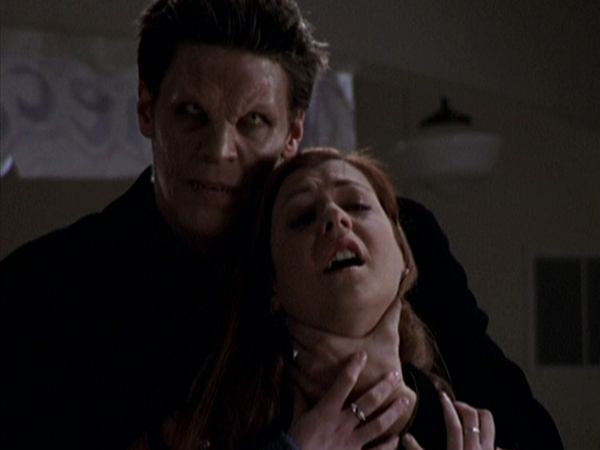
Angel himself complicates this further. When he threatens Willow in the school hallway and his turn is revealed, Jenny confronts him and declares that “he’s not Angel anymore”. Angel contradicts her. “I am Angel, at last!” he says. As far as he seems to be concerned, he is Angel, and the audience should recognise him as one consistent character.
…But yet, that isn’t quite true either. Because he changes his story merely a few lines later.
“This can’t be you.”
Buffy Summers and Angel, 2×14 Innocence
“Gee, we already covered that subject.”
“Angel, there must be some part of you inside that still remembers who you are.”
“Dream on, schoolgirl. Your boyfriend is dead.”
First he declares that he is Angel, and then he declares that Angel is dead, and that no remnant of him remains. It is openly self-contradictory. And then in the climactic scene, he changes his story again.
“That doesn’t work anymore. You’re not Angel.”
Buffy Summers and Angel, 2×14 Innocence
“You’d like to think that, wouldn’t you?”
He is constantly oscillating back and forth. One moment, he is declaring himself the total opposite of Angel, completely free from his former feelings for Buffy. The next, he is declaring himself to be Angel, and saying that he actually felt the same way the whole time (and that he was faking his love). This isn’t actual inconsistency on the show’s part. The contradictions highlight Angel’s fundamental motivation.
“The important thing is you made me the man I am today.”
Angel, 2×14 Innocence
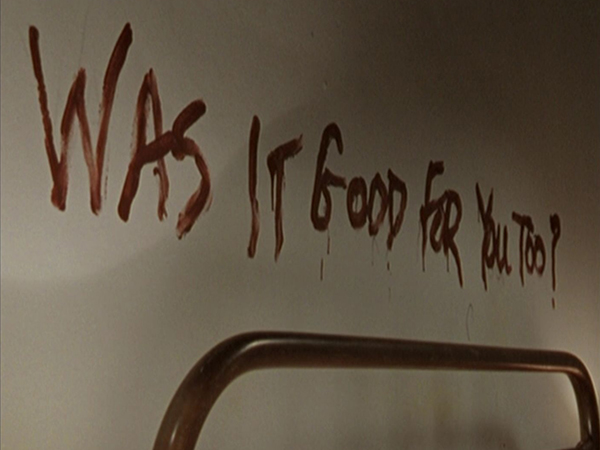
The important thing is hurting Buffy. The important thing is making her feel guilty and responsible. Whether that means making her believe that this was what he was always like and she fell for it, or that he has fundamentally changed and it’s because of her, it doesn’t matter. He is simply saying whatever will hurt her most in that moment. It’s the same thing that drives him to act as a bog-standard asshole boyfriend in his apartment, the same thing that drives him to write mocking references to their lovemaking in the blood of a murdered man. Drusilla tells us – he wants to hurt Buffy, like he once hurt Drusilla. Buffy is forced by him to take the role of her dark mirror, to suffer for his obsession. It all revolves around Buffy.
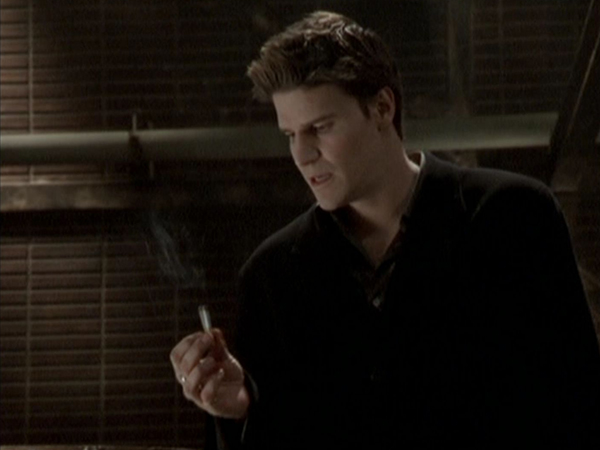
There is an ongoing and unresolvable debate in the Buffy fandom over vampires and the exact nature of the soul. A question reigns as to whether or not the vampiric version of a human is, in fact, that person, or if they are instead a demon that has happened to possess the body of a dead human. Giles’ explanation of the Buffyverse lore in episode one indicates this, and Buffy’s words to Ford in Lie To Me suggest she believes it too. It is often suggested that this is a general principle, and what we see later with Spike taking an active decision to obtain a soul is an aberration. Spike is seen as an exception to the rule. He is regarded as an aberration by both fans and critics of his arc. They are wrong. If there is any special case here, it is Angel.
As mentioned, Angel’s loss of soul and turn into evil is confirmed to us when the Judge is unable to burn him. This marks him as No Longer Angel. He is an evil vampire, just like all the others. But this moment also marks him as an aberration among the evil vampires. It has already been established that the Judge is able to burn Drusilla and Spike due to their love for each other, and he does burn Dalton for his love of books. Angel is demonstrably the special case here.
Throughout the run of both shows, we see countless examples of vampires retaining emotions and motivations from their former self before and after a soul. After being turned, Jesse is still an insecure tryhard who wants to get in Cordelia’s pants. Drusilla harbours affectionate memories of her family and anger at Angel for what he did to them. Darla retains her love of fine things after becoming a vampire, and retains her affection for Angel, killer instinct, and desire to create a family after becoming human again. Harmony remains just as motivated by a need to fit in and be admired as she was as a human. Willow is just as gay as a vampire as she is as a human. Psych major Holden Webster enjoys psychiatry post-mortem. Spike is everything that we see going on with Spike. All of these characters retain much of who they are despite transitioning to and from an undead life. None of them get a special name change to denote a different character. Again, if there is a special case here, it’s Angel.
I tend to favour the interpretation that the claim about vampires from Giles, that they are merely demons inheriting a body and some memories, is an oversimplification, if not outright propaganda from the Watchers’ Council. It is demonstrably made false by what we see from basically every vampire character of note. The transformation from human to vampire has an undoubted impact, but it still makes far more sense to me to consider the souled and soulless versions of these people as the same character, and this includes Angel.
Angel kicks up a dust cloud of ambiguity around himself, creating an in-universe lack of clarity over whether Angel and Angelus are two distincts beings sharing a body, or just the same person at a different time in their life. The presence of a soul clearly means something, but it is never clear exactly what. And so, the common fan reading has to go off the general vibe of the situation. Boreanaz’ performance creates a general vibe of two different characters, and so that vague feeling becomes assumed as concrete canon by the audience. When the show returns to the idea of Angelus later, the fan perception feeds back into it, and it becomes more explicitly married to the idea of a strict dichotomy between Angel and Angelus, even though that’s not the story they’re exactly telling here.
The story they’re telling here wants to blur the lines between ensouled Angel and soulless Angel. They are so different in so many ways, but they share a common fundamental motivation: Buffy. As Willow tells us in Passion, she is still the only thing he thinks about. He is unconcerned with the apocalypse – he cares more about Buffy. He changes his claimed identity based upon how it will affect her. As he tells Spike (in a line that becomes quite hilarious foreshadowing for Spike’s future arc) – “To kill this girl, you have to love her”. Which would very much imply that whatever you call him, this man still, in some gross and misshaped way, still loves Buffy Summers.
This is a story that is supposed to be ambiguous. There is still something resembling love there, but it has been twisted into something cruel. The fiery passion between them now burns more than it warms. The line is blurred between Angel and Angelus, between love interest and villain, between death and love. Between innocence and evil. There are no easy answers here. Not anymore.
Innocence .vs. Age
“I got older.”
Buffy comes out of this episode severely traumatised. It is the most emotionally intense thing she has had to experience since Prophecy Girl, and as Giles tells us in the car, it is merely the beginning. There is more suffering to come. If the show is about the growth into adulthood, then this is another horrible step on that journey; another shattering of childhood innocence. She is older now, both literally and emotionally.
Perhaps that is what she is mourning, when she attends that funeral in her dream. Her childhood lies dead in that grave, and is never coming back. She is no longer in touch with that part of herself. Her heart has been wounded. The whirlwind of passionate love that she wanted to feel is now tainted with grief. She will never get back that feeling, the freedom that comes with naivety. It is gone now, and she can never get it back.
The show itself is changed now too – a little older, a little more aware of its own world and in touch with the emotional lives of its main characters. More and more, it is leaving behind the monster-of-the-week silliness of childhood, and embracing the heavy arcs of adulthood. It is a more experienced series now, and Buffy is a more experienced protagonist.
But just as Angel retains much of his former self after this transformation, so does Buffy. Joyce tells her – “You look the same to me” – and she does indeed remain the same. Changed, but still Buffy. Just as the show is still Buffy. After she suffered her first great trauma with her death in Prophecy Girl, Buffy rose again, stronger than before. She did it by reclaiming her connection with the show that she inhabits, with her fundamental self as expressed by the Buffy the Vampire Slayer theme song.
She does a similar thing here. She reconnects with her fundamental premise. As we’ve said, the premise of this show was subversion, a tweak on the classic horror trope where the blonde cheerleader turns around and kills the monster chasing her. She continues to gain and demonstrate her power by rejecting classic tropes, and imbuing her heroic role with modern sensibilities. She can fight demons, but she can also take classes and go shopping and watch movies with her friends. She brings the mystical world into the late 20th century, and is a greater demon fighter for her modern perspective.
The Judge declares that he cannot be killed by any weapon forged. He is a classic trope come to life, a walking fantasy villain. He is undefeatable, unstopped, unharmed by sword or axe. But who cares? This isn’t that kind of story; this is Buffy’s story. That was then, this is now, and they have a rocket launcher. She quite literally defeats this demon with the power of modernity. That is Buffy’s fundamental power – to retain her self-identity by transforming the situation around her.
Buffy has completed its chrysalis into the show we know and want to write extensive essays about, but Buffy is still the same. She is hurt, but she has not been fundamentally altered or broken by this experience. She has not become a different character. She has not been corrupted or tainted. She is not guilty or condemned. She is still the same person, still Buffy. She’s just a little older.
* * *
Thanks for reading! If you enjoyed this piece, please consider supporting me on Ko-Fi!
* * *


One thought on “A Person Doesn’t Just Wake Up And Stop Loving Someone (Innocence)”