
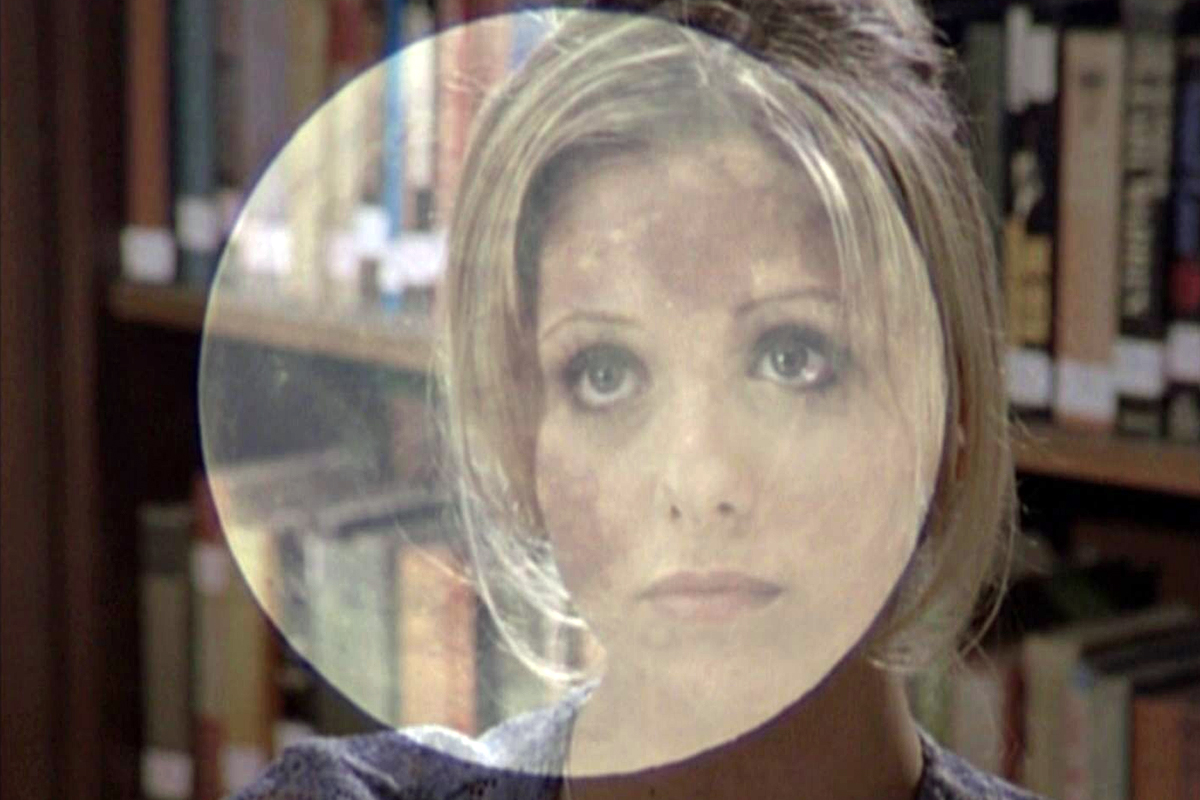
With Angel making the switch from Love Interest to Big Bad last episode, the show switches its central focus too. The first two thirds of the season were concerned with Buffy’s burgeoning romanticism, and asking questions about it.Would she would commit to a sexual relationship with Angel? If she does, how will that go for her? And, well, the show has answered those questions. Yes, and Badly. So now we have a new overriding question to take us through to the final moments of Becoming – will Buffy be able to kill Angel?
A more arc-focused season might move immediately to tackling that question directly. This one gives us an episode about werewolves. One criticism often leveled against the earlier seasons – season two in particular – is that the main Angel arc is constantly interrupted by monster-of-the-week shenanigans. While the looming homuncule that is Go Fish gives me some sympathy to that viewpoint, I think it misses a lot of what the show is doing at this point. It is folding Buffy’s internal conflict into the monster-of-the-week plot, dealing with it indirectly and through parallels.
Just as Buffy loses her Monster Boyfriend, Willow gains one. Her and Oz became significantly closer during Innocence, and she reminds us of the link between these two relationships when she complains early in the episode about potentially being the “only girl in school without a real boyfriend” – immediately and accidentally sparking Buffy’s Angel-angst.
This idea of normality and “real boyfriends” held up against the complexity and inherent unreality of Monster Boyfriends runs through both the Willow/Oz and Buffy/Angel dynamics. There is a suggestion in both cases that “normal” domestic bliss is impossible for them because of one partner’s Monsterhood. In both cases, it is Xander who hypothesises this – in both cases giving us an elaborate, half-serious scenario of domestic horror.
“I mean, what kind of a future would she’ve really had with him? She’s got two jobs — Denny’s waitress by day, Slayer by night — and Angel’s always in front of the TV with a big blood belly, and he’s dreamin’ of the glory days when Buffy still thought this whole creature of the night routine was a big turn-on.”
Xander Harris, 2×13 Surprise
“What relationship? I mean, what life could they possibly have together? We’re talking obedience school, paper training, Oz is always out back burying their things, and that kind of breed can turn on its owner.”
Xander Harris, 2×15 Phases
It’s no surprise that Xander immediately presumes a horrible future relationship for them. We know what his home life is like. He was raised within his own domestic horror, with parents constantly fighting, and expressing violent disappointment with their lives. His image of Angel as a bitter old man sitting in front of the TV is based not only in his jealousy over Angel and Buffy – it’s based on his experience of his father.
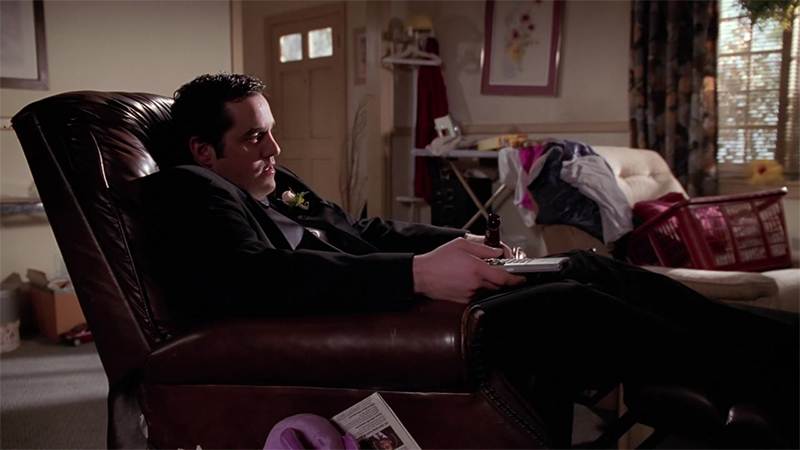
This exact image crops up again later in the series. In Hell’s Bells, Xander leaves Anya at the altar largely because he fears they will end up like his own parents. In one of the false future visions shown to him, he sees himself, sitting in front of the television with a beer, bitterly complaining of an injury that apparently keeps him from working, while Anya is forced to work to support them both.
Xander’s skepticism over the possibility of happy relationships with non-humans is also folded into his Hell’s Bells fears. In those visions, he sees his hypothetical daughter being bullied and ostracised for her demon ancestry, and clashes with Anya over her own demon past. The mundane fears of a failed and unhappy marriage overlap and become conflated with fantastical fears about the perils of dating demons. That is a consistent trait of Xander’s, from here all the way until season six, and it is based in more than simple romantic jealousy.
Ultimately though, both these fears are just that: fears. It is up to the individual whether to listen to these fears and play it safe, or risk hurt for the chance of happiness. Earlier in the season, Angel repeatedly warned Buffy of the dangers of being with him, and there must be a good part of her that wishes she had played it safe. We saw in Innocence how much she was driven by her own guilt in “causing” Angel’s turn. Given the same choice,again, she may well have chosen to avoid Angel.
In this episode, Willow is given the same choice. In the final scene, Oz gives Willow a very clear chance to steer clear of him, using similar logic to Angel. But Willow chooses to risk it anyway. She is aware of the complications that come with dating a werewolf, and she accepts them, but doesn’t let them dominate their relationship. She sets some very smart ground rules (no biting!) and invites him to carry on their relationship.
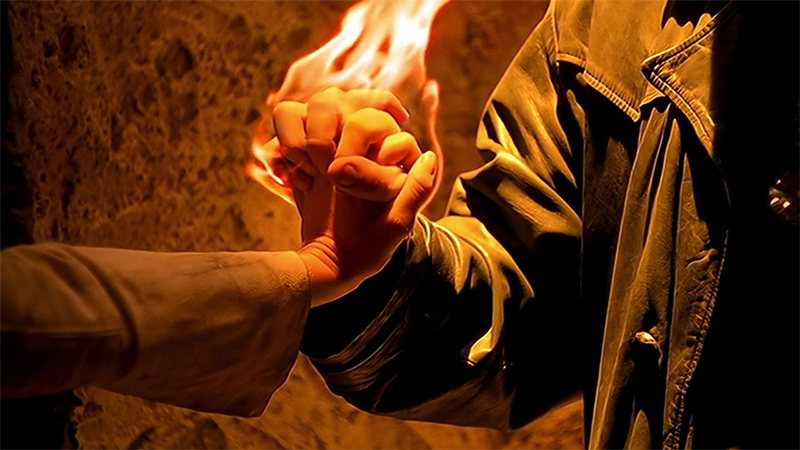
Just as Buffy made a choice in Surprise to become physically intimate with Angel, Willow does the same here. She decides she’s ready, and at the end of the episode, she kisses him. Because she wants to, and there’s nothing wrong with it. Because after all, it is her choice to make, and she decides that the pursuit of love and happiness is worth the possible dangers that come with it. Just as Buffy was ready to before – Willow risks the fire.
Angel and Oz are set up as very clear parallels in this episode. They are both suspects in Teresa’s death – Buffy assumes that the werewolf (Oz, but that detail is unknown to her) is responsible at first, and later discovers that it was Angel. This discovery is nice for Oz’ conscience, but not at all for Buffy’s. Whether a vampire or a werewolf was actually responsible makes no difference – she takes it on her own shoulders regardless. If it was the werewolf, then it’s Buffy’s fault for not killing it when she had the chance. If it’s Angel, it’s Buffy’s fault for turning him soulless. And also for not killing him when she had the chance. If this episode proves anything, it’s that when tragedy hits, there is no force on this earth that could stop Buffy Summers from blaming herself.
“No good. Instead of not protecting Theresa from the werewolf, I was able to not protect her from something just as bad.”
Buffy Summers, 2×15 Phases
The debate over whether or not to kill the werewolf raises some interesting moral questions about the Buffyverse, and about the Angel situation in particular. Buffy and Giles are positioned against the hunter Cain – who has no compunctions at all about killing werewolves – in arguing that it is wrong to kill them. A werewolf is extremely dangerous and lacking in the ability to control themselves for the three nights around the full moon, but the fact that they are moral and complete people for the rest of the time overrides that, and makes it wrong to kill them. It’s not an invalid argument – if a creature can be good most of the time, then they should be merely controlled and not killed for the time they are dangerous.
It’s interesting though if we apply this to Angel. Because Angel is someone who is a complete and moral person for the majority of his time on this earth, and the majority of his time on either show. He is only dangerous and lacking in self-control for limited spans of time – the time he is soulless. So under this same framework, we could argue that it would be wrong to kill Angelus. He is a creature that can be good most of the time, and so should not be killed when they are dangerous. The relative time spans are different, but the principle remains much the same.
“It doesn’t bother you that a werewolf is a person twenty- eight days out of the month?”
Buffy Summers and Cain, 2×15 Phases
“That’s why I only hunt ’em the other three.”
Cain differentiates between killing a werewolf in its human form and killing it in its wolf form – he only does the latter. From his general personality, I think it’s fair to assume that that is a matter of squeamishness rather than meaningful morality, but if we apply it to vampires, then it is not actually too far away from Buffy’s moral framework. She is perfectly happy hunting and killing soulless vampires, but has a strict no-kill policy when it comes to ensouled (or in the case of Spike in seasons four through six, otherwise controlled) vampires.
In both cases, the animal side is held up in comparison to the human side. The Beast versus the Man. Cain reduces Oz to an animal in his treatment of him – talking about his pelt and calling him “doggy”. Many characters do the same to Angel. We saw this back in our discussion of Angel, and we will carry on seeing this next season and beyond. When a character believes he deserves to die, they tend to reduce him to his mere animal instincts. Those that believe he can change will call him a man.
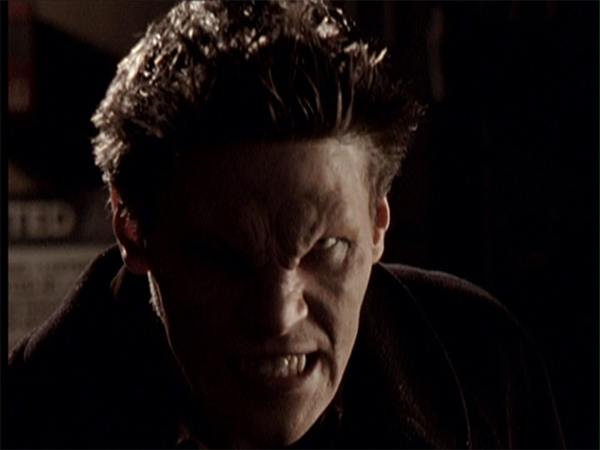
The main functional difference between werewolves and vampires is that the former will naturally revert to their controlled/”Man” state after a set period of time, while the latter need active external intervention to become ensouled. And currently, the characters have no way of ensouling a vampire – those magics died with Uncle Enyos, if not long before. Later in the series, when the characters have the knowledge and several powerful witches on hand, it becomes more of a sticking point. Why is it wrong to kill werewolves when they can be controlled, but not wrong to kill vampires? That’s not meant as a cinema-sins ‘gotcha’ against the show’s morality – I think it’s just an interesting thing to bear in mind as the show’s philosophy around souls develops.
One argument might suggest that an ensouled vampire is still dangerous and can still choose to be evil. However, the same is true of werewolves, as we see with Veruca. The split between Man and Animal is not clean and distinct. A simple way of looking at it would be to say that wolf!Oz/Angelus = Animal and human!Oz/Angel = Man – drawing a clear line between the two. But the lines bleed. Oz tells us in Wild at Heart that the wolf is inside him all the time, and always has an influence on his actions. In Amends, we see the same – how Angel’s animalistic urges are always present and merely held in check by his soul, and how he blames his failings not on the Animal inside him, but on the Man.
“It, uh, acts on-on pure instinct. No conscience, uh, uh, predatory and, and aggressive.”
Rupert Giles and Buffy Summers, 2×15 Phases
“In other words, your typical male.”
Xander relates to the experience of having an animal inside oneself when he brings up the events of The Pack – reminding us that this is the second episode in the ‘Men Are Beasts’ trilogy. In that episode, Giles blamed Xander’s behaviour on testosterone, while Buffy – at that time still in her early flirtations with Angel – pointed to other causes. In this episode, the roles are reversed. Buffy immediately equates the werewolf’s animal instincts with maleness. In the wake of her relationship with Angel falling apart, she is ready to condemn an entire sex, and Giles is the one pointing out that the wolf could be anyone of any sex or gender. The Beast/Man dichotomy is not simply used to examine the difference between animalism and humanity, but is specifically gendered – in this episode and others.
Nowhere are the themes of masculinity and patriarchy more obvious than with the character of Cain. Passion of the Nerd has memed his line for a reason – he is the shining example of Buffy’s wonky approach to explicit misogyny. With some notable exceptions (see: The Trio), the subtler forms of misogyny that make up the bulk of what women experience in real life are often missing, or present and unexamined in the series’ heroes (see: many fair issues with Xander Harris). Cain’s open misogyny and gendered dismissal of Buffy is so on-the-nose and clumsy that it blunts any critique of patriarchy that the episode is attempting to construct.
Just like the repeated link between the male sex and mindless/animal behaviour, the presentation of misogyny as a blatant neon sign held up by MisogynistsTM is a limited, incomplete, and harmful approach to feminism. It was barely acceptable in the 90s, and it’s certainly not acceptable now.

Still, there are some interesting nuggets here. Buffy herself queers and challenges the gender binary – and not just in the admittedly very fun scene when she bends and renders useless Cain’s penis gun. In the self-defense class, Buffy has to be reminded by Willow that she is “supposed to be a meek little girly-girl”. In other words, she has to perform femininity. It doesn’t last long – because that performance leaves her at risk from Larry’s sexual assault, and she has to display her physical strength to protect herself. Later, Willow is searching for students who fit the profile of aggression and violence – the traits that Buffy explicitly aligned with maleness – and finds that Buffy herself is a perfect example of this profile.
Just as the Slayer straddles the line between humanity and monsterhood, Buffy also straddles the line between male and female. She exhibits a profile of typical masculinity, while also rejecting Cain’s toxic masculinity in favour of more feminine-coded traits – mercy, and non-violent resolutions. She bleeds the gender lines, therefore showing their inherent disvalue.
Of course, no discussion on toxic masculinity would be complete without its favourite bedmate – internalised homophobia. Larry gives us a full dose of both. Larry last appeared in Halloween – another episode deeply interested in gender dynamics – and he appears again now, this time with revelations about his sexuality. His aggression, sexual harassment and general hyper-macho attitude – again, all stuff Buffy attributed to maleness – is in fact all fake. It’s a performance. Larry is projecting this image, but it is not intrinsic to who he is. He’s gay – and being gay is inherently a challenge to the societal image of Maleness. As soon as he becomes more comfortable with his sexuality, he no longer feels the need to project this image, and develops into a better person as a result.
The message here is clear – toxic masculinity is a performance, and it is always possible for men to reject it and be kinder, more considerate people. And if maleness and monsterhood are intertwined, then perhaps we can assume the same for monsters. They too can reject their assigned roles as monsters, and become men.

Larry’s coming out scene, where he comes to believe that Xander is also gay, is an interesting bit of nixed foreshadowing. As has been well documented, Whedon always knew he was going to have either Xander or Willow come out as gay in a later season. The decision was not made until season four – made easier by the timely exit of Seth Green – but the first three seasons include drips of foreshadowing for the queerness of both these characters. In both cases, it is Schroedingers Foreshadowing – little jokes and moments that can easily be written off if the story does not go down that route, but work as meaningful foreshadowing if it does.
There is a universe in which Willow’s “and I think I’m kinda gay” from Doppelgangland is a remembered as a minor joke from a character that goes on to only ever date men, and Xander being identified as gay by Larry in Phases is held up as secret proof that the show was always writing Xander as gay. And while that isn’t true, I would argue that, taking only into account what we have seen so far, Xander is more easily interpreted as a gay character than Willow is.
Willow is mostly pretty consistent in her affections. She has a long-standing crush on Xander, a brief relationship with a mind-affecting internet demon, and then develops feelings for Oz. There is little here to suggest that her feelings for Xander and Oz are anything but legitimate. Xander, on the other hand, is erratic and inconsistent in his affections. He ignores Willow entirely and pursues Buffy, showing jealousy over her relationship with Angel – but then starts dating Cordelia. Then when Willow starts dating someone else, he ignores Cordelia and starts exhibiting jealousy over Willow. It very much appears like he isn’t legitimately attracted to any of these women, and is simply hanging on to whatever he sees.
Willow spells it out for us – he’s so busy looking around at everything he doesn’t have, he doesn’t realise what he does have. His flaw is vague, unaimed envy – not for the love of anyone specific, but for the idea of love itself. It is very easy to read his consistent unhappiness with what he does have as a closeted gay person endlessly disattisfied with their relationships with the opposite sex for reasons they don’t fully understand yet. Plus, Xander has exhibited a shockingly consistent habit of pointing out the attractiveness of every other male character – a habit that will continue throughout the show.
“He’s a very attractive man! How come that never came up?”
Xander Harris, talking about Angel, 1×04 Teacher’s Pet
“I just don’t trust Oz with her. I mean, he’s a senior, he’s attractive — okay, maybe not to me, but — and he’s in a band.”
Xander Harris, 2×15 Phases
“I totally get it now. Can I have sex with Riley too?”
Xander Harris, 4×14 Goodbye Iowa
“It’s understandable. Spike is strong and mysterious and sort of compact but well-muscled…”
Xander Harris, 5×18 Intervention
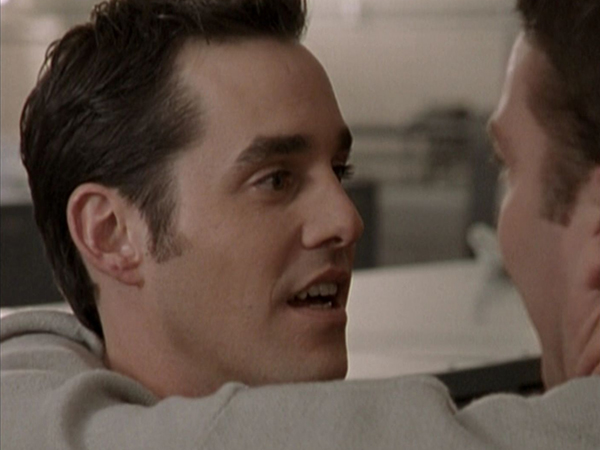
The Gay Xander timeline is not the only jettisoned plot with now unmoored foreshadowing in this episode. The Dark Willow story was a long time coming, and it has been said that Willow’s love was always on the chopping block because of this. There is a world, therefore, where it is not Tara who dies in Seeing Red, but Oz. If that had been the case, then – presuming a stray bullet is still the culprit – we have already seen some major build-up.
In Oz’ first episode getting any major development, and his first actually meeting Willow – What’s My Line – he takes a bullet in the arm protecting Willow from the Order of Taraka assassin. In this episode – his first officially dating Willow and becoming fully incorporated into the main cast – he is shot again, this time by Willow herself. In this universe, her meek exclamation of “I shot Oz!” becomes less a slightly cute comment and more a piece of foreshadowing more starkly upsetting than the infamous “funny aneurysm”
“I, uh, I’m shot, y’know! Wow! It’s odd! And painful.”
Oz, 2×10 What’s My Line?
“The pain will be unbearable, but you won’t be able to move. Bullet usually travels faster than this, of course. But the dying? It’ll seem like it takes forever.”
Willow Rosenberg, 6×20 Villains
We don’t live in that universe. It’s fun to imagine all the little lost threads and planned pathways that disappear as the show develops, but it’s not that useful when analysing Buffy as a completed and fixed piece of art. So Willow shooting Oz remains only as foreshadowing for the rest of season two. As mentioned, Willow and Oz are a stand-in for Buffy and Angel, used to comment on their relationship and Buffy’s emotions. And Willow, despite her affections for Oz, is able to stand up and do what is needed at the end of this episode. She takes him out. She puts a bullet in him to save them all. Right in the chest.
* * *
Thanks for reading! If you enjoyed this piece, please consider supporting me on Ko-Fi!
* * *
 Insect Reflection