
Guillermo Del Toro’s 2017 masterpiece The Shape of Water – a film built around the love story between a human woman and the “monstrous” Amphibian Man she finds a kindred spirit with – closes out its runtime with a shot of two lovers submerged beneath the water, and a poem that the narrator tells us was “whispered by someone in love hundreds of years ago.”
Unable to perceive the shape of you, I find you all around me. Your presence fills my eyes with your love. It humbles my heart, for you are everywhere.
This poem is of debated origin. The original source for the poem in this exact form seems to be the film itself. Del Toro claims he read the poem in a book of Islamic poetry[1], but doesn’t recall its exact source. Some digging – which, luckily, some smart people at the Library of Congress[2] have already done – reveals though that the most likely originator is Hakim Sanai, a poet who wrote on themes of God and mysticism in the 11th and 12th centuries. The translation that Del Toro most likely read, given its similar phrasing, comes from 2002 book The Book of Everything: Journey of the Heart’s Desire : Hakim Sanai’s Walled Garden of Truth, by Priya Hemenway, which reads as such:
Unable to discern the form of You, / I see your Your presence all around / Filling my eyes with the love of You / my heart is humbled / for You are everywhere.
So the poem in The Shape of Water is a half-remembered transcription of a modern translation of a 12th century poem, which itself could be based on ideas even older. A copy of a copy of a copy. And yet, it retains its power in the film because it strikes true at its core themes. The film is fundamentally a love story, and the universality of love is something that stretches back across human history.
It is more than just “love” in abstract though – it is a specifically Islamic perception of love that Del Toro pulls from. Fatemeh Keshavarz in this linked article[3] speaks about how the inability to perceive the shape of a beloved due to their omnipresence is a concept based in the Qur’an, and so became a major theme in Islamic love poetry. Del Toro drew from that concept when he made this film, and made it its central metaphor. It is called The Shape of Water because water, like love, has no shape. It flows and fills whatever space it finds itself in. It exists in any and all forms. It cannot be contained – but seeps and spills into every crack and crevice, trickling through the seams of inhuman systems, inevitably bursting the banks of anything that would attempt to contain it. The film is a story about love, and it is a story about water, and in that final shot, we see both, and it tells us everything we need to know.

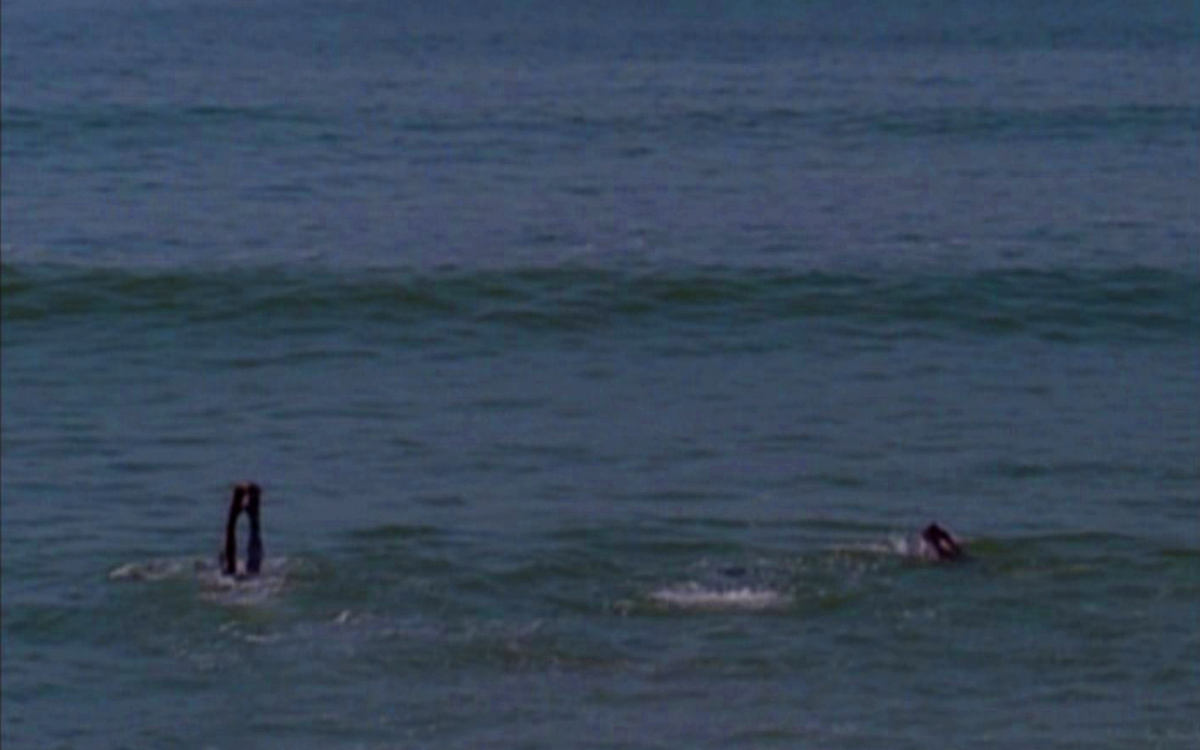
David Fury’s 1998 colonic discharge Go Fish closes out its runtime with a shot of the ocean, and deep, evocative music as we watch the amphibious fish-men submerge themselves in its depth, swimming out to a place that Buffy tells us, in the episode’s closing words, is “home”.
Season Two of Buffy the Vampire Slayer is, just like The Shape of Water, a love story. It is the story of a determined young woman and her star-crossed love for a vampire – a man deemed monstrous by society, who she finds a kindred spirit with. It is a love that perseveres and finds shape even in the strangest of circumstances. It is a love story with an inevitably tragic end that we are edging ever closer to. The universality of love applies to this show too, and it is always useful to compare it to other notable love stories.
There is a certain amount of intentionality that the Insect Reflection intends to approach each episode with. This is a series that is written under the base assumption that Buffy is a show worth writing about. That the words and images it presents to us have meaning – perhaps not always a meaning that is intended, but always a meaning that is communicated. It presupposes that the worst episode of Buffy the Vampire Slayer should be treated with the same analytical seriousness as an Oscar-winning film.
This episode is sandwiched between the haunting ghost tale that is I Only Have Eyes For You and the gut-wrenching tour de force that is Becoming. Both these episodes centre upon the Buffy/Angel romance, and the choice that Buffy will be forced to make at the season’s climax. Go Fish is clearly the odd one out. And so we are faced with a choice ourselves here, and two options. The first option is that we assume the show ignored its main arc right before the climax, spat out a meaningless glob to fill forty-five minutes of screentime, and laced it with some casual misogyny and rape jokes. The second option is that this episode has subtle meaning and importance for Buffy’s arc, and should be dissected with that in mind. The former option is untenable for this project, and so we must accept the second. We must watch a collection of men in ill-fitting fish suits splash oddly amongst some waves at the episode’s end and assume that it means something approaching the importance that the music cues want to lend it – or that it means anything at all.
So let’s do that. Let us consider this speech in the opening scene, where pretentious senior Cameron Walker talks to Buffy about the ocean – and perhaps, something more in its metaphor.
“Beautiful. Isn’t it? Eternal. A true mother, giving birth to new life and devouring old. Always adaptable and nurturing… yet… constant… and merciless.”
Cameron Walker, 2×20 Go Fish
Vampires are creatures of eternal life – living forever and never ageing. They possess a dark beauty and allure to our main character – indeed the most prominent vampire in the story so far was apparently named for his beauty. He was named by his sire – his “mother”, as Drusilla might say. Vampires constantly birth new (un)life by feeding and siring other vampires. In most cases – such as with Darla and Angel, they will “nurture” and shape their progeny, guiding them to kill and hunt and survive. They are ever adaptable – surviving on a planet whose sun will burst them into flames by hiding away in sewers and abandoned houses and other cracks and crevices of society. And yet, they are constant – unchanging, un-ageing, and unlike our protagonist, unable to grow up, unable to make choices, unable to change. But they are, above else, without mercy. Without a soul, mercy means nothing to them. It is not something they would ever offer, for it requires some level of empathy, kindness, and sacrifice.
The ocean… is vampires. Vampires possess all the qualities invoked by this speech, and that Cameron seems to admire, and want to possess. If vampires are the ocean, then in the ever-evolving conversation of Buffyverse morality, we could consider them in the same way we do the sea – dangerous, unforgiving, and heartless, but ultimately morally neutral. They are a force of nature more than a force of evil.
Buffy is not so loquacious, but she has an admiration for the ocean too. When we first see her in the episode, she is apart from the group, looking out over it – probably musing on her Angel-related angst while she stares at the symbol of his race. She tells Cameron soon after that she feels like she is “swimming against the current” – and she is. She is locked in a constant, unending, unwinnable battle against vampirism – against the forces of darkness. And right at this moment, she is locked within her inability to kill Angel; to completely let go of him. It is actually appropriate that this episode does not progress the series arc, because Buffy too is stuck, unable to progress, fighting the current just to stay in place.
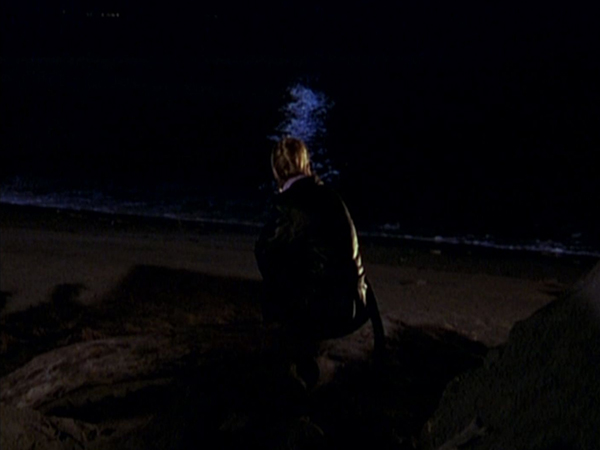
Yet, the ocean could be seen as a source of power too. When we see the beach at other points in the series, it is always as some kind of “happy place” for Buffy – a place where she has everything she wants. It’s where she dreams of Angel, alive and forgiving of her, in Anne. It’s where Buffy .vs. Dracula opens, where she is surrounded by friends and happiness and has more or less everything she wants. Buffy seems to link the sea to strength and happiness on some level.
We should remember that the ocean is described here as a “mother” – a source of specifically feminine power. The ocean is often linked to femininity – referred to by sailors with she/her pronouns, and linked to the moon – itself a feminine symbol in many cultures. So perhaps the ocean does not just represent vampirism, but also represents the show’s symbol of feminine power – The Slayer. Slayers and vampires are often two sides of the same coin, and this is one example of this. When Buffy is “swimming against the current”, she is swimming against her own nature, her own power – because every second she isn’t killing Angel, she is denying her destiny. The metaphor changes, but the meaning for the character stays the same – it’s still the same choice she’s struggling against.
There is a repeated idea throughout the series that feminine power is intrinsic in some way, while masculine power is stolen and temporary. The Slayer’s strength comes from within themselves, while patriarchal villains like The Mayor, Caleb, or Warren have their strength gifted temporarily upon them from external benefactors. This idea is present in this episode. Buffy’s power is like the ocean’s – inherent and immutable. The swim team gain their power through artificial means – transforming themselves with steroids stolen from the Soviet Union – and can lose their power if the treatment ceases.
The masculine/feminine dichotomy continues throughout the episode. There is a lot of talk about the swim team and their “special privileges” throughout the episode, and the existence of those privileges is proven. Willow is pressured by Principal Snyder into raising Gage’s grades, despite his obvious lack of engagement/effort, simply because he is a member of the swim team. Cameron is excused for attempting to assault Buffy and she is blamed for defending herself. The reasons given to justify his behaviour are clearly gendered in nature – “Look at how she dresses”, he says. There is a clear (if pretty basic) criticism of rape culture going on here.
So when we’re talking about “swim team privileges”, what we’re actually talking about is male privilege. It is the environment in which men are granted extra excuses for their behaviour, and women are allowed none. Where sexual violence against women is excused and normalised. Where a man only has to put in half the effort to get the same rewards as a woman, and the systems of power in place (in this instance, Snyder) will bend over backwards to protect them and then claim it is for the benefit of “the team”. The “team” that Snyder is talking about here is in this metaphor, general society. The patriarchy is proposed to exist for society’s benefit (for “the team”) but this ignores the fact that only a few select members of the team/society are actually benefiting. The coach’s constant talk of the team as “his boys”, and attempting to allow them to sexually assault Buffy at the episode’s climax compounds this metaphor.
“You see how they’re treated. It’s been like that forever. […] Meanwhile, I’m breaking my nails every day battling the forces of evil, and my French teacher can’t even remember my name.”
– Buffy Summers, 2×20 Go Fish
Also notable is the theme of emasculation. In the opening scene, Buffy protects Jonathan from bullies, but he becomes angry and rejects her help – and it’s clearly because she is a girl, and her protecting him is perceived as emasculating. It’s heavily reminiscent of Xander’s complaint in Halloween, that being protected by Buffy breaks some kind of “guy code”. Xander himself suffers similar insecurities in this episode – being mocked by Cordelia for being insufficiently “manly” in response to being attacked by a fish-monster. These insecurities drive him. He is both indignant about the privileges that the swim team receives, and jealous of them. He clearly wants to be a part of the privileged group – and indeed does take the opportunity to do so, joining the team of his own volition.
“Well, it was dark! And the thing went through the window so quick, and I was a… little shocked when I saw it, and…”
Xander Harris and Cordelia Chase, 2×20 Go Fish
“Go ahead. Say it. You ran like a woman.”
Xander’s attitude here is typical of the specific type of nerdy-male fragility we would nowadays typify as inceldom. He is not upset because the patriarchy is unjust, but because he does not get to participate in it, and his comment about Buffy being “one of [the swim team’s perks]” when she spends time with Cameron underscores this, given how Buffy is clearly something he still wants. It’s a gross comment, and as someone who generally likes and defends Xander – this episode is not one of his better looks.
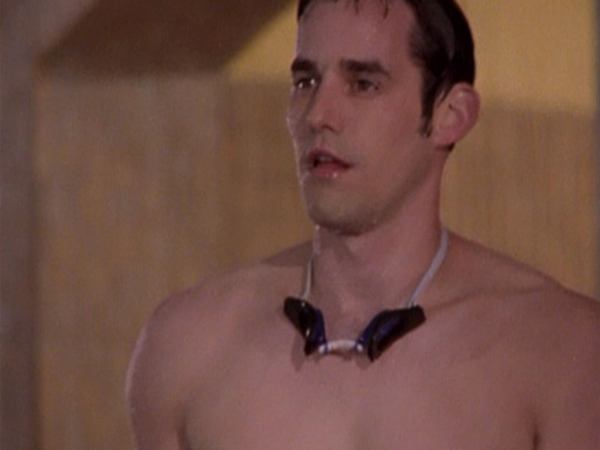
So if the swim team are male privilege, then their transformation into fish-monsters represents the inherently corrupting nature of patriarchy. This is why bully Dodd and wannabe-rapist Cameron are the first to turn. Their toxic masculinity is externalised, and they turn literally monstrous. In joining the swim team – joining the upper echelons of patriarchy – Xander exposes himself to their influence, and risks being corrupted himself. It’s the same lesson he learned in Reptile Boy – that actively engaging in patriarchy means becoming a monster himself. He is saved from this fate by the Scooby Gang, and saves the day through helping Buffy – an act described in scene as “teamwork”. The Scoobies are a positive model of a team, in opposition to the swim team – aka. Patriarchy and toxic masculinity. They are a positive model of masculinity, based in bravery and kindness.
This is where Buffy diverges in its themes from something like The Shape of Water, at least at this point in the show. In The Shape of Water, monstrosity remains internal. The villain and true monster of the story is Colonel Strickland – a man who exemplifies idealised 1960s masculinity, and is clear about his belief in his own superiority as a white (and cis, and straight, and able-bodied, and human) man. This is held in direct contrast to the romantic lead of the film – the Amphibian Man – whose external monstrosity is irrelevant when considering his kindness and gentleness. In The Shape of Water, the true monsters are the people who look most “normal”. Buffy meanwhile tends to use external monstrosity more directly as metaphors for internal monstrosity. Vampires are a refusal to grow up. Snake demons are capitalism. Bug monsters are sexual predators. Fish-men are toxic masculinity.
All these metaphors are tied together by Angelus, who surely does more in his little appearance than just fill out David Boreanaz’ contracted episodes quota. He refers to Buffy as a “head trip” and agrees with Gage’s assessment of her as a “psycho bitch” – all insults gendered in their nature, and all of which put blame onto her for affecting the mental state of a man. He is a man who has become a monster, and blames Buffy for that, despite it not being her fault. As the exaggerated Worst Ex-Boyfriend Ever, he is a fantastical metaphor for mundanely shitty men – just like the fish-monsters are in this episode. He talks about “recruiting” Gage – meaning to make him a vampire, but it’s specifically a term reminiscent of sports teams, who recruit athletes for their team. Vampires and fish-men are on the same team here – the team of the patriarchy.
The privileges of men and competitive athletes are not the only privileges relevant to this episode, however. Cordelia comes out in full defence of privilege, claiming that some people simply deserve more than others. It’s played for laughs, but it’s notable how similar her standpoint here is to her standpoint in Ted.
“The truth is, certain people are entitled to special privileges. They’re called winners. That’s the way the world works.”
Cordelia Chase, 2×20 Go Fish
“I don’t get it. Buffy’s the Slayer. Shouldn’t she have…”
Cordelia Chase and Xander Harris, 2×11 Ted
“What, a license to kill?”
“Well, not for fun. But she’s like this superman. Shouldn’t there be different rules for her?”
As Buffy’s shadow self, Cordelia’s lines should always been considered an important indicator of Buffy’s mental state. Just as in Ted, she is struggling with the idea that she might have a licence to kill – the privilege to decide who lives and who dies. This is the idea that is threaded through the season. If Buffy is to be able to kill Angel, then she must first accept that she has the right to make that decision in the first place. She must accept her own superiority. It’s the ocean speech again – she already possesses what the swim team wants to possess, but through inherent feminine power rather than stolen masculine power. She has to figure out a way to deal with that, and Cordelia shows her how – by accepting that she has it. Until she does that, she will just be swimming against the current.
Cordelia indicates another anxiety of Buffy’s in this episode, when she expresses insecurity about dating a monster, in a way that is linked to her insecurity over dating the unpopular Xander that we saw in Bewitched Bothered and Bewildered. It was a stand-in for Buffy and Angel then, and it is again here.
“It’s one thing to be dating the lame unpopular guy, but it’s another to be dating the creature from the Blue Lagoon.”
Cordelia Chase, 2×20 Go Fish
We can assume therefore that Buffy is still harbouring some guilt over falling in love with a vampire – a monster – and this guilt exists in her shadow self. So when Cordelia makes her speech at the fish-man she believes is Xander about how she will accept and love him despite his external monstrosity, it is not just a cute and funny scene. It’s important. It represents Buffy accepting her own love for the monstrous. It brings us back closer to the themes of The Shape of Water, and to the poetry of Hakim Sanai. It’s, once again, love’s ability to exist in all shapes, to creep into cracks and crevices – to become omniscient, like God. In order to fully come into her own, Buffy must kill the monster Angel has become – but she must love the monster too.
In the closing scene of Go Fish, we end on a shot of the ocean, evocative music, and the fish-men swimming out into its depth, heading to a place that Buffy tells us is “home”. After all these contorted metaphors and intertextual discussions, we aren’t actually any closer to working out what this final shot really means. But what we haven’t yet considered is what bodies of water have meant to Buffy before. Notably, in last season’s finale. There, they meant her death.
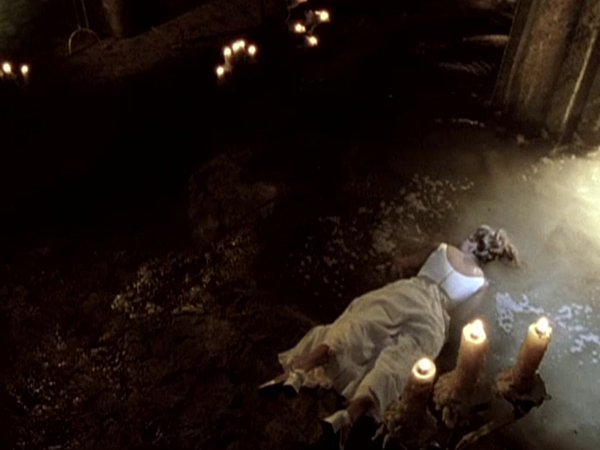
Buffy dies by drowning. It is a metaphorical baptism – a metaphorical rebirth – but it is a literal fatality too. Water means death for her, so the ocean is the mother of all deaths. Eternal. Devouring the old, making space for the new. Constant, and merciless.
If the fish-men are a stand-in for vampires in this episode, then it is only natural that they return home to the ocean. Death is home for vampires. They are born in their own graves, and death is a state they are always running from, but can never truly escape. Going home for vampires means returning to the grave – dying. For the fish-men, it means returning to the ocean. Dying.
In two episode’s time, we will close on a shot of someone else riding out into the distance. That person will be Buffy, leaving Sunnydale and her life behind. On one hand, it is the inverse of this scene – she is literally running away from home, rather than going towards it. But visually it is very similar, and metaphorically too. I will argue in the essay for Becoming II that this moment is a metaphorical death for Buffy, and this episode tells us that here in advance. Every slayer has a death wish, and slayers, like vampires, are born from the death of another. Dying, for a slayer, is returning to the ocean. It’s going home.
You might consider this metaphor a stretch. I might too. In writing this essay, I attempted something different. I wanted to go into Go Fish with the presumption that it was the best episode of Buffy the Vampire Slayer, and see what happened to my interpretation next. It didn’t help much. I still think that this is the worst episode of Buffy the Vampire Slayer. It’s really not that deep. This episode is more puddle than ocean. But loving this show can mean making it a new shape. It can mean pouring it into different places to see where the rivulets will flow. And we have to accept that sometimes that means we will not be able to see the forest for the trees – or the ocean for the water. We will disappear beneath its depths, and become unable to discern its true form, for it will be all around us.
* * *
References:
[1] https://www.thenortherner.com/arts-and-life/2017/11/25/review-guillermo-del-toros-the-shape-of-water/
[2] https://blogs.loc.gov/catbird/2018/03/who-wrote-the-poem-at-the-end-of-the-shape-of-water/
[3] https://leahkstewart.com/hakim-sanai-everywhere-poem/
* * *
Thanks for reading! If you enjoyed this piece, please consider supporting me on Ko-Fi!
* * *
 Insect Reflection
Thank you for respecting this show enough to try and seriously analyze the plot and metaphors even of “Go Fish”.
LikeLike