
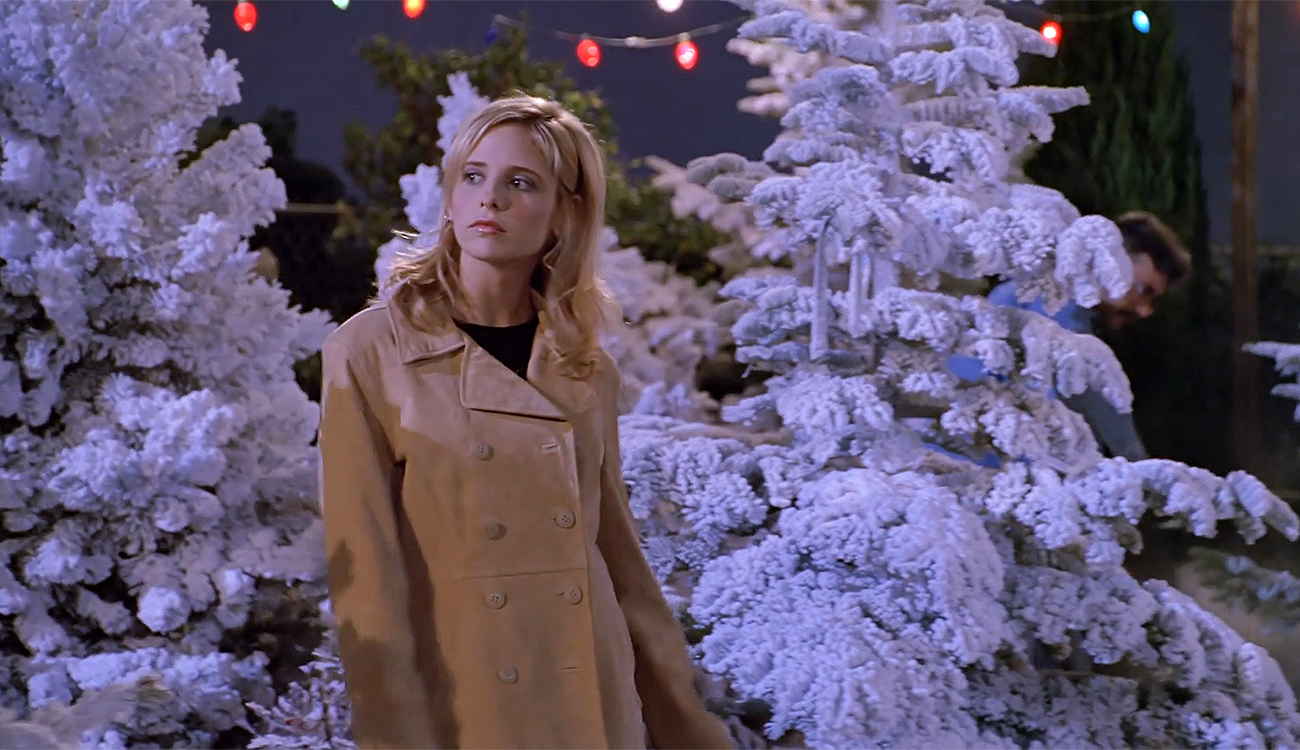
“All he wants for Christmas is redemption for two hundred years of killing.”
The original WB trailer for Amends, first aired in 1998.
Holiday episodes are a dying art form in the televisual world of 2023. With the domination of on-demand streaming services, the exact airdate of an episode has come to matter less and less. Modern shows might still centre episodes around certain holidays, but rarely can they be considered true Holiday Episodes. By virtue of being easily available outside of one specific date and time of airing, they cannot have the same inherent link to a specific temporal point that the Holiday episodes of years past did.
Things were different in 1999. Episodes were tied to specific points in real time, which affected the fiction. Buffy is no exception. The show progresses at a linear rate of one in-universe year to one real-world year, and all on-screen events occur within the nine-to-ten months we would recognise as an academic year. Buffy herself notes the hellmouth’s tendency to become extra-apocalyptic each May in Get It Done. The show moors itself in the chronology of our world, a choice which benefits television’s personable nature.
As far as traditional holidays go, Buffy is slightly more indifferent. The closest thing to an annual holiday the show has is Buffy’s yearly birthday disaster. Outside of that, we have three Halloween specials, one Valentine’s Day episode, one wildly misguided Thanksgiving story, and this – Buffy’s first and only Christmas episode. This episode has no shame in wearing its Christmassiness on its red-and-white sleeve. Everything from the advertising, to the carol singers that open the episode, to the saccharine snowfall of the climax, to the Santa hat placed on the Mutant Enemy demon during the credits, all screams Christmas. ‘Tis the season, screams the Buffyverse, and of course that means that this is a time of warmth, community, and coming together with the people you love – for other people. For the inhabitants of the Buffyverse, it is a time for demons, loneliness, and seasonal depression.
The Scooby Gang discuss their plans for the holidays, and each of them seems progressively more bleak. Buffy has probably the best time of it – a low-key Christmas with just her and her mother. Willow is alone, still flagellating herself over the Xander incident, and trying to make things up to Oz. Xander is planning an escape from his abusive family’s violent arguments. Cordelia claims she is going skiing in Aspen, but given that we are now in the mystery zone where Cordelia’s father may or may not have been arrested yet, there’s a good chance she’s lying and is spending the Christmas penniless and friendless. She would have this in common with Faith, who is stuck hanging a sad single string of lights in a dingy motel room, inventing fictional parties that she can claim to be invited to so as to not lose face in front of Buffy. And then there is Angel, who, in addition to being a vampire stuck in a Christian holiday, and having recently been dumped, is also being tortured by the incorporeal manifestation of pure evil.

Sadder than perhaps anyone is Giles, who is spending Christmas alone, as he seems to do every year. Unlike Faith, he doesn’t earn an invite to the Summers Christmas due to the mutual awkwardness between him and Joyce after their Band Candy fling, though this is the least of his love-life-related woes. This is the first Christmas since Jenny’s death, and though he doesn’t speak her name this episode, it is obvious that this must be on his mind. This is a Giles who is becoming increasingly adrift, still reeling from Buffy’s betrayal of him in Revelations. He has lost the love of his life, and now only has his role as Watcher to give his life direction. The previous Christmas of 1997 must have been a happy time for him and Jenny. Both of them were in Sunnydale, neither was likely to be visiting family, and it arrived between their reconciliation in Ted and their next falling-out in Innocence. It seems very likely that they may have spent Christmas of ‘97 together. Their first Christmas, their only, and their last.
This is an episode of Firsts and Lasts, and the most obvious example of that is the inaugural appearance of Buffy’s final villain – the being known as the First Evil. It is a peculiar happenstance that Season Seven’s Big Bad is introduced here, as a Monster Of The Week in a one-off episode, after which they aren’t mentioned for another three and a half years. This is extremely atypical for Buffy. This is a season-led show; it doesn’t do long-running villains. Big Bads are created in order to fill some specific role in a season. They are cast, introduced, tackled and completed within that season – a rule that the First alone is an exception to.*
The debatable effectiveness of The First as the Big Bad of season seven is an interesting topic that’s worth getting into, but it would be foolish to start such a discussion here, as The First is not being introduced as a future Big Bad. It is being used, in the fashion of a MOTW, to service the needs of this episode alone, and as a character it is appropriately thin for those needs. This story requires a character that a) is powerful enough to have conceivably brought Angel back and b) can torture him with visions of his past sins. Therefore, a character is created with no defining features other than being a) old, b) powerful, and c) evil. No more is required from them. Buffy effectively laughs the threat away and ignores it as soon as we reach the episode’s emotional climax. The First is not so much defeated as it simply walks off stage once its part is played.
“You’re not supposed to die. This isn’t the plan… But it’ll do.”
The First, 3×10 Amends
If the First has a plan here, it is a roughly-sketched one that luckily, almost appears inspired in retrospect. The indications we get from this episode are just that the First wanted to turn Angel evil, but was content with him dying instead. Why exactly the First is so invested in this endeavour is initially unclear, and only becomes more coherent once we reach the end of Angel’s first season, and the cosmic importance of an ensouled vampire’s morality becomes central to at least five other deipotent entities^. Those entities may even be involved in the episode’s climax, as it is very feasible that the snowstorm that saves Angel’s life was sent by the Powers That Be, whose interests will become a major part of the spin-off series.
Guest starring as The First (alongside a collection of interchangeable Angelus victims) is the woman who played Angelus’ most memorable victim. Robia Scott (née LaMorte) has one of the more fascinating post-Buffy careers, in that she didn’t really have one. Shortly after this appearance, Scott converted to Christianity, disavowed the show, and abandoned her acting career to become a missionary and – according to her website – a life coach. She only returned to acting in 2019, to star in a dismal anti-aborton screed called Unplanned. Her website frames this return as “God strategically using Robia’s acting talent for a Kingdom message of hope and redemption”, a concept I will not trouble myself to conjure respect for, even if I was inclined to respect a forced-birth propagandist (or god forbid, a life coach).
Ironically, being strategically used as a face to further the aims of a supposed higher power would be a fair description of Jenny Calendar’s fate in this episode. This is not Jenny Calendar’s last episode. She died in Passion, and though we described her presence in the tail end of Season Two as ghostly, it would not be accurate to call this the ghost of Jenny. She is just the face of a plotline that has nothing to do with Jenny Calendar. The brief (and admittedly tragic) shot of Jenny’s image standing directly next to an oblivious Giles is the only nod to Jenny’s arc in a story that is otherwise all about Angel. It’s not even about Angel’s murder of Jenny. The specifics of that crime are glossed over, and instead Jenny becomes a muddy stand-in for all the generic crimes of Angelus.
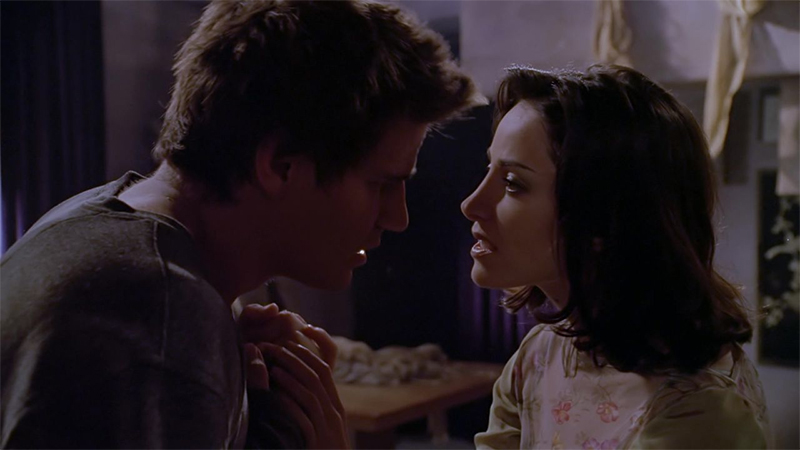
Amends is in many ways a backdoor pilot for Angel, and the elevator pitch for Angel is “a vampire who did a bunch of Evil moves to LA to do a bunch of Good”. Of course the details of that evil are irrelevant. You don’t need to know about Jenny Calendar or the legacy of his crimes against the Romani tribe to watch Angel. All you need to know to watch Angel is that he did Evil, and so it’s no wonder that Jenny Calendar’s actor isn’t playing Jenny Calendar, but is literally playing a vague, shifting representation of the concept of Evil.
“I should be in a demon dimension suffering an eternity of torture. […] But I’m not. I was freed, and I don’t understand why.”
Angel, 3×10 Amends
As it lays the foundation for what will become Angel the series, the show must take Angel forward from the basic character outline sketched in Angel the episode. The concept of Vampire: Was Evil; Now Good is enough for an elevator pitch, but to be worthy of standing alongside Buffy, the show must have more thematic purpose, and more complexity in its main character. It does this by leaving behind its focus on Angel’s evil/vampiric side, and more on the flaws of his human side.
The original purpose of vampires in this show was as a representation of undesirable qualities for Buffy to avoid. They represented death, and more importantly, stagnation: the inability to grow up in contrast to Buffy’s journey from childhood to adulthood. Angel threatens this foundation of the show by his simple existence as a vampire with interiority, and so Angel attempted to reconcile this by framing Angel as an exception. The one vampire with a soul, and therefore permission to be an actual character. The motif in that episode positioned vampires as basically animals, with Angel achieving personhood through the act of choice and self-control. Amends moves beyond that, revealing that it is not the animal in Angel that must be kept in check, but the man. It is his humanity that forms the basis of his evil, his lusts, and his desire for control.
“That’s what makes you different than other beasts. They kill to feed, but you took more kinds of pleasure in it than any creature that walks or crawls.”
The First, 3×10 Amends
“It’s not the demon in me that needs killing, Buffy. It’s the man.”
Angel, 3×10 Amends
We often analyse Buffy’s character through the lens of her shadow selves, and it may be useful to do the same for Angel. His unconscious shadow is more literal in its construction, as it is Angelus who fills this role of representing all of Angel’s repressed urges. When these urges are indulged – such as through the act of sex – Angel’s shadow takes over control of his conscious body, and he is subsumed within it. Angel’s struggle is to acknowledge his shadow desires without letting them take control of him – something that is always going to be hard because of the inherently dichotomous relationship that Angel and Angelus, now gradually starting to emerge as two separate characters, are always going to have. This marginally more complex approach that Amends takes in regards to the origin of Angel’s darkness as stemming from her humanity mirrors what this season is doing with Buffy and her increasingly obvious commonalities with Faith.
Angel proved his worth in Angel by not taking the chance to kill Buffy, therefore proving himself a man capable of free choice, rather than an animal driven by base desires. It was an act of Not Doing that set him apart. Here we see Angel’s desire to give into his id again – the urge that the First encourages to kill/eat/fuck Buffy – but this time his lack of action is framed as a weakness. He attempts suicide-by-inaction, and Buffy calls out this Non-action for the cowardice it is. Angel has been trying to become a participant in the world since he first saw Buffy (see Becoming). In order to do that, he must actively engage with it. It is not enough to avoid committing Evil actions; Angel must commit Good actions. It is the act of Doing that can propel him from his current state into something worthy of the position of protagonist.
“Angel, you have the power to do real good, to make amends. But if you die now, then all that you ever were was a monster.”
Buffy Summers, 3×10 Amends
The climactic scene that Buffy and Angel share atop the bluffs is genuinely iconic. It is a statement piece of not just the episode, and not even just one show, but of the universe that Buffy and Angel both share. Buffy captures the core of nihilistic hope – that the valid response to an uncaring universe is not to give up, but to fight. The world doesn’t care whether you live or die, but that is not an excuse to die, it simply means that you have to live in spite of the world, in order to impart meaning upon it.
“Strong is fighting! It’s hard, and it’s painful, and it’s every day. It’s what we have to do.”
Buffy Summers, 3×10 Amends
Yet, there is something undermining a pure existentialist reading of this scene. As inspiring as this speech is, it does not – by itself – quite work on Angel. He does not respond directly to it, and his last words in the episode are begging Buffy to let him go through with his suicide. Though he is clearly moved by her words, he does not change his mind in response to them. Shhe carries on, resolving not to mourn for him if he allows himself to die. The major turn in the scene comes not with Buffy’s speech, but in the moment that they both realise it has begun to snow. The snow, sent by mysterious unseen Powers, is the emotional turning point, and the first flakes we see of it come at the exact moment that Buffy says: “If I can’t convince you that you belong in this world, then I don’t know what can.” It is clear then that Angel did not change his mind because of Buffy’s speech. He changed his mind because he received a sign that he is wanted by the world for something greater; that perhaps the universe is not as uncaring as it seems.
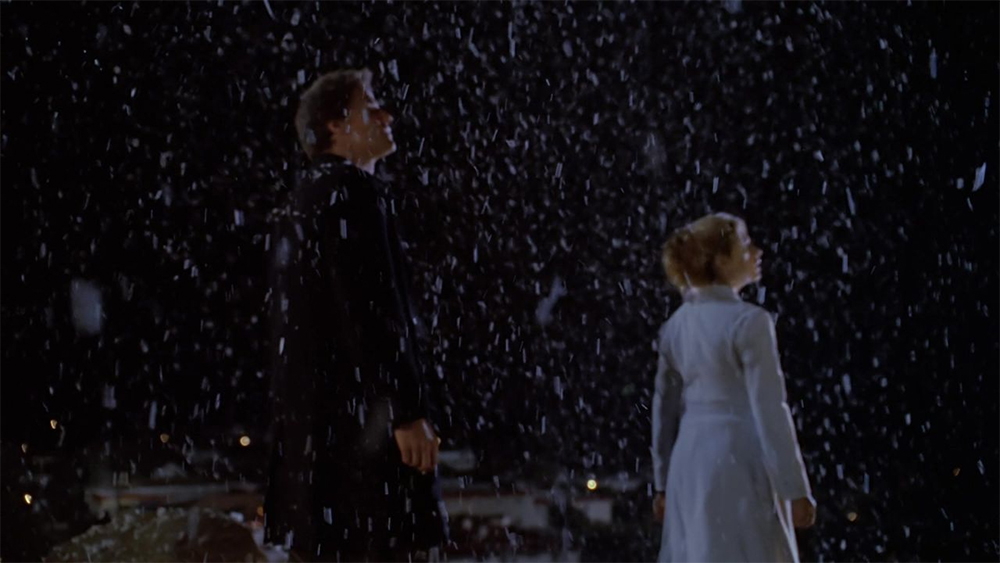
Here, the Powers are analogous to the ultimate overruling power: The Network Executives. They are calling Angel to a higher purpose, to ascend beyond this show and take up the mantle of his own. It proves that Buffy was wrong on one particular point: her statement that she and Angel could fight together. They cannot. Angel is being called to be a Hero, and he cannot do that while he remains a supporting character in somebody else’s story. He has to move on. Though in the moment this is a reunion for Buffy and Angel after their split in Lovers Walk, it is also the nail in their coffin. It is absolute confirmation that the current state of affairs is unsustainable, and in order for either of them to grow, they must take diverging paths.
The snow falls, the music swells. We montage each of our character’ responses to this miracle, and we see the hope that each of them have found in this episode. Willow and Oz cuddle in bed, reunited and having worked through Willow’s betrayal. Faith steps outside with Joyce and feels the flakes on her cheeks, looking like a kid who has for the first time found home. Giles stares in curiosity; Xander in shock. Buffy and Angel hold hands and walk blissfully through the snow. It is a Christmas miracle.
Yet this hope is all tinged by sadness. For every Christmas is somebody’s last, and in this case, it is true for all of them. Next Christmas, Willow will have been betrayed and left brokenhearted by an Oz that has left Sunnydale behind. Faith will be comatose, and the next significant interaction she has with Joyce will involve beatings and holding her hostage. Giles has already had his last Christmas with the love of his life, and will spend the next year adrift and alone. Xander will fail to escape his horrible family. Angel will leave, and he and Buffy will break up for good. There are no lasting victories in this world. There is no living happily ever after. There is only living, and taking these small moments of peace and joy for what they are: a respite from all horrors, and a reason to keep fighting. A reminder to love, and a reminder to be strong.
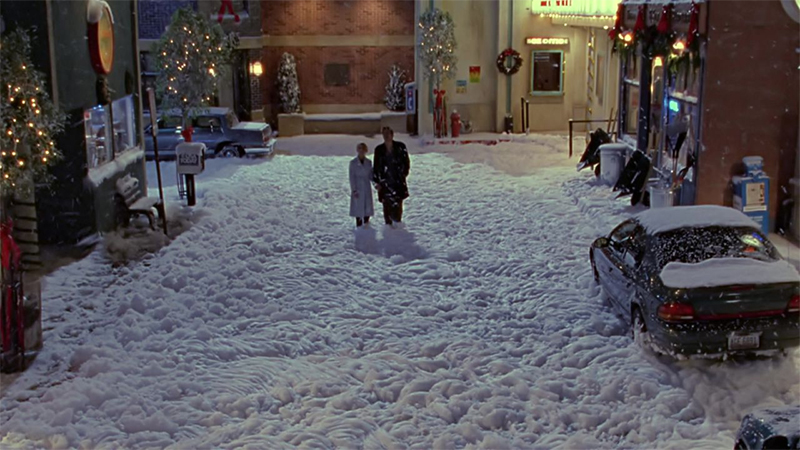
Merry Christmas.
*The Trio don’t count, as Jonathan and Warren were not active villains prior to Flooded.
^The Wolf, The Ram, The Hart, and a necessary multiplicity of Powers That Be.
* * *
Thanks for reading! If you enjoyed this piece, please consider supporting me on Ko-Fi!
* * *
Thank you to juanabaloo on Tumblr for her help proof-reading this essay.
 Insect Reflection
This is a fantastic analysis of one of my favorite episodes. I love all your essays, but this is undoubtedly one of my favorites. Thank you so much!
LikeLike
I LOVE these essays so much. It reminded me of a quote from Angel that is basically the mission statement of the show: “guess I kinda worked it out. If there’s no great glorious end to all this, if nothing we do matters… , then all that matters is what we do. ‘Cause that’s all there is. What we do. Now. Today.”
LikeLike
Thanks so much. 🙂 That quote is absolutely one of the most important expressions of existentialism in either series.
LikeLike