

Faith Lehane never had a chance.
Put yourself, if you will, in Faith Lehane’s shoes. You are seventeen years old. You have no friends, and in fact never seem to have had any. You grew up poor, neglected, and physically abused by your mother. Said mother dies when you are still a child, but you are taken under your wing by another woman: your Watcher, who reveals to you that you are a Chosen One – granted the power to fight vampires, demons, and the forces of darkness. She then also dies; violently murdered in front of you.
So you move across the country to another town, where you meet someone just like you. Like, freakily like you. As if you are her mirror image somehow. She is exactly like you, except she has friends, a loving mother, a living Watcher, and a warm three-bedroomed home to return to every night. You have none of these. You live in a run-down motel that you can’t afford. You have to feed, house and clothe yourself, and none of the adults in your friend’s life make any attempt to rectify this situation, including the one that’s meant to be acting as your Watcher. Again, you are seventeen years old.
But you carry on. You become good friends with this mirror-girl. Perhaps you even have a bit of a crush on her. You think you are inseparable, until you find out she has been secretly keeping her ex-boyfriend in a mansion. At the same time, you get another new Watcher who promises to take care of you, and you start to look up to her. Then she betrays and tries to kill you. And then dies. You spend Christmas Eve with this girl, but again she disappears to look after her ex who’s trying to kill himself. You carry on getting closer with her, finally feeling in tune with another human being who’s coming around to your way of thinking. Then a strange man basically runs into your stake and, oops, you’ve taken a life and might be facing manslaughter charges. It feels like everything in your life other than your freedom has already been denied you, and now you might lose that as well.
What I’m saying is: you wouldn’t have reacted that great either.
Though nobody in the Buffyverse can be described as having an untroubled life, if you did have to point to one single character with the overall worst deal, you’d struggle to find one with a life worse than Faith Lehane. The details of her life before Sunnydale are minimal, but every one that we do get is, without real exception, incredibly sad. The details that are not specified, but imply trauma through implication, are even sadder. There’s her unmentioned (absent? worse?) father. The unspecified amount of time between her mother’s death and her calling (who was looking after her? Was anyone?). Her total lack of any other friends in her life (she makes up parties that don’t exist to make herself sound cooler!). Her instinctive flirting with men twice her age, regardless of her actual attraction (who taught you that you needed to do this?). Her cluelessness around healthy sexual boundaries (who taught you that “safe words are for wusses”??!?).
And her life post-Sunnydale has basically been a series of rug-pulls. Faith has not yet had an episode focused on her that has not included her being given fresh hope, before having that hope smashed before her – be that Kakistos’ return, Post’s betrayal, Finch’s death, or Wesley’s bungled arrest. Faith is the Charlie Brown of this season, constantly having the possibility of something good dangled in front of her, before being yanked away at the last minute, leaving her in the mud. All of this combines to make Faith a strong candidate for the Saddest Character In The Buffyverse. Whether or not she is justified or sympathetic is another matter, but her life is inarguably sad.

It’s not surprising that she reacts so badly to Finch’s manslaughter. This is the natural behaviour of a child (let’s not forget that! A child!) with no support system and a history of abuse, who it seems has never caught a single break in her entire life. She spends this episode wildly lashing out at the unfairness of it all, and she’s right to! It is unfair! Her entire life has sucked for reasons that were not her fault and here is another thing that threatens to make her life suck even more, and yet again, it’s something that wasn’t her fault. The rage boiling inside Faith is fuelled by that sense of injustice.
That lack of support system is exactly what The Mayor is able to exploit – emotionally, yes, but also materially. He provides her adequate housing and financial stability – something that under any just society she should have been entitled to. As a man of political power, The Mayor symbolises the power structures of America – something that should protect the vulnerable but fails to do so. That vulnerability specifically is what allows him to exploit her, as he can offer her a way out of that vulnerability – so long as she remains useful to him.
It is also useful to view Faith as a victim of childhood abuse, not just for easy sympathy points, but because it explains her mindset. An abuse victim can do one of two things when it comes to their own agency in their abuse: they can believe that they are responsible for what happened to them, or they can believe that they are not. The former is obviously wrong and unhealthy, so Faith is right to choose the latter, but it creates within her that reflexive defensiveness that becomes her trademark. She is not liable for what happened to her, so when things continue to happen to her, they must follow that same pattern. Finch’s death was something that happened to her, so she cannot accept responsibility for it. Responsibility becomes a zero-sum game in Faith’s mind, in which to be responsible for this thing that was not her fault would mean she’s responsible for everything else that was not her fault either.
And of course she is paired in this accidental death with perhaps the worst person to be paired with if what you want is to absolve yourself of any responsibility: Buffy Summers. Buffy takes responsibility for her actions to a frankly unhealthy degree. By default she blames herself for every death that happens within a 10 mile radius. Of course for this one she goes even further. She accepts responsibility on both of their behalf, and to Faith, that sounds like blame. To an extent it is. Buffy doesn’t mean it accusatorily, but she does blame Faith in the sense that she blames herself, and includes Faith as part of that self-blame.
They’re approaching this shared trauma from opposite ends of the same spectrum. Buffy is desperate to talk about the event, independently bringing it up to three separate people on four separate occasions. Faith never wants to talk about it again. Faith downplays the event in the language she uses, referring to Allan as “a random bystander” and “some guy”. Buffy arguably overplays it – note the way she uses “you killed a man” in the active sense rather than the passive and actually more accurate sense of “a man was killed”. Buffy heightens the emotion to its maximum degree in a way that is, while extremely understandable, not particularly helpful if what one hopes to achieve is to get Faith to calm down and process her feelings.
Giles serves his role as Buffy’s more rational Mind, reminding her that although this event was tragic, it was still an accident. Slayers are soldiers fighting in a war, and in war, civilians sometimes get killed. It’s not nice, but it’s also not unexpected, and Giles’ rationality contextualises it in a way that I think would have been useful for Faith to hear. It’s a strong episode for the symbolic representations of Buffy’s psyche all round, as Xander tries to connect to Faith heart-to-Heart, while Willow’s resolve shatters when placed under the slightest amount of pressure. All these symbols relate to Faith in different ways, as Faith is herself a reflection of Buffy’s psyche.
“I’m sorry. I was too hard on you. Sometimes I unleash. I-I don’t know my own strength. It’s bad. I’m bad! I’m a bad, bad, bad person!”
Willow Rosenberg, reflecting Faith Lehane’s internal monologue.
But while Buffy and Faith are going through the same emotional turbulence, they are not truly in the same situation. Not only does Buffy have the support system and stability that Faith does not – Buffy also gets to be the lead character of Buffy the Vampire Slayer, and that position comes with inherent privileges. Just look at the other two parts of the You Killed A Man Trilogy – Ted and Dead Things. Because the show is unwilling to let its protagonist have genuine human blood on their hands, it offers Buffy narrative escape ropes. She didn’t really kill Ted, it was a robot. She didn’t really kill Katarina, that was a time loop illusion. Faith is not afforded the get-out-of-having-killed-someone-free card that the show is happy to hand Buffy repeatedly.
This is another injustice in itself. Faith, by all rights, should be the Hero of this story – or at least the Hero of a story. As we’ve said before, she is a Chosen One who turned up five minutes late and found her position had already been filled. To paraphrase Riley Finn – Buffy showed up on time, and so she got to be the Hero. Faith seems almost aware of this, spitting out how Sunnydale was “supposed to be [her] town” in Enemies. She is aware of not only the in-universe injustices she has suffered, but the injustices imposed on her by the structures of the show itself.

She is left as a mere foil, a role that not only has implications for her, but for the other characters around her. A Shadow Slayer needs a Shadow Watcher. Just as she gets to fail in all the way that Buffy succeeds, Wesley gets to fail in all the ways that Giles succeeds. While Giles trusts Buffy, lets her take the lead and avoids the toxic authority of the Council, Wesley distrusts Faith and wields his authority as a cudgel. While strictly speaking Wesley is no more Faith’s Watcher than he is Buffy’s, from this point on (especially in Angel), Wesley is positioned primarily as “Faith’s Watcher”. I think that points to how key his role in this episode is, as he tears Faith away from Angel’s attempted therapy session.
Said “therapy” scenes between Faith and Angel are the highlight of the episode, and probably form the bulk of it in the memories of most fans. It’s jarring to realise that these scenes comprise barely five minutes of the episode (check it – 29 minute mark to 34), because they are so thematically rich and a joy to watch on top. We have already detailed how much of Faith’s character has been built to parallel Angel’s, and this episode finally reaps what previous episodes sowed. These are two very similar characters with very similar experiences, and entirely different personalities. Of course it’s insanely watchable. Angel’s self-conscious seriousness plays wonderfully against Faith’s brash, flippant sarcasm. The greatest fault of this episode is that it’s not 45 minutes of this, and the greatest tragedy is that Dushku and Boreanaz don’t get more than 4 episodes together for the next 4 years.
“Going down this path will ruin you. You can’t imagine the price for true evil.”
Angel and Faith Lehane, 3×15 Consequences
“Yeah? Well I hope evil takes MasterCard.”
But although his speech to Faith seems to be getting through to her at the moment of Wesley’s clumsy intervention, there is a sense that Angel might have been the worst possible person to give Faith therapy. Like Buffy, Angel has an overwhelming guilt complex, and although he presents it to Faith in a more empathetic way that sidesteps her defensiveness, he is still heavily projecting onto her. He connects with her entirely by equating her experiences to his, and therefore implicitly tells her that her accidental manslaughter and trauma-driven assault of Xander is equivalent to his purposeful stalking, murder, and rape of hundreds of innocent people. This is last year’s Big Bad sitting down next to somebody on the verge of becoming this year’s, and telling her “don’t worry, you are just like me!”.
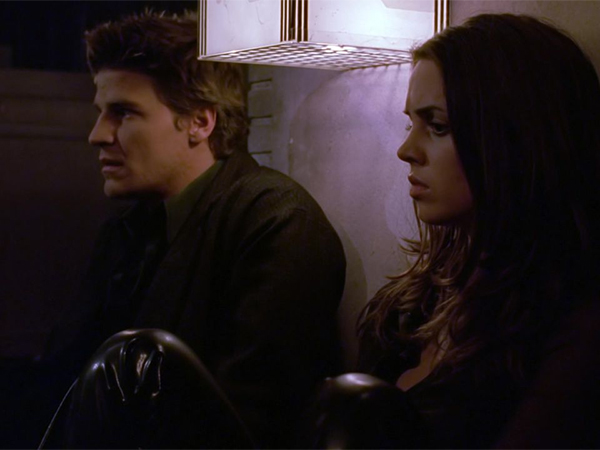
So yet again, we have a sense of Faith being railroaded into the endgame of this episode. She has been systematically screwed in every facet of her life, chucked into a situation out of her control, hung out to dry by the narrative and told she is on the path of evil. There is a grasping sense of powerlessness at the core of Faith’s story, a feeling that she had no other choice than to go down this path. She has always been the dark version of Buffy; can we really be surprised when she fills the role she was created for?
What stops the story falling into pure determinism – or indeed, pure woobification – are the constant reminders of Faith’s agency. It’s a conversation that isn’t complete until Willow’s speech in Choices, but the facts are all over this episode. Faith’s dire situation is the result of Faith’s own actions. Buffy tries to open up to her, and Faith shuts her down. Xander offers his unconditional support, and she sexually assaults him in response. Angel connects with her, and two episodes later she exploits that connection to try and rob him of his soul. We’ve admonished the adults in her life for not offering her a place to stay, but given how she instinctively responded to Buffy’s invitation to Christmas by making up a party for the sake of her pride, I can easily imagine a similar situation unfolding there. Even Wesley’s actions only occur because she, entirely of her own volition, tried to throw Buffy under the bus rather than simply tell Giles the truth.
This is why the episode finishes with the Mr. Trick fight, forcing Faith into a direct decision – run away and let Buffy die, or come back and save her. As Buffy reminds us, she didn’t have to come back. The power to do so or not remained entirely in her hands, and she actively chose to do so. This moment does not just exist to show that Faith still holds genuine affection for Buffy, but also to remind us that there is one person who has complete control over how she acts in this situation: Faith.
This is the key trick to keeping Faith’s story compelling. It captures the dichotomy of the ideal tragedy – a simultaneous sense that her downfall was inevitable, and entirely avoidable. Both these things need to be true in order for Buffy to remain coherent as an existentialist piece of work. Faith is not an object in the world; she is an actor. The titanically unfair position she has been put in is entirely beyond her control, and how she reacts is entirely within it. She can face up to her demons and let in the people who, for all their faults, are genuinely trying to help her, or she can turn them away and walk down the path of evil.
Faith Lehane never had a chance.
But she always had a choice.
 Insect Reflection
Reading Faith as trapped by the structures of the show is very interesting. I certainly agree. Buffy seems to me to be a show with stable equilibria for story structures and unstable equilibria for character arc structures. Faith brings this discrepancy into conflict, in a way, and the story structure prevails.
LikeLike