

Please be aware that this essay contains discussion of homophobia, transphobia, racism, antisemitism, general bigotry and hate speech.
On the 24th May 1988 the Conservative government of Great Britain, led by Margaret Thatcher, passed a law known officially as the United Kingdom Local Government Act 1988. This Act had many effects, but by far its most famous and influential section was the part that has come to be known as Section 28. Section 28 outlawed any school or local authority in the United Kingdom from “promoting homosexuality”, “publishing any material with the intention of promoting homosexuality”, or “promoting the teaching of the acceptability of homosexuality as a pretended family relationship”. Given that the act (intentionally) made no effort to define “promotion”, the effect was clear and predesigned: from 1988 until its full repeal in 2003, queerness was illegal in British schools.
This justification for this discrimination was the same one that is always trotted out – the protection of children from predatory influences. Homophobic attitudes were rising in the wake of the HIV/AIDS epidemic, whipped up by an entrenched conservative government and a vulturine news industry. The likes of The Sun, Daily Mail, and The Telegraph ran regular scare pieces about the homosexual lifestyle and its apparent attempts to indoctrinate children. The most benign depictions of queer acceptance were accused of being pornographic, of being propagandic, of “glorifying homosexual intercourse”. One book – Jenny Lives With Eric And Martin – was described by The Sun as “vile” and Today as “gay porn”[1], and was deemed controversial enough to kickstart the movement that resulted in Section 28. It depicts a girl with a gay father, engaging in such salacious events as going to the laundrette, and planning a birthday party.
The accusations leveled at these books were lies, and easily revealed as lies to anyone concerned enough to engage in actual research, but their purpose was not to be true. Their purpose was to combine latent homophobia in the general population with the instinctive human desire to protect the young. Together, these elements create a powerful boogeyman. This boogeyman was then paraded out during the general election of 1987, in which the Labour Party was attacked for their (claimed) promotion of such offensive materials. This was an imagined threat cooked up by bigots and seized upon by political actors most interested in protecting their capital. It worked. The Conservatives won the election with 42% of the vote, and remained in power until 1997.
It is into this cultural landscape that Buffy airs the eleventh episode of Season Three, Gingerbread. The plot revolves around the deaths of two young children, and how those deaths spark a wave of anti-witch paranoia among the townsfolk of Sunnydale; a paranoia that escalates into censorship, persecution, and eventually a literal witch-burning. The dead children are eventually revealed to be an evil demon exerting some kind of mind control on the population, which is standard practice for Buffy hijinks. The important aspects are the real-world parallels that this storyline is intending to highlight.
Needless to say, this is an American show being made for an American audience, and so its primary inspiration is not homophobic legislation within Britain, but the phenomenon we call the Satanic Panic, which took hold primarily (though not entirely) within America in the 1980s and 90s. There was no single coherent theory of conspiracy at the heart of this craze; moreso it was a disparate collection of accusations against a variety of groups, the underlying allegation being that the nebulous “They” were attempting to promote Satanism, corrupting the youth, practicing human sacrifice and/or child sexual abuse. Often remembered from this time are the more memeable accusations against whatever phenomenon happened to be popular at the time: the likes of Dungeons and Dragons, Pokemon, and Harry Potter being framed as some kind of Luciferian Trojan Horses, intended to infect children with a desire to become devil-worshipping occultists.

These properties survived these accusations, of course, being the pop-cultural juggernauts that they are. The real victims of the Satanic Panic were the individuals falsely accused of horrific crimes against children – cannibalism, murder, pedophilia. In reality, those accused were simply social outcasts that were feared by white middle-class America: queer people, jewish people, people of colour. The paranoia became a convenient cover for the discrimination that mainstream society wanted to inflict upon minority groups. One lawyer who represented four queer Latina women who were falsely accused of “satanic sexual abuse” made the link clear, stating: “Law enforcement had what they needed – ‘they’re gay, the other, who knows what they’re up to?”[2].
All of this is to say that the underlying motivation here is a generalised fear of the Other, and a need among reactionaries to justify their hatred. They will paint pictures of human sacrifice, ritual sex magic, demon-summoning, drinking the blood of children. They concoct accusations so cartoonishly evil that they can justify any level of discrimination against oppressed groups. The ludicrous nature of these accusations is the point, because even the most minute possibility of any of these things happening can spark enough fear to justify any more mundane evil.
“Some demons thrive by fostering hatred and persecution amongst the mortal animals. […] They feed us our darkest fear and turn peaceful communities into vigilantes.”
Rupert Giles and Buffy Summers, 3×11 Gingerbread
“Hansel and Gretel run home to tell everyone about the mean old witch.”
“And then she and probably dozens of others are persecuted by a righteous mob.”
Gingerbread drops a nugget of lore that was touched on back in Killed by Death, and will be again in Hush. That being that in this world, fairytales are real. This shouldn’t be a great surprise, given that it’s already a world where vampires, werewolves, and several other folkloric monsters are real. What’s interesting about the implementation of the concept here is that in Buffy’’s version of the myth, Hansel and Gretel are the villains. They are the demonic monster at the heart of this episode and the original myth. The witch is no villain, but a victim of othering and persecution.
As a natural result of these themes, the show starts to build a metaphorical framework that positions witchcraft as equivalent to lesbianism. This metaphor becomes a major part of seasons four and five, and is core to Tara’s introduction, the Willow/Tara romance, and to Willow’s development more generally. Willow’s growing confidence in her magical power is linked to her confidence in what will be stated to be her true sexuality. Even in this episode, presumably before it has even been decided if Willow is gay or not, she gets a coming-out scene, as she reveals that she is a witch to her mother. Even as her mother doesn’t accept her, she refuses to back down, sarcastically calling for Satan to “fill her with black naughty evil”. It is a powerful moment of self-confidence for Willow that links queerness and occultism to the parental anxiety that surrounds both.
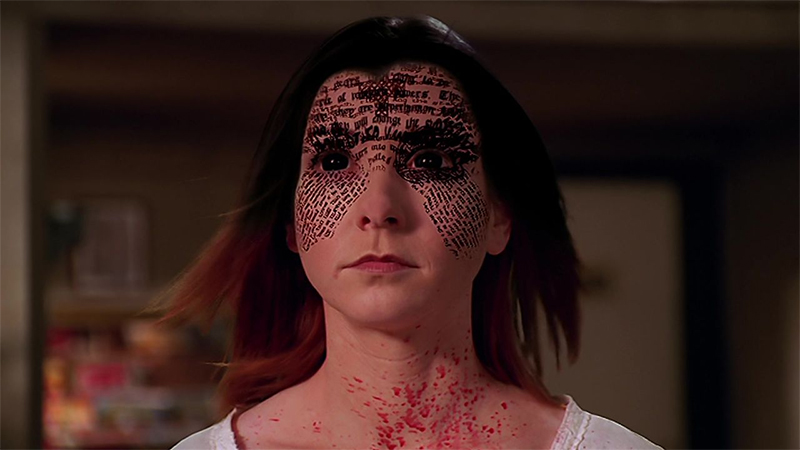
Of equal importance is the likening of Slayerhood and queerness that has been part of the show’s symbolic language since Becoming. I would argue that this metaphor is as key to Buffy’s development in Season Three as the magic/lesbianism metaphor is to Willow’s in Season Four. Buffy’s relationship with Joyce has remained strained since her “coming out” in Becoming, and Buffy herself has developed a major complex around accepting her own desires (a complex given personhood in the form of Faith). This episode displays the nightmare result of a child coming out to a parent, in that the parent becomes radicalised and attempts to harm their child under the guise of protecting them. Joyce literally attempts to burn Buffy at the stake for the crime of being metaphorically queer.
“Since when does it matter what I want? I wanted a normal, happy daughter. Instead I got a Slayer.”
Joyce Summers, 3×11 Gingerbread
On three separate occasions this episode, the demon refers to Buffy and Willow as “bad girls” as it attempts to goad their mothers into killing them, a phrase that must intentionally be evoking the title of Bad Girls – an episode that is only a couple of weeks away from airing at this point, and is well remembered for being especially heavy on the lesbian subtext that runs throughout this season. This is not a coincidence, and serves to tie Buffy and Willow together as both metaphorically and canonically queer women who are being persecuted for reasons historically intertwined with homophobia.
As fine a job as the show does with exploring anti-queer oppression, it remains frustratingly oblivious when it comes to discussion of race. Real-world moral panics almost always invoke racial fears in some way, whether that’s anti-police books being used to justify Section 28, the modern furor in America over Critical Race Theory, or how the previously mentioned incarceration victims[2] were likely as much a target of racism as they were of homophobia. The show simply glosses over this flavour of persecution, in a way that leaves the episode a less complete exploration of the topic that it could have been. Moreover, it is a major missed opportunity that the show doesn’t do anything with Willow as a Jewish character reacting to all this. Much of the Satanic Panic mythology has its roots in antisemitic stories of blood libel, and the scene showing the police raiding lockers explicitly references Nazi Germany. The show wants to tell a story about moral panic and historical persecution, but its typical negligence of these topics leaves it a less complete exploration than it could have otherwise been.

It’s a shame, because the episode is otherwise fairly effective at understanding the enmeshed nature of these prejudices. The moment where Joyce conflates monsters, witches and slayers as equally responsible for Sunnydale’s high death rate is an effectively chilling reminder of how normative society views oppressed communities. Much in the way that real-world conservatives see no difference, for example, between gay people and trans people (and will maliciously conflate both with paedophiles), the conservatives of Sunnydale see no difference between witches and slayers, and conflate both with monsters. They do not see in-group distinctions, and they don’t care about morality. There is simply a general Other that is viewed with hegemonic fear.
“This isn’t our town anymore. It belongs to the monsters, and the witches, and the slayers.”
Joyce Summers, 3×11 Gingerbread
And so they turn to the same thing that these people always turn to – institutional power in the form of The Mayor. This is the first episode in which Buffy is in the same room as this season’s Big Bad, in a scene where he gives an impassioned speech against the dangers that Sunnydale faces. It’s a funny bit of irony, because the Mayor himself is the biggest danger that Sunnydale faces, and he routinely enables these smaller dangers. He will happily enable the police to seize occult books from the library while keeping demonic shrines in his office. Even as Joyce criticises The Mayor for his inaction, she remains oblivious to his complicity. It’s a reminder that power systems like the police will always be used against those with less power, regardless of their relative crimes.
So lockers are searched, books are banned, “offensive material” is seized, and teenagers are nearly burned at the stake. It’s a little cartoonish in its escalation, but in many ways, it isn’t too different to the realities of moral panics in the modern day. Giles’ books being hauled out of the school library by police seems like nothing compared to the 176 books banned in Florida this year, or the 801 books banned in Texas[4]. Section 28 may be long gone, but the British government is doing its best to repeat the concept, this time aimed specifically against the trans community. The details change, but the use of moral panic to silence progressive thought remains the same.
In Gingerbread, we learn that the central demon returns every 50 years. The places and times differ, but the events do not. They come to a small town, they trigger paranoia, they stoke persecution, and they leave the community in ruins. It happened in 1999, in 1899, in 1649, and potentially even earlier, and all the time it’s the same demon. They are Hansel & Gretel, they are the nameless dead children, they are the supposed victims of satanic ritual abuse. They have no true identity, but represent the eternal faceless Victim. As we see this demon returning, over and over again, so do we see the demon of bigotry return in our real world, over and over again. The same hatred with a different face.
Buffy destroys this symbol of recurrent bigotry with a simple stake-through-the-neck – a solution that is sadly unavailable to those of us in reality. It is an insufficient ending that doesn’t really answer the questions that this episode poses about how to deal with insidious moral panic that repeat themselves again and again. The episode doesn’t have a satisfying answer to this, because there is no satisfying answer. Unlike a 45 minute episode of Buffy the Vampire Slayer, the fight against bigotry has no ending, but simply repeats in different forms.
This is why the show returns again to the salve of existentialism. Angel’s words to Buffy are a comfort to her in the moment, and they can be a comfort to us too. In a world that seems like it returns again to the same horrors and the same tragedies, it is worth remembering that “winning”, whether or not it is possible, is not the aim here. We are not going to defeat bigotry with a stake through the neck. Instead, we do what we do for the sake of each other, and the solidarity that we share.
“We never win. We never will. That’s not why we fight.
Angel, 3×11 Gingerbread
We do it ’cause there’s things worth fighting for.”
* * *
Thanks for reading! If you enjoyed this piece, please consider supporting me on Ko-Fi!
* * *
Thank you to juanabaloo on Tumblr for her help proof-reading this essay.
* * *
References:
[1] Buckle, Charles (2012). “Homosexual Identity in England, 1967-2004: Political Reform, Media and Social Change”, p. 114.
[2] Mike Ware, quoted in The Guardian, ‘San Antonio Four: women link ‘satanic’ child abuse convictions to homophobia’ https://www.theguardian.com/us-news/2016/apr/14/san-antonio-four-tribeca-documentary-child-abuse-homophobia, accessed 14/04/23
 Insect Reflection
God I love these essays so much. Thank you!
LikeLike
Thank you so much for this essay. I despise social conservatism and it’s moral panics, I despise their virginity fetish and their normalcy fetish. Gingerbread isn’t the first or last time this show will be frustratingly oblivious when it comes to race, I don’t remember it being the worst example either. I’m curious what you’re take will be on Faith’s relationship with the Mayor.
LikeLike